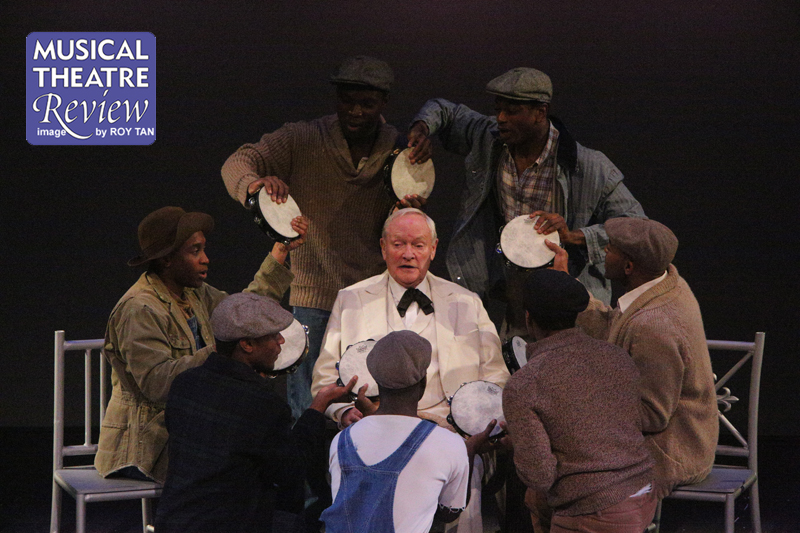
The Scottsboro Boys continues at the Garrick Theatre until 21 February 2015. Picture: Roy Tan
The Scottsboro Boys continues at the Garrick Theatre until 21 February 2015.
Any play dealing with America’s troubled racial history can struggle to feel like it has a place on a British stage at times. There isn’t quite the same sense of shared history, so what can feel raw and visceral to US audiences risks leaving their UK counterparts feeling slightly more detached. The Scottsboro Boys, a musical by John Kander and Fred Ebb centred around a group of nine young black men falsely accused of rape, breaks through any such divide by sheer force of will, using Vaudevillian excess to bring such a shameful episode into the spotlight.
Framed as a minstrel troupe re-enacting the history of the men under the direction of ‘interlocutor’ Julian Glover, comedy barkers Bones (Colman Domingo) and Tambo (Forrest McClendon) take on a number of legal and judicial roles. The broad slapstick of their caricatures of the white men in charge brings light to what would otherwise be a downtrodden tale of injustice spurred on by prejudice, while also mirroring the caricaturisation of African-Americans in the minstrelsy of which the Scottsboro Boys themselves – or at least, the Vaudevillians playing them in this twisted retelling – are complicit.
Director Susan Stroman’s impressionistic storytelling style – an almost bare stage, with just nine chairs to act as railroad cars, cell walls, and the like – effectively compresses an eight-year-long story of judicial oppression into a taut hour and 50 minutes, continuing the recent vogue for interval-free offerings. Despite the intensity and troubling nature of the framing story, there are plenty of occasions to laugh, plenty of reasons to warm to the police officers and judges who kept the innocent men behind bars. And that makes the dark sequences – such as young Eugene’s (Keenan Munn-Francis) nightmares about the electric chair – all the more affecting.
Within a group of nine, it is perhaps inevitable that several, if not most, of the troupe remain little more than ciphers, especially when most of the nine double up in various other roles. The strength of the group is personified in its de factor leader Haywood Patterson, in a performance by Brandon Victor Dixon that is imbued with passion, rage and dignity throughout.
Glover’s Interlocutor, a seemingly friendly man who sets himself above the minstrels in his charge, and wants to gloss over the harsher aspects of the story so he can get to the happy ending he craves, is a rather clumsy metaphor, albeit one that is enlivened by the 79-year-old actor’s sprightliness and grandfatherly charm.
Ever present on stage as a silent observer, Dawn Hope’s Lady starts out as a passive observer, gradually echoing the choreography of Patterson and others, growing in her own stature before ending the show with her own act of defiance. It helps to place this true life incident in the timeline of America’s civil rights struggle, although maybe suggesting a little too much that it is a story which remained in the past: in real life, the last Scottsboro Boys were not posthumously pardoned until 2013.
With its accomplished choreography, thought-provoking story and combination of raucous humour and heartbreaking truth and injustice, The Scottsboro Boys remains nonetheless a hard sell in today’s West End. If it cannot succeed, that would be a shame for all – while the incident being retold is not part of Britain’s direct history, its lessons can be learned by all while enjoying a masterful evening.
Scott Matthewman
www.scottsboromusicallondon.com
SHARE THIS POST:


Comments are closed.