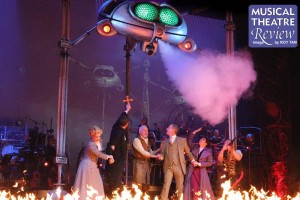
The War of the Worlds continues at the Dominion Theatre, London. Picture: Roy Tan
The War of the Worlds continues at the Dominion Theatre, London until 30 April.
Star rating: one star ★ ✩ ✩ ✩ ✩
For some people of a certain age, the music most closely associated with alien contact is the five-tone sequence from Close Encounters of the Third Kind. For others such as myself, who were too young to see that film when it first came out but not too young to listen to family LPs, the true sound of extraterrestrial life was a mix of orchestra and synthesisers, three powerful string chords conjuring images of alien invasion.
The War of the Worlds – or to give it its full title, Jeff Wayne’s Musical Version of the War of the Worlds – was a prog rock album that used HG Wells’ story of Martians landing in the Home Counties as the basis for a stirring symphony. With portentous narration by Richard Burton and the voice talents of David Essex, Phil Lynott, Justin Hayward and more, it is an enduring classic that forms one of the all-time classic audio musicals – which makes the failures of this stage interpretation all the more disappointing.
It all starts off well enough, with an impressively sized band – electronics and percussion on one side, strings on the other, with conductor Jeff Wayne front and centre – housed on staging reminiscent of the 1960 film of HG Wells’ other great science fiction work, The Time Machine. The rather twee projections’ abstract patterns have a certain cheapness to them, but supplement the overture well enough.
The drawbacks with this production, though, soon start to become apparent. The promise of a ‘holographic’ Liam Neeson, taking over Burton’s role of narrator, is revealed to be a simple projection of his pre-recorded talking head (only at the end of the production, when his character is shown at life size and at stage level, does the effect even come close to living up to its promise).
His character narrates events in the past tense while a team of actors, dancers and singers attempt to portray scenes on stage. Throughout Act I the choreography consists mainly of people walking about in period dress – or, once the aliens have landed, shuffling about slightly less slowly, presumably to portray panic.
And as for the aliens themselves – never has the phrase ‘less is more’ been so resoundingly, so comedically awfully, ignored. On audio, Wayne’s music for the reveal of the aliens can survive a three or four minute suite: on stage, that means we are treated to the sight of a ridiculous octopus-like puppet quivering slightly for the same duration.
As the organic aliens move into mechanical tripod devices striding across the Surrey countryside, destroying all in their wake with heat rays, what was a series of evocative scenes in Wells’ book and suitably impressive on disc is reduced to a cheap-looking stage effect, as a plastic tripod trips about like a spider that hasn’t quite worked out how to walk after having five of its legs pulled off.
Much of the onstage acting and singing falls on the shoulders of Michael Praed, playing a younger version of Neeson’s journalist narrator (although accent, dress and stature differences do their damnedest to make this hard to discern). Praed’s singing voice is passable here, and certainly ends up benefitting by comparison to Jimmy Nail’s parson and Daniel Bedingfield’s artilleryman. And while David Essex (here playing the ‘voice of humanity’ for a single song, after playing the artilleryman on Wayne’s original album) does his best, there’s really not much in the way of vocal performance to be praised from anyone. Madalena Alberto and Heidi Range emerge as the best of the lot purely by default.
Things go from bad to worse in Act II as the Martians’ ‘red weed”’, a vegetative mass that starts to cover the earth, is re-enacted through the medium of contemporary dance, performers decked out in crimson tendrils and top hats. The projections become rife with low-quality animations, badly Photoshopped composites and crowd scenes that make even less sense than the live action mess on stage.
And just when all hope seems lost, the Martians succumb to bacterial infection and die. In the novel, Wells’ conclusion is the ultimate in unsatisfactory deus ex machina conclusions, but in the Dominion it comes as blessed relief.
It is such a shame that Wayne’s original work, so imaginative, experimental and inspiring in audio form, has become such a catastrophic failure on stage. Resist the temptation to see it: instead, stay home, listen to the album and conjure up your own images that will be more impressive than anything seen on stage. This is one War of the Worlds where you’ll be begging the Martians to win.
Scott Matthewman
Tickets are available for The War of the Worlds: HERE
SHARE THIS POST:


Comments are closed.