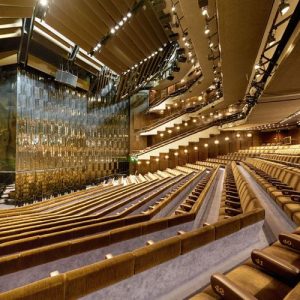
The Barbican Theatre auditorium with the curtain down. Pictures: Peter Dazeley
Renowned theatre critic Michael Coveney has joined forces with leading photographer Peter Dazeley to take theatre lovers on a tour of London’s most iconic theatres. Below, he writes about which musicals those venues have hosted.
If it’s a so-so musical, you may come out humming the scenery. If it’s badly designed as well, more likely you’ll come out humming the theatre. For our greatest London theatres, as documented in the selection of photographer Peter Dazeley and myself – this is a choice, not a gazetteer – have hosted the greatest British and Broadway musicals; as well as the others, of course.
You’ll know exactly the venues I mean: Drury Lane, Her Majesty’s, the Palladium, the Palace, the Coliseum and the Savoy. And that’s just for starters.
The first three are all owned now by Andrew Lloyd Webber’s Really Useful Theatres and it was he, of course, who initiated the fantastic clean-up of the Palace when he bought that spectacular Victorian gothic pile in 1983 (it’s now owned by Nica Burns’s Nimax and has morphed into Hogwarts).
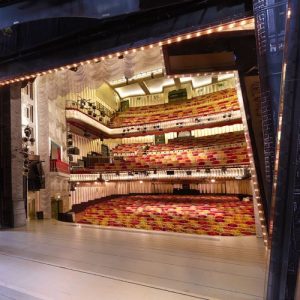
The Savoy Theatre auditorium from the stage
The façade of the Palace, on a gentle curve at Cambridge Circus, was a highlight, said one architectural writer, of the reign of terra cotta. In my early theatregoing days I’d perch in the perilous gallery. But although the Palace is high, it’s not too wide, and I relished John Hanson in The Desert Song and Constance Shacklock urging Maria to climb every mountain in The Sound of Music; that mountain was Constance herself, said one critical wag.
But did you know that the Palace was built by the impresario Richard D’Oyly Carte, who had made a fortune with the Gilbert and Sullivan operettas at the Savoy (and, as a result, established the world famous hotel next door)? And he built it as the new home of English opera, opening the doors in 1891 with Arthur Sullivan’s Ivanhoe.
But high-minded aspirations soon faltered, variety took over, and then long-running musicals. The Sound of Music was followed by Judi Dench in Cabaret, Jim Sharman’s beautiful, oratorio-like production of Jesus Christ Superstar and Les Misérables which occupied the theatre for 19 years before moving along Shaftesbury Avenue to the Queen’s.
Lloyd Webber wrote much of his Phantom score in an office at the top of the Palace, hoping to present the show on the stage below. But Les Mis refused to close, so he went across to Her Majesty’s, a much smaller theatre (only 1,200 seats) and the rest is history.
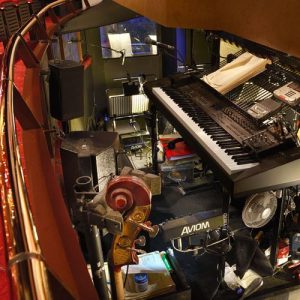
The view into the orchestra pit at the Prince of Wales Theatre. Pictures: Peter Dazeley
This theatre is the fourth on the site; the second was the second largest opera house in Europe (after La Scala) and the third presented the first Ring cycle in the UK. But the current beautifully proportioned stage and auditorium has seen, pre-Phantom, three of the greatest modern Broadway musicals, their sequence charting the elision from operetta to serious narrative constructions with essential musical numbers: West Side Story, Fiddler On the Roof and Company.
The golden age of Broadway musicals was housed first in Drury Lane – Rodgers and Hammerstein’s Oklahoma!, Carousel, South Pacific and The King and I, then Lerner and Loewe’s My Fair Lady – while the Coliseum, an opera house for the past 50 years, played host to rougher diamond, more idiomatic Broadway fare – Annie Get Your Gun, Call Me Madam, Guys and Dolls and The Pajama Game.
No one’s written better songs – simple, joyous, melodic and popular – than Irving Berlin for the first two of that quartet.
Two of the most fascinating theatres in our book are the Prince of Wales and the Adelphi, both drastically re-modelled in the 1930s, the first spectacularly refurbished by Cameron Mackintosh to resemble an art deco ocean-going liner.
The first was home to three of the most endearing Broadway shows of the 1960s – Funny Girl (which marked
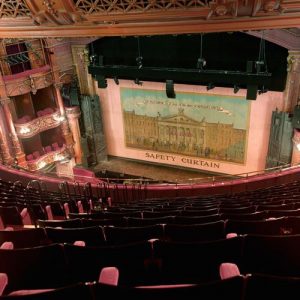
The Palladium as seen from the Upper Circle
Barbra Streisand’s only London theatre gig), Sweet Charity and Promises, Promises (recent London revivals demonstrated that only the first two really survive well, if suitably cast) – the second, with its sleek rectangular lines, opened in this guise in 1930 with Jessie Matthews ‘Dancing on the Ceiling’ and on London’s first revolving stage, in Rodgers and Hart’s Evergreen.
The Adelphi is one of the most spectacular examples of the myriad layers in our theatre building history. It dates from 1806 and has been home to music hall, melodrama and even murder – the matinee idol William Terriss was stabbed at the stage door in 1897 by a disgruntled small-part actor – and we try in the book to mingle that history with architectural detail and tales of ownership, triumph and disaster throughout the sumptuous chain of Peter Dazeley’s photography in stalls, fly floors, foyers and dressing rooms.
Musical theatre will receive a special boost when the brilliant Hamilton opens at the restored Victoria Palace in November while the re-energised and re-named The Other Palace chugs away behind it hoping to uncover new musical trends and talents.
And the history of that little space, in the former cloak of the Westminster Theatre and then the St James (a name with other connotations as the original St James’s was bulldozed by property developers in 1956 after a huge demonstration led by Laurence Olivier and Vivien Leigh in pre-Theatres Trust days) is just as colourful as that of the Lyceum, the Old Vic, the Almeida…
* Michael Coveney is the author of London Theatres with photography by Peter Dazeley and a foreword by Marck Rylance. Published by Frances Lincoln on the 7 September. Available from all good book retailers.
Our book reviewer Nick Wakeham writes…
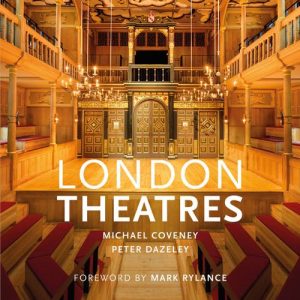 LONDON THEATRES – Michael Coveney and Peter Dazeley (Frances Lincoln – ISBN: 978-0-7112-3861-9)
Christmas came early for me this week when a new book landed on my doorstep. Published by Frances Lincoln, London Theatres is part of a series of books looking at London. The other two are London Uncovered and Unseen London. If those other publications are half as impressive as this one, then they should be on every person’s list of most wanted books.
Written by Michael Coveney, leading theatre critic, and beautifully photographed by Peter Dazeley, award-winning photographer, this book is a treasure of London theatre.
Most people interested in the theatre have not had the pleasure or experience of seeing backstage or taking in the grandeur of even the smallest of London theatres which is a great shame as they are architectural jewels. I have had the pleasure of being part of the London theatre scene (both front of house and backstage – and occasionally even on stage) since the 1970s. As a result, I have seen some of these theatres go through much-needed restoration by people who have loved them and treasured them enough to spend the money or fight for the funding needed to preserve them for future generations.
There are 46 theatres featured in this magnificent tome. Including: Haymarket, Drury Lane, Palladium, Coliseum, Old Vic, National Theatre, Roundhouse, Royal Court, Donmar, The Other Palace, Richmond Theatre, Adelphi, Alexandra Palace, Normansfield, Hackney Empire, Wilton’s Music Hall, Stratford East, Savoy and Duke of York’s – to name but a few.
Each entry has just the right amount of information attached to the theatre to make it exceptionally interesting without becoming tedious and the photographs are simply outstanding. Little tidbits appear here and there that are fascinating, such as the cherubs at the Lyceum on one of the front of house boxes that used to hold candles to help light the auditorium; the original wind machine from the St Martin’s for The Mousetrap; the actual well at Sadler’s Wells Theatre; the magnificent ceiling and auditorium arch at the New Wimbledon Theatre; even the Stage Door lantern that was found under the stage at the Duke of York’s (having been general manager of the DOY in the 1990s I remember that lantern very well).
This is one book that anyone who has any interest at all in London theatre should own. It costs £30 but I assure you it is worth every last penny. I’d be over the moon to receive this as a present – for those of you who are already wondering about the ever-elusive Christmas presents. I could go on singing the praises of this publication but there would not be enough room on this site. I highly recommend it.
SHARE THIS POST:


Comments are closed.