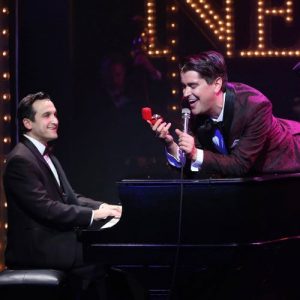
Jeremy Cohen and Sam Bolen in Midnight at The Never Get at The York Theater Company, New York. Picture: Carol Rosegg
Midnight at The Never Get continues at The York Theater Company, New York until 4 November 2018.
Star rating: three stars ★ ★ ★ ✩ ✩
A poignant gay love story blends with a respectful but spotty homage to the Great American Songbook in Midnight at The Never Get, playing Off-Broadway at The York Theatre Company, whose tagline is “where musicals come to life”.
The show is basically a two-hander, and the story is presented as a reminiscence by a fellow named Trevor. We first see him in shadowy lighting, seated atop a piano and singing a ballad entitled ‘The Mercy of Love’, which sounds vaguely like a torchy ballad from the 1930s. It isn’t one, but like the entire score for the show, it aims to replicate the sound of that era’s popular music.
With book, music and lyrics all by Mark Sonnenblick, the show is an ambitious undertaking, which may – as the vintage saying goes – have bitten off more than it can chew. But – as another saying goes – you have to admire it for trying.
As Trevor tells us his story, we learn how he came to New York in the early 1960s from the wide Western open spaces of Idaho, but to a man of his temperament, it was a stultifying atmosphere. Trevor sings about it in a satirical vein in an upbeat number called ‘Wallace Falls’: “Spend half your life inside the/chapel walls/You spend the other half in/Overalls.” He tells us that the real name of the town was Twin Falls, but the extra syllable was needed for the melody.
The song, we also learn, was written by a fellow named Arthur, the love of Trevor’s life. When they met, Arthur played at a piano bar in Greenwich Village. The two form an act, with Trevor singing and Arthur playing piano and writing the songs. A big factor in their act is that when Trevor sings Arthur’s love songs, the object of his affection is a ‘he’. No preposition change here to make the lyrics acceptable to general audiences.
Their act is booked as a one-night-a-week feature at midnight in the back room of a gay bar called – as you might guess from the show’s title – The Never Get. There the act develops a sizable following but is never able to move on despite auditions for a better club and even a recording contract. Arthur’s songs are rejected as not being in tune with the times.
But this is the kind of music Arthur wants to write, and eventually his work does spark interest. A career, apart from Trevor, develops for him in Los Angeles, followed by his breaking up with a still deeply in love Trevor. While Trevor pines, Arthur, who always showed a resistance to participating in gay movement politics, goes on to “two Oscars. five gold records, three failed marriages…”
“And if it was easier for Arthur to not be a homosexual…,” Trevor muses, “maybe he just needed an extra syllable.”
And now, Arthur has just died – as Jeremy tells us at the top of the show – and Trevor in his mind’s eye has re-created the back room of The Never Get – looking spiffier than it ever did – and he hopes for a rendezvous with Arthur. And we might suspect that Trevor is also dead.
Sam Bolen, who gets credit as having ‘co-conceived’ the show, plays Trevor, and his portrayal brings the tale arrestingly to life. The storytelling gets a little weepy, but it nevertheless evokes the sequestered but colourful atmosphere of New York gay life in the mid-1960s, and also takes us beyond to an affecting ending.
However, there are bumpy moments getting there. And a lot of them come with the score. There are some 13 numbers, and in the main they show how elusive it can be to capture the vintage melodic appeal of the standards catalogue. Despite some clever wordsmithing in the lyrics and integration with the dialogue, the songs – at least on first hearing – sound more determined to ape those classics rather than inspired.
Delivery of the songs, mostly by Trevor, also seems to be trying to make up for this with oversell and an abundance of animated choreography (by Andrew Palermo). Long, loud notes climax song finishes, and just about every phrase gets its own gesture.
The narrative also takes a peculiar turn late in the show, when Arthur tells Trevor the reason they didn’t get a better booking or recording contract was that Trevor wasn’t “good enough. You’re very good, Trevor. Very good but… a hundred other singers can sing my songs better than you’ll ever be able to.” I would think this sets up a particular problem for any actor-singer portraying Trevor. How good or not good should he be? And it had me questioning Bolen’s performance. Was he purposely not being “good enough”.
As Arthur, Jeremy Cohen does triple duty in fairly commendable fashion: nimbly playing piano, occasionally delivering vocals, and depicting a man uncomfortable with his sexuality or at least the more flamboyant or political demonstrations of it.
The show has been solidly mounted, with Max Friedman’s staging on the dramatically lit scenic design by Christopher and Justin Swader lending a stylish air. The musical numbers get a big band sound with a five-piece orchestra situated in the crepuscular upstage environs. Musical direction and orchestrations are by Adam Podd.
But finally, Midnight at the Never Get may be a show that’s too honest for its own good. Telling how his songs were initially rejected, Arthur quotes a recording executive as saying: “Cole Porter had written these songs thirty years ago and better.”
Ron Cohen
SHARE THIS POST:


Comments are closed.