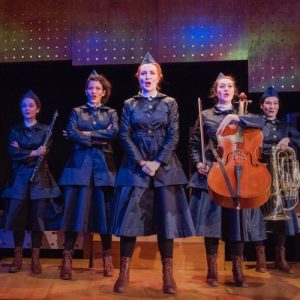
Cathryn Wake, Skyler Volpe, Ellie Fishman, Chanel Karimkhani and Lili Thomas in Prospect Theater Company’s The Hello Girls. Picture: Richard Termine
The Hello Girls continues at 59E59 Theaters, New York until 22 December 2018.
Star rating: five stars ★ ★ ★ ★ ★
Ever hear of The Hello Girls? Unless you’re a First World War history buff, probably not. But if there’s any justice in the musical theatre universe, you’ll be hearing quite a bit about them.
These women were a group of bi-lingual American telephone operators who served in that great conflagration in France, facilitating vital communications between the US Army and its allies. It’s an inspiring story, extraordinarily relevant for our #MeToo era, and it’s now being celebrated in a grand rouser of an Off-Broadway musical, entitled, of course, The Hello Girls.
The title may be a no-brainer, but it’s a show that overflows with inspiration and both musical and theatrical know-how. It’s also a lot catchier than the group’s official name: “The Bell Battalion Telephonic Ladies Switchboard Unit Number One”.
The show is a product of the 20-year-old Prospect Theater Company, dedicated, as its programme info says: “to fostering and showcasing today’s new voices shaping tomorrow’s musicals.” The company has struck gold with this one.
The rich traditional score, both music and lyrics, is by Peter Mills, and Mills wrote the book in collaboration with Cara Reichel, who is Prospect’s producing artistic director. Reichel also directs and has assembled a cast of prodigious talents.
It’s one of those shows where the performers are also the musicians, but you’re hardly aware of the double-duty; everything on stage happens so seamlessly. When the actors pick up their instruments, it becomes a part of their character. And it should be added, the music is totally ear-filling gorgeous, from the mood-setting underscoring to the lush harmonies of the chorale singing.
The book, inspired by actual men and women who served in the war but shaped with creative liberties, tells its story through five women. At the centre is Grace Banker (Ellie Fishman), an exceptionally skilled operator who also studied French in college, who becomes the chief of the unit.
Serving with her are her best friend, Suzanne Prevot (Skyler Volpe), a feisty New Yorker; Louise LeBreton (Cathryn Wake), a feisty French-born gal; Helen Hill (Chanel Karimkhani), a self-described farm girl fresh from the open skies of Idaho but whose mum spoke French; and Bertha Hunt (Lili Thomas), a more mature lady whose doctor husband is in the Army.
The actresses fill the roles beautifully, each character coming vividly alive, with Fishman providing a solid centre for the narrative. As such, she is the only cast member not to play an instrument.
Still, what a stunning coup de théâtre it is to see farm girl Helen bowing grand music out of a cello, or young French gal Louise vigorously puffing through a clarinet. You get the idea. And yet, as said before, it all seems so natural. After all, this is a musical.
And with all this music-making, the book and the expertly wrought lyrics have the crackle of an adventure story laced with humour. They take us through the year 1918: the rigorous examinations the women go through before being accepted; their training; their troopship passage to Europe; their time at the headquarters of General Pershing; the head of the American forces, and finally, their crucial service on the front lines as Pershing directs the offensive that ends the war.
But it’s not all flag-waving. The human costs of the war, the questionable political forces that ignited it, are not ignored. And through it all, is the struggle of the women to achieve parity with men, both in service and recognition.
A final blow comes when the women upon deployment learn that they were not considered soldiers but private contractors and thus denied veteran benefits. The women fought that, but it took until 1977 to correct that miscalculation, and, as the script tells us, only 33 of the 223 women who served overseas survived to receive honourable discharge papers.
Nevertheless, the show ends on an upbeat note in the final number, ‘Making History,’ reminding us that these women defied odds to make history, and asking us, the audience, “If you have the chance/Will you answer the call?”
The male side of the company is also handled by a grand quintet of actor-musicians. Most prominent is Arlo Hill, as Lieutenant Riser, who oversees the ladies battalion, an in-the-blood military man who has tried hard but still finds it difficult to have women in the Army. Scott Wakefield makes an affable but authoritarian Pershing, when he isn’t playing a bass, and music director Ben Moss, Andrew Mayer and Matthew McGloin take on assorted roles and instruments with aplomb.
The relationship between Riser and Grace ignites plenty of friction, call it chemistry, but not sexual. It’s always a case of recognising what women are capable of. The book-writers have – and perhaps wisely – eschewed any idea of romance in their story. Still, when Riser finally extends his hand to Grace for a mano a mano handshake, it’s a moment as thrilling as when Professor Higgins finally admits he’s “grown accustomed” to Eliza’s face.
And there’s also an echo of Higgins in Hill’s Riser when he sings ‘Marching Orders,’ in which he tries to accept the idea of females in his army, but it’s a number with a stirring military cadence that can just about lift you out of your seat (Elena Bonomo is the in-the-wings drummer).
The only hint at Eros comes when Volpe’s Suzanne attempts to teach a wounded soldier, played by McGloin, how to operate a switchboard, and he turns the terminology into innuendos. It’s a brief but tasty Rodgers and Hart pastiche. Elsewhere, Mills’ music is infectiously seasoned with ragtime, early 20th-century pop and timeless melodic strains.
Among other musical highlights is Grace’s ‘Twenty’, in which she enumerates 20 reasons why women can and should serve on the frontlines. There’s also the sparkling title song, in which the girls discover that US soldiers have dubbed them ‘The Hello Girls’, indicating their joy at hearing at American voice when they pick up the phone. The eerie ‘See You On the Other Side” is a telling depiction of the fear that could be felt when crossing the ocean in wartime.
Working totally in sync with the movement of Christine O’Grady’s choreography, Reichel’s staging is on a par with the music, building tension when needed, humour when needed. Together they create ever-shifting arresting stage pictures on Lianne Arnold’s multi-platform set, backed with Arnold’s atmospheric and time-telling projections. Isabella Byrd’s lighting provides the focus, while Whitney Locher’s costumes, especially the bulky blue, definitely unsexy, uniforms donned by the ladies, tell us a lot about the period.
It’s a sign that a show has gotten to you when a number ends and you instantly want to hear it again. I think you’ll be wanting to say once more to these Hello Girls time and time again.
Ron Cohen
SHARE THIS POST:


Comments are closed.