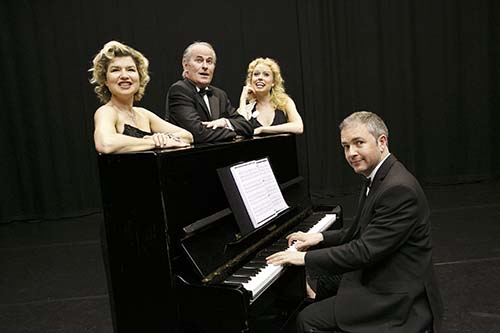
Issy van Randwyck, James Vaughan, Holly Dale-Spencer and musical director Ian Townsend in Words and Music, part of the Lost Musicals season at the Lilian Baylis Theatre
Lost Musicals – Noel Coward’s Words and Music was performed at the Lilian Baylis Theatre at Sadler’s Wells, with further dates on 28 July and 4 August.
The reason why Coward’s revues such as London Calling!, On With the Dance, This Year of Grace, Sigh No More and Words and Music are never seen is because revue is a lost art that the theatre no longer wishes to entertain. The most successful of the Coward revues in later years were Oh Coward! and Cowardy Custard, compilations of the Master’s oeuvre, but they were both first staged more than 40 years ago, although they are still sometimes revived.
After his great success with his play Cavalcade at the Drury Lane in 1931, where it ran for more than a year, Coward decided to stage a cabaret with no stars, using instead his own conception and plan for the show, writing all the songs and sketches and with him also directing. Producer Charles B Cochran and indeed Coward himself were probably disappointed by the relatively short run for Words and Music of just 164 performances, although it had received good press notices. For anyone else at that time that would have been considered a huge success. Coward blamed himself, but the show did not end there, as he rewrote it for Beatrice Lillie and Broadway where, under the title Set to Music, it ran for just 129 performances. Since then neither version has been revived until now.
In 1932 Words and Music sported quite a cast in Ivy St Helier, Doris Hare, Joyce Barbour, Edward Underdown, Romney Brent and a young John Mills who Coward had seen in an amateur production of Journey’s End in Singapore and immediately put him into Cavalcade and Words and Music, the latter having a musical parody of the R C Sherriff play. It is a well-assembled show, as you would expect from Coward, a mixture of sharp satirical sketches and luscious lyrics set to marvellous melodies. It includes some of Coward’s immortal songs such as ‘Mad Dogs and Englishmen‘, ‘Mad About the Boy’ and ‘The Party’s Over Now’. It is interesting to see them now in context as part of a complete show.
The ‘Opening Chorus’ has the ladies of the line getting stage-fright with their dresser Maggie (Nicola Keen) about performing because they reckon they are only there to distract the audience. It is then followed by the ‘Debutantes’, three rather depressed bright young things who are now disillusioned by the way the world is going. However, as long as the gin lasts, they can forget the sober truth. Many of the numbers are strictly for the ensemble, but there are some fine solo turns too. Issy van Randwyck sings delightfully of the ‘Children of the Ritz’, about all the luxury items such as fashion, perfume, jewels, smart cars and holidays in Monte, that they can no longer afford after the world economic crash (how topical!) has brought them right back down to earth.
In ‘Three White Feathers’ Holly-Dale Spencer plays a working-class girl (father was a pawnbroker in Ealing) who has made good and now wears feathers in her hair. Coward was always obsessed with class and manners and was at times a little patronising, but he gets some good mileage out of presenting the man and woman in the street who may or may not be recognised despite their obvious talents. In ‘The Hall of Fame’ we meet The Man Who Caught the Biggest Shrimp (James Vaughan), The Oldest Postmistress in England (Vivienne Martin), The Man Who Rowed Across Lake Windermere in An Indian Rubber Bath (Matt Stevens), The Clergyman Who’s Never Been to London (Dom Hodson), The Holiday Mermaid (van Randwyck) and My Life Story (Pamela Miles) about the power of the press and how a tart can become a toff. It’s all good fun and, although Coward’s type of satire is not exactly relevant today, the songs are so good that they have a life of their own.
‘Mad Dogs and Englishmen’ has certainly taken on a life of its own, remaining popular to this day. If Coward became tired of it (he sang it as fast as possible to get it over with), it still never fails to entertain. James Vaughan sings it softy as if imparting confidential knowledge to those about him and he is very funny. ‘Mad About the Boy’ is now usually sung as a kind of blues-type torch song (Dinah Washington’s version is a classic) but in fact in Words and Music it is sung by a Society Woman (chic van Randwyck), a Schoolgirl (a yearning Laura Coard), a Cockney (a potty Martin) and a Tart (Holly-Dale Spencer in a blue mood), all talking about an unnamed movie star.
The whole show is staged with élan by a very talented company that responds with great vivacity to Coward’s humour and music. Musical director Ian Townsend plays the score with immense fervour that brings the material alive. That said, however, founder of the series and its artistic director Ian Marshall Fisher actually wanted to stage Set to Music, the US version of Words and Music, as his self-imposed brief is to discover only Lost ‘American’ Musicals, but he could not find all the material for it, hence the original British version now on show. However, since then more material has come to light, so it is not unlikely that a future Lost Musicals season may include Set to Music.
The show closes with a song that has a touch of the bitter-sweet about it, ‘The Party’s Over Now’, in which “Dancing time/May seem sublime/But it is ended all too soon…” You may feel that way about Words and Music.
Michael Darvell
SHARE THIS POST:


Comments are closed.