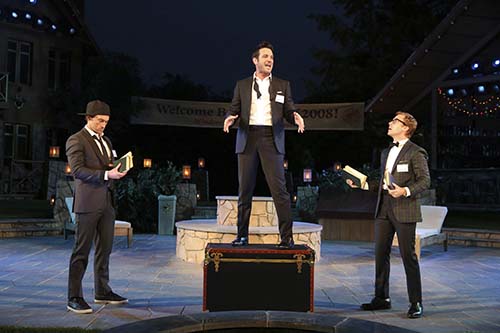
Bryce Pinkham, Colin Donnell and Lucas Near-Verbrugghe in the Public Theater’s Shakespeare in the Park production of Love’s Labour’s Lost at the Delacorte Theatre, New York. Picture: Joan Marcus
Love’s Labour’s Lost has opened at Shakespeare in the Park, Delacorte Theatre, New York, to continue until 18 August.
Back in 1971, the esteemed Off-Broadway producing company The Public Theater had a big hit at its Shakespeare in the Park season with a musical adaptation of Two Gentleman of Verona. The production transferred to Broadway, where it won a Tony Award as Best Musical and ran for more than 600 performances. Now the Public has turned to another of Shakespeare’s early comedies, Love’s Labour’s Lost, as the basis for a musical comedy and as the second offering in this year’s Shakespeare in the Park. And with the imaginative and unpredictable adaptor and director Alex Timbers at the helm, and one of his past collaborators, composer/lyricist Michael Friedman, providing the score, the Public has come up with another winner. It’s a brilliantly entertaining romp, demonstrating the foibles and ecstasy of young love and youthful aspiration. Although much of Shakespeare’s text has been excised to make way for a slew of great musical numbers, the Bard’s magic is still palpable, blending happily and artfully with a contemporary sensibility.
Shakespeare’s Ferdinand, King of Navarre, and his three aristocratic buddies take on the air of recent graduates from some elite American college, not yet quite willing to give up playtime for the more studious route proposed by their King leader. However, he has gotten them to take an oath to lead the contemplative life for three years, with the condition that they will traffic with no women during that time. Of course, those oaths are quickly broken once the French Princess, an old flame of the King, and her three ladies-in-waiting arrive on the scene for some business of state as well as hanky-panky. Each of the guys tries to hide his palpitating libido from his pals, but it eventually it all comes out in the open to be celebrated in a madcap romantic revelry.
The hijinks come to life with a terrific cast. Colin Donnell brims over with irresistible machismo as Berowne, the most cynical of the King’s entourage, making a terrific provocateur against the more sober King, played by Daniel Breaker. But each guy in this privileged quartet, which also includes Bryce Pinkham and Lucas Near-Verbrugghe, gets his own big musical number as they compose sonnets or odes of love to the gals of their choice. Typical of the show’s free-wheeling deliciousness, the King practices his by bringing on stage a woman from the audience to sing to. (At least, it was a woman at the performance I attended.) Another of the sonnets builds into a production number reminiscent of the finale from A Chorus Line, complete with glitter and top hats.
The ladies, including Patti Murin as the Princess and Maria Thayer, Audrey Lynn Weston and Kimiko Glenn as her coterie, don‘t have quite as much to do as the men, but they do it with panache and comic bravura. Adding to the frivolity are Caesar Samayoa as Armado, a blowhard Spanish Lothario-in-his-own-mind, who the guys keep around for laughs, and his curvaceous heartthrob, the barmaid Jaquenetta, played by Rebecca Naomi Jones.
Rachel Dratch, known to American audiences for her seven seasons on TV’s Saturday Night Live, contributes an extra fillip of comedy as the pedant Holoferness.
Friedman’s score is a joy; it‘s peppy and tuneful with occasional quirks that surprise and beguile, in the melodies as well as the lyrics. And what a pleasure it is to have performers actually communicate words, replete with deep feelings and ideas, in a song rather than simply scream at you, as is this case in so many new musicals. Several of Friedman’s songs, with just the slightest tweaking, could develop into show tune standards. I was particularly taken by the ballad ‘Love is a Gun’, given an all-out torchy rendering by Jones as Jaqeunetta.
The production has been given a lavish mounting, with John Lee Beatty’s luxurious patio set design and Jennifer Moeller’s eye-filling costumes, and apparently no whimsical idea of Timbers and Friedman too difficult to fulfill. When Berowne sings in a climactic song near the finish: “I don’t need scores of back-up singers and a great big brass band,” what should appear marching on stage from the audience but a great big brass band (courtesy of an area high school).
The show, which had its press opening on 12 August, is scheduled to wrap up quickly, on 18 August. You can’t help wondering if it will, like Two Gentlemen, move from Central Park to Broadway. Some oracles of the Great White Way say a Shakespeare title alone (without names, that is) doesn’t have the commercial appeal to make it these days in the big time. Shakespeare in the Park did see its production of The Merchant of Venice transfer to Broadway for a successful run in 2010. Granted that production starred Al Pacino as Shylock. Love’s Labour’s Lost doesn’t have Pacino, but it certainly has a helluva lot more laughs.
Ron Cohen
SHARE THIS POST:


Comments are closed.