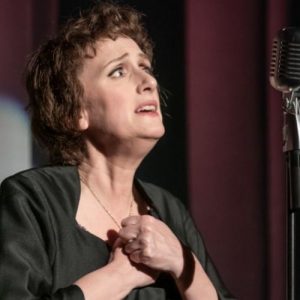
 Piaf continues at Leeds Playhouse until 7 August 2021.
Star rating: four stars ★ ★ ★ ★ ✩
Of course, bringing any show to the stage these days ranks as a minor miracle. At the time of writing, Home, I’m Darling lies dormant at the Stephen Joseph Theatre and Cinderella is yet to rise from the ashes at the Gillian Lynne.
It is therefore with a mixture of emotions that I report on Pam Gems’ Piaf at Leeds Playhouse. Was it really sufficient in 1978 (the year Piaf was first staged) to say the word ‘fuck’ every other sentence in order to extract a snigger from an audience, presumably in the name of pushing the limits of free expression? Seen from the perspective of 2021 it seems merely tiresome, indeed, rather desperate. And what happened to the attempt, in the early scenes, to render demotic Parisian dialect into a Cockney accent, which then faded as the evening progressed?
Jenna Russell is first rate at representing the chanteuse’s physical decline and her humiliation at being unable, in her later years, to give voice to the torch songs that have been her hallmark. The same black dress that fits her perfectly in earlier scenes just seems to hang from her as we watch the drugs and alcohol take their toll.
While the acting is sufficiently raucous, I do not feel that Russell is channelling enough of Piaf’s magnetic artistry. No sensible member of the audience would expect a Piaf sound-alike, but there is only a few occasions where her singing is close enough to evoke the response: “Yes, that’s the voice.”
The best of such moments is in the opening bars of ‘Les Trois Cloche’ where the ensemble performs a very creditable version of Les Compagnons de la Chanson’s best-known work. Russell comes in with just the right nasality to place some grit against the smoothness of the men’s voices.
The whole ensemble performs well collectively, as well as individually. They sing, dance and play musical instruments with plenty of opportunity to step into supporting roles. Matthew Woodyatt gives a touching portrayal as the loyal, but resigned, Charles Aznavour.
Present on stage throughout is musical director Gareth Valentine. His work on the piano is faultless and adds greatly to the atmosphere of the nightclub scenes.
Set designer Frankie Bradshaw takes out the front row of seats to enhance the nightclub milieu by placing some audience members at round tables. Changes to the set are carried out efficiently, while a huge sign at the back of the stage reading ‘Piaf’ and ‘Olympia’ provides some stability as the chaos that is her life unfolds before us.
Piaf cannot help but remind us of the fate of Amy Winehouse with themes such as addiction and the destructive nature of some artists’ private lives. Running alongside these, the ability to communicate directly with an audience through a distinctive singing voice reminds us that sometimes talent comes at considerable cost.
Artistically, I was left wondering about the problems facing an author who has to select scenes from a life that can give a rounded appreciation of who the subject was and what he or she achieved. I could quite happily have done without at least two scenes that director Adam Penfold chose to include, notably the Second World War occupation episode and the unfunny appearance of two stereotypical German soldiers. Caricature only succeeds when it is witty.
Edith Piaf continues to fascinate the public and there have been many representations of her life, notably Olivier Dahan’s magnificent La Vie en Rose (2007). Pam Gems’ account is probably an accurate, if flawed, version of a perplexing artist’s life.
Mike Tilling
SHARE THIS POST:


Comments are closed.