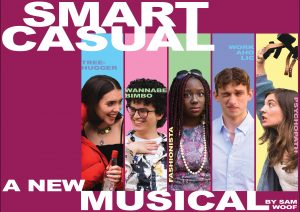
 Smart Casual at the Cockpit Theatre as part of the Camden Fringe Festival, London.
Star rating: three stars ★ ★ ★ ✩ ✩
There are few times more given to upheaval than leaving university. In Sam Woof’s musical Smart Casual a group of six recent graduates find their worlds realigning as they seek to find their individual place in the world.
At first glance, the six characters are cut from very stereotypical cloth – the fashionista who has yet to land the job at Vogue she desires, but still has the flat of her dreams thanks to the Bank of Mum and Dad; the catty gay artist who is always ready with a withering quip; the flighty airhead; the banker; the raging socialist; the working class lad who struggles to keep up.
And when the characters stay in these lanes, Woof’s book and lyrics find much to mine for comedic value. Ellie Cooper’s near psychopathic Lily, a principled firebrand, sparks nicely off Jamie Murphy’s True Blue city banker. The concept of opposites attracting is hardly a new one, but a nice line in barbs and the gradual realisation that two intransigent characters might be slowly growing as a result of their relationship works well.
Also following a well-ploughed furrow is the concept of Marc, the camp commentator of the group. William Foxton is clearly the stand-out performer of the ensemble, delivering the show’s best lines along with the most lexically dexterous number of the piece, as Marc cuttingly deconstructs all the worst parts of heteronormative life.
Also refreshing to see is that Marc’s behaviour is challenged – that sometimes in the quest to always be “on”, he ends up just being mean. Disappointingly, though, such insights go nowhere, and end up repeated in lieu of character progression.
And that is the biggest problem with Woof’s work here. As enjoyable as brief moments are, the 18 months chronicled in the whole musical suffer from repetition and lack of depth. In particular, Darcy Dixon’s Mel, in whose apartment all the action takes place, is underserved by narrative impetus, even though she does get a powerful solo number for her to express her frustrations at being taken for granted by her friends. However, when it is suggested near the end that she has done nothing in the period in which the play is set, it is hard to sympathise with her angry response because, thanks to the writer, it’s a fair accusation.
In both his lyrics and his book, Woof displays a keen ear when humour is involved. Conversely, though, when matters turn more serious, originality and interesting dialogue are found wanting.
Thankfully, there is rather more to enjoy in his composition. Musical director Livi van Warmelo orchestrates the musical numbers with deftness that means the five-piece band is the highlight of the whole performance.
Vocally, the actors are limited by the lack of amplification and the Cockpit’s thrust stage, meaning that even with the best voice projection in the world some words are going to get lost beneath the lushness of the band’s sound. Such limitations are further hampered by the cast often struggling to find the right volume to fit both mood and audibility. This is most noticeable in Grace de Souza’s portrayal of flighty conservationist Willow; already saddled with a wafer-thin character, her duets with Henry Waddon’s Ben often rely on her natural expressivity to convey what one had hoped to hear in the lyric.
There is perhaps a concern, then, that in also opting to direct his own work, Woof may have denied himself the chance of an additional eye on how to best deliver his vision to an audience. But for a young musical theatre writer, there is much in Smart Casual to suggest that this is one composer who has a lengthy and productive career ahead.
Scott Matthewman
SHARE THIS POST:


Comments are closed.