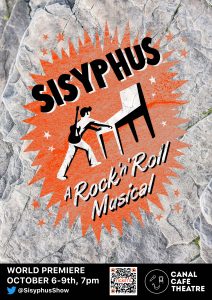
 Sisyphus at the Canal Café Theatre, London.
Star rating: three stars ★ ★ ★ ✩ ✩
Ancient Greek mythology is profoundly androcentric, to the point of misogyny. Women – be they immortal or god – are the property and playthings of the male gods, who basically run around doing what they want and having their way with whoever they desire.
At the start of Ian Bowkett’s new musical Sisyphus, this state of affairs is highlighted by Orion the Hunter and his relentless pursuit of the Pleiades, seven nymphs who were the daughters of Atlas. In particular he sets his sights on Merope, who has no desire to go the way of her sisters and be the plaything of the gods.
So instead, Merope forms a marriage of convenience with a mortal: Sisyphus, the King of Corinth. But Sisyphus is having his own run-ins with the gods, and when he tricks Thanatos, the God of Death, things don’t go according to plan…
These days, our knowledge of Sisyphus tends to be limited to his eventual punishment in the underworld, in which he was condemned to roll a rock up a steep hill only for it to roll down again. That part of his story lives on in adjectival form, with a fruitless or never-ending task often described as Sisyphean.
But, as writer/composer/direct Bowkett shows, Sisyphus’ life has much more to offer. Casting three women to play all the roles is a statement against the male-centred mythology he is adapting, in which Bryony Purdue’s Merope is the only female character of note.
Purdue is the standout star here, delivering just the right amount of confident sass as Merope so that, when her guard is down and she is required to show her vulnerability, it becomes heartbreaking to watch. Opposite her, Emily Rushton’s Sisyphus cuts a slighter figure, but the duo play the relationship – initially one of convenience for Merope, but deepening over time – with a balance of comedic charm and romance that is truly engaging.
At least, until they start simulating sex with Barbie dolls dressed as their characters. For as part of this production’s lo-fi staging, any off-stage characters (and some onstage ones) are represented by children’s toys. The strength of the actors’ characterisations is such that the dolls just become a distraction.
Rushton provides an even more spirited performance as Zeus, the vain, lamé-jacketed king of the gods. Also doubling up is Ciara Whiting as both Orion and Thanatos, although she does struggle more than her cast mates with solo numbers. But one advantage to Bowkett’s production is that no number ever outstays its welcome – just as well, with 30 songs crammed into the 80-minute show.
Indeed, there are occasions where one might appreciate a little break from the rock’n’roll-infused score, even though Bowkett delivers a cracking set of numbers. There are a couple of places where space to allow the audience to pause for breath would reap benefits.
All told, though, the mix of mythology and mirth that Bowkett has hit upon would seem to be a winning formula. And while it’s clearly a show that doesn’t need the most expensive of staging, a little more care and attention to presentation would reap dividends for a musical which deserves a longer life.
Scott Matthewman
SHARE THIS POST:




Comments are closed.