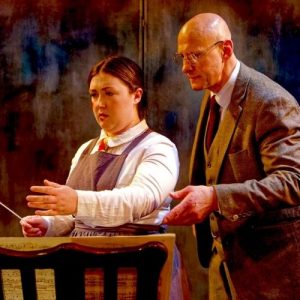
 Holst: The Music in the Spheres at the New Wimbledon Theatre Studio, London.
Star rating: four stars ★ ★ ★ ★ ✩
If you’re wondering why a play about one of Britain’s most celebrated classical composers Gustav Holst (don’t be fooled by the name, he came from Cheltenham!) is being reviewed here, there may be a closer connection than you think.
And if you are a young woman trying to make your way in musical theatre or even already have your name up in lights, you probably owe a debt of thanks to that shy genius from the dark days of the First World War who achieved unwanted fame for his one masterpiece, The Planets, which was performed in public for the first time just after Armistice Day in November 1918.
For Holst, in his role of teacher – what he most loved doing and did with such distinction for virtually his entire adult life – pioneered musical education for women.
Ironically, his most famous pupil at St Paul’s Girls’ School in Hammersmith, Cecilia Payne, went on to achieve international renown not in music but as a groundbreaking astronomer and astrophysicist.
It is their relationship, superbly scripted by author-director Ross McGregor and matched by the acting talents of Toby Wynn-Davies and Laurel Marks, that is at the heart of The Music in the Spheres and its companion piece Payne: The Stars Are Fire which rotated with the Holst over the two-week Wimbledon Studio run.
We are taken through Holst’s life, from sickly boy shouted out by bullying father to thwarted pianist (had to stop because of neuritis in his right arm), theatre-orchestra trombonist, teacher, composer, husband and father, to the point where the music from The Planets soars and he is finally recognised, not only here but in Europe and the USA, as one of England’s great “moderns”, alongside his good friend Ralph Vaughan Williams, Edward Elgar, William Walton, Frederick Delius, Benjamin Britten and, in lighter vein, Arthur Sullivan.
Yet, in some ways, he was, in pop music terms, a one-hit wonder. Who, outside classical scholars, could tell you what else Holst wrote? Thanks to this play, I can now reveal that the much-loved carol ‘In The Bleak Midwinter’ is Holst’s music to poet Christina Rossetti’s words.
And I liked the line about why the composer was originally referred to as Mr Von Holst. He later dropped the “Von” which his harp-teaching grandfather Gustavus had inserted as an affectation to make him feel closer to the great German composers of the time while also enhancing his status and attracting more pupils. One lives and learns!
McGregor’s well-crafted script is as much about the man and his passion for teaching as his music and this Arrows & Traps Theatre Company production deserved a bigger audience than the evening I saw it.
Scene-shifting from “Gussie’s” travails as a boy and young man at the end of the 19th century through to the triumphant first performance of The Planets two decades later gave full rein to Wynn-Davies’ versatility, while Marks as the unpopular, brusque but ultra-determined Cecilia was bang on the money and Isabel Harrison, the choral soprano who became his wife, was played with great natural charm by Cornelia Baumann.
Less impressive were the other three actors. If the author-director wanted Lucy Ioannou to play the posh, garrulous head of the girls’ school Miss Gray as a caricature from an Oscar Wilde comedy because he felt his piece was too “teachy” and dry, it was a poor call as there were plenty of bons mots and witty lines in the script.
Likewise, Edward Spence as Vaughan Williams and Alex Stevens as Holst’s father were too loud and in-your-face for my taste. Generally less is more in such a small space.
Full credit though to the clever use of projections to present different timelines and Odin Corie’s work on set and costumes was admirably in period. With most of Holst’s music as canned as the wine in the fridge which serves as the bar in the Studio’s limited facilities, Richard Baker’s piano was the only live instrument on view but only the flavour of Holst’s work was required and that was nicely achieved.
Wimbledon Theatre should spend a bit of money on its baby sister: the entrance hallway could use several coats of paint and the thinly-padded banquette seating needs bringing into the 2020s.
These days most paying customers, with so many TV entertainment avenues on tap at home, require more than the bare play to tempt them out, yet thanks to the sterling efforts of the enterprising Arrows & Traps company, those numb bums were well worth enduring.
Jeremy Chapman
SHARE THIS POST:



Comments are closed.