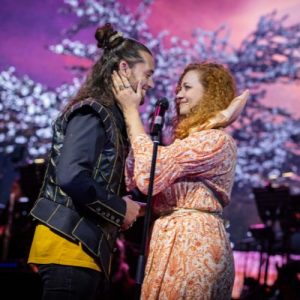
Bradley Jaden and Carrie Hope Fletcher in Treason The Musical In Concert at Theatre Royal Drury Lane, London. Picture: Mark Senior
Treason the Musical in Concert was performed at the Theatre Royal Drury Lane.
Star rating: three stars ★ ★ ★ ✩ ✩
With luxury casting and impressive production values, Treason arrived at the Theatre Royal via a concert staging at Cadogan Hall and a vast following on various social media and streaming channels. Striking video projections behind the orchestra, by Gino Ricardo Green, enhanced the feel of the evening, along with lighting by Simisola Majekodunmi. Plus the London Musical Theatre Orchestra, led by Alan Berry, sounded more substantial than a mere nine players.
Ricky Allan (music, lyrics and book) and Kieran Lynn (book) eschew using Guy (or Guido, using the Spanish name he later adopted) Fawkes as the pivot of their work in favour of the Percys, Thomas – a relative and close aide of the Earl of Northumberland – and his wife Martha. Their relationship of doubt, support and endearing love moves the work in a different direction, with the political intrigue constantly narrated less involving than were it an unfolding plot.
We have the death of Elizabeth sung to us, and though this entails some beautiful writing and choral singing, it feels like we are at a choral symphony rather than a piece of theatre. Ditto the many moments when the machinations of the treason are narrated to us by the plotters rather than dramatised. Though we are told in detail that the plotters were motivated by the suppression of Catholicism and the failed promises of James VI, there is no sense of the brutal fate of being hung drawn and quartered metered out to those guilty of treason.
The historical operas of Verdi advance their stories musically while their plots unfold. The original Paris staging of Les Misérables was similarly more of a tableau until the intervention of Trevor Nunn and the RSC dramatised the story.
Now it might seem churlish to make comparisons, but Treason, subconsciously perhaps, appears to have influenced by Les Mis, Hamilton and even Six. There is a secondary theme about the role of women in history which is confronted more effectively in the musical Fantastically Great Women Who Changed The World. The crucial betrayal of the plot to blow up Parliament is, we are led to believe, the work of Martha and her fellow women, an attempt to save their men and innocent lives, when history tells us differently.
What set the evening alight and had the capacity audience on its feet was the five star vocals. Carrie Hope Fletcher sang exquisitely, sculpting every phrase, soaring with internalised passion then dropping down to gentle soft notes. Her solos were a highlight of the evening. In her brief moments Rebecca LaChance also shone, and all the female artists singing together conjured up a world of Elizabethan folk music.
Bradley Jaden as Thomas Percy was equally thrilling, whether singing solo or during his final duet with Hope Fletcher. Cedric Neal, playing the Earl of Northumberland, made an impact as always, thanks to impeccable diction and effortless vocals. Simon-Anthony Rhoden, Waylon Jacobs and Adam Pearce made up the complement of plotters, all singing with great aplomb.
As James VI, later James I, Daniel Boys was delightfully funny, foppish and camp. There’s a chance this characterisation may be accurate, but it did seem as if it had been dropped in for comic effect, rather like Herod’s song in JCS. The same went for Les Dennis as Robert Cecil. He sold the Gilbert and Sullivan-ish ‘Paperwork’ but it didn’t seem organic to the rest of the work.
Debris Stevenson added additional narration that she performed for this staging. Her rapping was fierce and funny, and she had a commanding presence. However, the narrative seemed to sit at odds with the tone of the work, and I long to see her in works of her own devising.
The dancers from Urdang Academy were polished and energised, though it was difficult to relate to the gymnastic choreography alongside the period content.
Summing up? An evening of musical riches, more choral symphony than a work of theatre. Allan’s music for the ballads and duets made an impact and would be memorable with repeat hearings. The cast were exemplary. Less eclectic, less expository and it might be a hit.
Leon Ferguson
SHARE THIS POST:


Comments are closed.