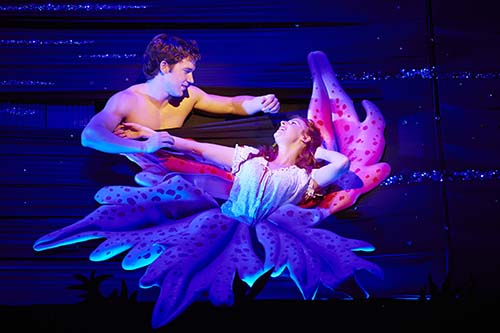
Nick Hendrix and Rosalie Craig in The Light Princess at the Lyttelton at the National Theatre
The Light Princess continues at the Lyttelton in rep at the National Theatre, London until 9 January.
The best children’s fairytale stories of classic literature are allegories wrapped up in engaging fantasy storytelling. The National’s new musical, The Light Princess, is a beautifully told example in this tradition, showing how living in denial may produce short-term happiness, but prevents a true connection with the world.
Based on a tale by Victorian wordsmith George MacDonald, Samuel Anderson and Tori Amos’ stage production tells the story of two very different realms. Lagobel is a golden, opulent, water-scarce desert kingdom, while on the other side of the wilderness lies the water-rich militaristic Sealand. Each kingdom has lost their queen: Sealand’s Prince Digby (Nick Hendrix) has reacted by finding everything devoid of humour while the kingdom’s subjects revel. Over in Lagobel, the perpetual mourning of the populace is interrupted by Althea, whose reaction is to laugh at everything, to make light – and who is as unaffected by gravity as she is by grief.
As with the best fantasy tales, while the high concept is laid out with broad, primary coloured strokes, the true artistry is in the fine detail. And it is here where The Light Princess elevates itself, quite literally at times. Even if Rosalie Craig’s performance as Althea had been presented with both feet on the ground at all times it would have been a delight. But for most of the evening, she is either flying on wires or, more imaginatively and impressively, supported by a team of four black-clad acrobats who, like the puppeteers in director Marianne Elliot’s equally emotional National production War Horse, fade from the attention while their presence is always notable.
The floating sequences culminate with a beautiful love duet between Craig’s Althea and the handsome, debonair, earthbound Digby. The aerial choreography is captivating, breathtaking and beautiful, further enriched by the charismatic leads. As Althea feels the pull of Digby’s gravity, equally he begins to appreciate her levity. But as Althea’s father (a suitably majestic Clive Rowe) campaigns to find a cure for his daughter’s affliction, the production does not shy away from the implicit brutality that is never far away from Grimm or Perrault, but which is so often whitewashed from Disney’s bowdlerised versions of the popular folk tales.
And yet, while Act I reveals a “cure” that is shocking and brutal, the start of the second comes as close as The Light Princess can to the animation studio’s take on such stories. Anthropomorphised animals cavort (and copulate – not something you’d imagine Disney allowing) through the lake that allows Digby and Althea to swim, for once in unison. Act II is much shorter on the aerial acrobatics that thrill so much in the first, but it never stops being a visual spectacle, with Rae Smith’s set design combining with beautiful projected animations and puppetry.
Originally announced for spring 2012, whatever caused the delay in production of The Light Princess has surely contributed to its undoubted success as a beautifully crafted piece of musical theatre. And as a production which, like many of the National’s recent productions, would not have come into existence outside the subsidised sector but which will surely have a commercially successful lifetime for years to come, it is a beautifully appropriate piece to open in the month of the National Theatre’s 50th anniversary.
Scott Matthewman
www.nationaltheatre.org.uk/shows/the-light-princess
SHARE THIS POST:


Comments are closed.