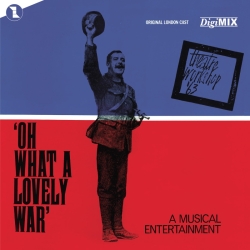
 OH WHAT A LOVELY WAR – Original London Cast (Jay Records CDTER 1043).
Star rating: five stars ★ ★ ★ ★ ★
“May we present the ever popular war games…” was the opening line of Joan Littlewood’s amazing Theatre Workshop production of Oh, What a Lovely War! in 1963 at the Theatre Royal in Stratford, east London. It was inspired by The Long Long Trail, a documentary radio series that BBC producer Charles Chilton had made about the First World War, accompanied by the patriotic songs of that time, and set against the appalling statistics of the millions of soldiers who met their fate in the trenches. Chilton made the programme in memory of his father who was killed in the war at Arras.
Gerry Raffles, Littlewood’s partner and collaborator at Theatre Workshop, had the idea of adapting Chilton’s work for a stage piece. However, Littlewood wanted the audience to leave the theatre laughing at the vulgarity of war, so they used hymns and music hall songs with the new lyrics that had been written during the war and published in 1917 as Tommy’s Tunes.
Littlewood didn’t feel the cast should wear military uniforms, so decided to dress them up as pierrots in order to give the piece the sense of a seaside end of the pier show – after all it was billed as ‘A Musical Entertainment’ – but with an additional layer of the truth about what actually happened in the ‘war to end all wars’.
While the cast were cavorting about the stage, singing patriotic songs and ostensibly enjoying themselves, above their heads was a constant stream of statistics enumerating the tragic loss of lives in a panel of moving lights, or as Littlewood called it her ‘electronic newspaper’. From the opening title song, the show presented many of the tunes written at the time that were meant to be patriotic but in this context there was the awful irony that contrasted the humour with the real facts, because the figures, the losses and the results spoke for themselves.
For example, just look behind the lyrics of such comic songs as ‘Belgium Put the Kibosh on the Kaiser’, ‘Hush Hush Here Comes a Whizzbang’ or ‘I’ll Make a Man of You’ and you will see that war is plainly nothing to be cheerful about. However, just as a collection of First World War songs, the show worked as an excellent evening’s entertainment which made the piece even more subtly moving.
Songs such as ‘Hold Your Hand Out Naughty Boy’, ‘Pack Up Your Troubles’, ‘There’s a Long Long Trail’, ‘Good Byee’, ‘The Bells of Hell’ and ‘Keep the Home Fires Burning’ took on a new resonance in this context, while changing the words for ‘They Were Only Playing Leapfrog’, ‘When This Lousy War is Over’, ‘Joe Soap’s Army’ or ‘They Didn’t Believe Me’, for example, only added an extra layer of irony to the proceedings.
As the original production couldn’t decide on a complete script, the cast were allowed to improvise, so that even though it was Littlewood’s production, it was essentially a team effort by the Theatre Workshop members including such luminaries as Avis Bunnage, Fanny Carby, Judy Cornwell, Larry Dann, John Gower, Godfrey James, Murray Melvin, Brian Murphy, George Sewell and Victor Spinetti among others in the cast.
Following the show’s opening in Stratford East, it transferred to Wyndham’s Theatre in London’s West End and later moved to Broadway where it was nominated for four Tony Awards. Victor Spinetti won for Best Performance by a Featured Actor in a Musical.
Jay Records has re-issued the original cast recording and it comes up as fresh as anything and still makes its presence felt, even after six decades because this year marks its 60th anniversary. There were revivals in 2003, 2010 and 2014, but whether there is still a place for the show to be revived on stage remains to be seen.
So long as there are world wars this ‘Musical Entertainment’ will always be relevant and it still has plenty to say within its pierrot show format. Therefore the re-issue of the original cast recording is worth acquiring. It is a delight in itself, full of musical comedy excellence but still packs a hefty punch as a political commentary on the place of war at this or at any other time. Produced as an attractive evening’s entertainment, it is a winner through and through but, considering the current parlous state of the world, it couldn’t have come at a more appropriate time. The revived recording still does the show enormous justice.
Michael Darvell
SHARE THIS POST:


Comments are closed.