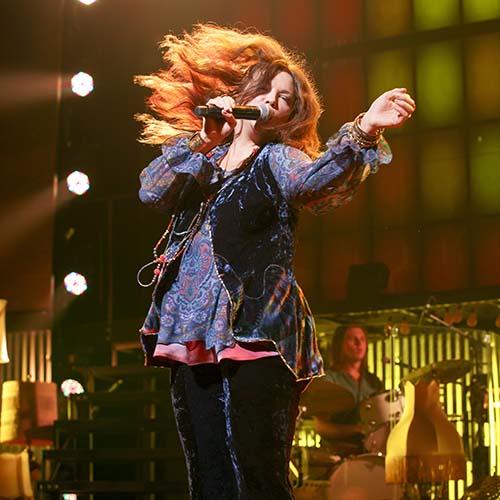
Mary Bridget Davies in A Night with Janis Joplin
at the Lyceum Theatre, New York
A Night with Janis Joplin opened at the Lyceum Theatre, New York, for an open-ended run.
“Settle in and have a rockin’ good time,” the off-stage voice advises the audience before the curtain goes up on A Night with Janis Joplin. And shortly after the show begins, the legendary Joplin, in the person of the wondrous Mary Bridget Davies, asks the audience: “Are you ready to party?” This Broadway show – written and directed by Randy Johnson – lives up to its promise. It is a rockin’ good party.
Immersing the theatre in rock-concert ambience, the show has no semblance of plot. Mainly, there’s a series of showstopping numbers, including gems from a bevy of replicated guest stars – singers who we’re told ignited Joplin’s fervour for the gutsy blues – as well as Joplin’s own career-defining hits. They range from her hair-raising rendition of the Gershwin classic ‘Summertime’ to the deliciously materialistic ‘Mercedes Benz’, which Joplin co-wrote.
In between the songs, Joplin talks about her life and career, including a seemingly idyllic childhood in Texas. Her father was a “secret intellectual” and her mother filled the home with the Broadway cast recordings she played over and over, even though she – Joplin – burned with the desire to “get out of Texas”. Mainly, though, Joplin tells us about the high she gets from performing and philosophises about the soul-revealing nature of the blues. There is little foreshadowing of Joplin’s tragic end – death at 27 years of age from a drug overdose – although she does take a few swigs from a whiskey bottle during the show. There’s also a poignant moment, when Joplin, negating the idea of ever retiring, says she plans to be around for a long time.
She also speaks about all those singers that influenced and inspired her, from anonymous blues singers to such personalities as Bessie Smith and Odetta, brought to life by a quartet of women collectively dubbed ‘The Joplinaires’, who also function as back-up singers. An unbelievably rousing duet between Aretha Franklin, played with grand gusto by Allison Blackwell, and Joplin singing Franklin’s ‘Spirit in the Dark’ brings Act I to a close with a standing ovation. Other sterling moments include Taprena Michelle Augustine as an unnamed singer ripping apart ‘Today I Sing the Blues’, and De’Adre Aziza as a majestic Nina Simone, getting together with Joplin, in a riveting if almost unrecognisable rendition of ‘Little Girl Blue’. There’s also Nikki Kimbrough appearing as a blond-wigged Etta James.
Production values add to the excitement. The great eight-piece band conjures up a variety of styles and sometimes becomes a visual adjunct to the meaning of a song. The lighting – by Justin Townsend who also designed the set – changes moods instantaneously, and Amy Clark’s costumes help define the periods of the various women on stage, especially Joplin’s voluptuous take on 1960s flower child. Patricia Wilcox’s choreography works hand in hand with the music, amplifying its vibrancy.
But it is, of course, Davies’ re-creation of Joplin that is the driving engine here. It’s something to behold and hear. There’s the mop of stringy hair, framing an impish smile; the forceful gestures underpinning lyrics and controlling the band, and all the rasp, quirks, anger, joy and hurricane power that made Joplin an iconic voice of rock ‘n’ roll. After just a few songs have been sung, you are ready to ‘settle in’ and just accept that you’re actually in the presence of Joplin.
Ron Cohen
SHARE THIS POST:


Comments are closed.