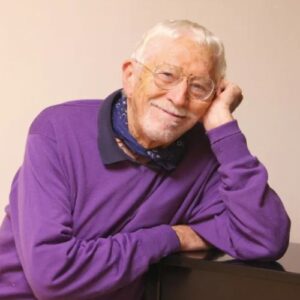
 A tribute to the Broadway lyricist and writer of the longest-running musical, The Fantasticks, Tom Jones (1928 to 2023).
There is nobody else in the American theatre, apart from Tom Jones, who can claim to have written the world’s longest-running musical – not yet anyway. It was The Fantasticks, a show that ran from 1960 for 17,162 performances, which was 42 years Off-Broadway. As lyricist and actor Tom Jones has died, Michael Darvell traces the life and career of this, yes, fantastic Broadway veteran…
With his writing partner, composer Harvey Schmidt (1929 to 2018), Tom Jones wrote both the book and lyrics for The Fantasticks and he also acted in the original production when it first opened and directed and acted in the New York City revival in 2010 for three months under the name of Thomas Bruce. The show will always be remembered for the classic songs it introduced to the world, namely ‘Try to Remember’, ‘Soon It’s Gonna Rain’, ‘Much More’ and ‘I Can See It’ etc. Together Schmidt and Jones also wrote other musicals including 110 in the Shade, I Do! I Do!, Celebration and Philemon.
Thomas Collins Jones was born in Littlefield, Texas and raised in Coleman, also in Texas. He was the son of William Jones, a turkey farmer, and his wife Jessie. As a teenager Tom worked as an usher at a local cinema and when he enrolled at the University of Texas he became part of the Theatre Department and from the university received a Master’s Degree in 1951. It was where he met his writing partner Schmidt, who was also from Texas. At university Schmidt started playing piano accompaniment for Jones and so they began to write together.
Their first effort was a revue but then Schmidt, after his US Army service moved to New York to work as a graphic artist at NBC Television and later became an illustrator for magazines such as Life, Fortune, Harper’s Bazaar and Sports Illustrated. However, they stayed working together and eventually in 1960 came The Fantasticks, an allegorical story based on an 1894 play, The Romancers, by Edmond Rostand, most famous for Cyrano de Bergerac, although here he used a plot not unlike that of Pyramus and Thisbe in A Midsummer Night’s Dream.
The Fantasticks is about two neighbours who set out to trick their own children into marrying by pretending to have a feud, rather like the Montagues and the Capulets in Romeo and Juliet but with a happier outcome. It was perhaps surprising that the show ran for so long as it was not a straightforward musical comedy or drama, but rather more poetic than most shows. However, for some reason the piece caught on with the public audiences and it never let go for over 40 years. Maybe it was the romantic plot or more likely the delightful, charming songs mentioned above with the brilliant melodies of Schmidt coupled to the subtlely poetic lyrics of Tom Jones.
The history of The Fantasticks begins in a version of the Rostand play in 1956 when Tom Jones and composer John Donald Robb adapted it and set in in the American West, naming it Joy Comes to Deadhorse. However, after its premiere at the University of New Mexico, Jones felt it didn’t really work, so he tried again with Schmidt. They rewrote it completely, added new songs and called it The Fantasticks, after another adaptation of the Rostand play in 1900. After a trial run in August 1959 at Barnard College, Columbia University in Manhattan, it was ready to open Off-Broadway the following year.
It premiered at the Sullivan Street Playhouse in Greenwich Village, opening on 3 May, 1960 and it closed 42 years later on 13 January 2002. It originally starred Jerry Orbach, Kenneth Nelson, Rita Gardner and Tom Jones himself – but using his pseudonym of Thomas Bruce. It was staged on a very low budget of under $1500 with a small cast and just a few musicians. Was it the show’s romantic charm the deciding factor or a song like ‘Try to Remember’, one of the hits, that kept it running for so long? That song, just like Sondheim’s only chart hit, ‘Send in the Clowns’, which was written overnight for A Little Night Music, so was ‘Time to Remember’ a last-minute addition according to Schmidt, written in a single day after he had had “a fruitless afternoon attempting to compose other songs”.
Many famous performers appeared in the show during its lengthy Off-Broadway run and they include Glenn Close, Liza Minnelli, Elliott Gould, F Murray Abraham, Kristin Chenoweth, Bert Convey etc, while other productions have sported the likes of John Carradine, Richard Chamberlain, Robert Goulet and David ‘Bonanza’ Canary. It also became a favourite with schools, colleges and amateur companies and has played around the globe.
The Fantasticks has never been away for very long. After the initial run ended in 2002 there was a revival in 2006 which ran for another 4,390 performances unitl 4 June 2017 at the New York Theater Center. Tom Jones directed it and appeared in it again until 2010 when the show celebrated its golden jubilee. Then the Theater Center was renamed the Jerry Orbach Theatre in honour of the original star of the show. It played in Washington DC in 2009-10 and since then has been seen all over the world, in no less than 67 countries and translated into numerous different languages. Ghostlight Records issued a recording of the New York revival.
Sadly it didn’t run for long in London, in fact a mere 44 performances at the Apollo Theatre in 1961, with Terence Cooper, Peter Gilmore, Stephanie Voss and David Suchet. Still, I do recall a memorable production at the Open Air Theatre in Regent’s Park with Roy Hudd and Anthony O’Donnell in 1990. It returned to London in June 2010 at the Duchess Theatre with Clive Rowe, Edward Petherbridge and David Burt, but it was poorly received and, although it was booking to September 2010, it closed after three weeks.
The Fantasticks was seen on television in an abbreviated version in 1964 with John Davidson, Stanley Holloway, Bert Lahr, Ricardo Montalban and Susan Watson (who was in the original Barnard College production). Director Michael Ritchie filmed the show in 1995 but it was not released until 2000, with Joel Grey, Brad Sullivan, Barnard Hughes and Joey McIntyre, but it fared badly with the critics and the public alike.
I suppose it was nigh on impossible to think that the Schmidt-Jones partnership would ever have another hit as big as The Fantasticks, as they had already made theatrical history. Their next collaboration was 110 in the Shade, an adaptation of N Richard Nash’s 1954 play The Rainmaker. It tells of Lizzie, a spinster living on a ranch in the American south west and her relationship with File, the local sheriff. Along comes Starbuck, a con-man who promises the locals that he can bring much-needed rain to their drought-stricken community. The play had a short run in New York with Geraldine Page as Lizzie, Richard Coogan as File and Darren McGavin as Starbuck. Although it ran for only 125 performances, it was taken up by companies around the world, having been translated into over 40 languages. There was also a famous film version with Katharine Hepburn, Burt Lancaster and Wendell Corey in 1956.
The first version of 110 in the Shade turned out to be more of an opera than an American musical and after it was previewed in Boston, many of the songs were ditched and replaced by more accessible material. It opened at the Broadhurst Theatre in New York in October 1963 and ran for over 300 performances. Robert Horton (from Wagon Train) played Starbuck, Inga Swenson was Lizzie and Stephen Douglass was File. It was well received and it had some good songs including ‘Another Hot Day’, ‘Love, Don’t Turn Away’, ‘The Hungry Men’, ‘The Rain Song’, ‘A Man and a Woman’, ‘Everything Beautiful Happens at Night’ and ‘Old Maid’, but the score did not release any numbers that became standards in the way that, say, ‘Time to Remember’ or ‘Soon It’s Gonna Rain’ from The Fantasticks had become global hits. It was nominated in four Tony Award categories but did not win any.
The show came to London in 1967 and played at the Palace Theatre for just over a hundred performances with Inga Swenson as Lizzie, Stephen Douglass as Starbuck and Welsh singer Ivor Emmanuel as Sheriff File. There was a concert version in London in 1999 presented by Ian Marshall Fisher for his Discovering Lost Musicals season at the Fortune Theatre, with Louise Gold playing Lizzie, and a New York revival in 2007 by the Roundabout Theater Company at Studio 54 for about 120 performances with Audra McDonald and Steve Kazee.
I Do! I Do! was Jones and Schmidt’s project for 1966. It was a two-hander piece telling the story of Agnes and Michael from 1895 to 1945, covering their marriage’s good times and the bad and set in just their bedroom. It was based on Jan de Hartog’s play The Fourposter which premiered in the UK in 1950 at the New Theatre in Cambridge, with acting couple Michael Denison and Dulcie Gray, and then transferred to the West End’s Ambassadors Theatre. The Broadway production featured another married couple, Hume Cronyn and Jessica Tandy, and Jose Ferrer directed it in 1951 when it ran for over 600 performances, with occasional cast changes on the way. It was filmed in 1952 with Rex Harrison and Lili Palmer who were at the time married to each other.
Although it was a Broadway production, I Do! I Do! was more like The Fantasticks in that it had a small cast of two, a single set and fairly simple costumes. As usual Schmidt’s music was romantic and Tom Jones’ lyrics fitted the music and the play’s situations perfectly. The songs included ‘All the Dearly Beloved’, ‘Together Forever’, ‘I Love My Wife’, ‘My Cup Runneth Over’, ‘Nobody’s Perfect’, ‘Where Are the Snows?’ etc, and of course the title song. With the ideal casting of Mary Martin and Robert Preston, the show was a hit, running from December 1966 for 560 performances. Preston won a Tony Award for Best Leading Actor in a Musical.
Carol Lawrence and Gordon MacRae played the matinees from October 1967 and eventually took over full-time from December that year. Carol Burnett and Rock Hudson did a tour of the show from 1973. There was an Australian tour and the show was filmed for television with Lee Remick and Hal Linden in 1982. Like The Fantasticks, it became a popular production for regional and amateur theatre companies in the US and Canada. One production in Minnesota ran for over 20 years.
The next show from Schmidt and Jones was Celebration in 1969. A move away from the standard musical form saw the writers presenting an allegorical, avant-garde fable about the struggle between youth and old age, love and ambition, poverty and wealth and innocence and corruption. Not with the happiest of themes, the show lasted just three months at the New York Ambassadors Theatre. Its downbeat subject did it no favours with a musical theatre audience expecting something more uplifting. However, it became popular with college and local groups and it did get a revival in New York in 2007, while Jones revised the show for a production in St Louis in 2016.
Philemon seemed also to be another doubtful choice of subject for Schmidt and Jones. Basically it is about a clown who has to choose whether to save his own life in third-century Ancient Rome or help the rest of the population save theirs. Apparently it was a gem of a piece in 1975 Off-Broadway and filmed for Hollywood Television Theatre in 1976. A revival played Off-Broadway in 1991.
Roadside was a project that Schmidt and Jones had worked on when they were both still at the University of Texas. Fifty years later they resurrected it. Based on a short story by Lynn Riggs who wrote Green Grow the Lilacs, which became the musical Oklahoma!, Roadside had a similar plot to the Rodgers and Hammerstein show in that there is a feud between the farmers and the cowboys. Although Schmidt’s music was generously praised, apparently Jones’ lyrics did not match up to his usual poetic imagery, not even ‘Smellamagoody Perfume’ or ‘Another Drunken Cowboy’ or ‘Ain’t No Women But You’. Following a premiere in February 2001 in Irving, Texas, it moved to the Granbury Opera House, also in Texas, and then opened Off-Broadway in November 2001 but only for a few weeks.
And that was about all that Jones and Schmidt had written together. They both collaborated with others but their time working together produced the best results. Jones did collaborate with composer Nancy Ford on The Game of Love, taking a play by Arthur Schnitzler, translating it and setting new lyrics to the music of Offenbach with additional music by Nancy Ford. They began working on the piece in 1965 but it did not premiere until 2012 in Illinois and then again in 2016 in Miami. Jones put all his career experiences down on paper in his book Making Musicals: An Informal Introduction to Musical Theatre in 1998.
He was first married to Eleanor Wright but they divorced and he later married choreographer Janet Watson and they had two sons, Michael and Sam. Janet died in 2016. Tom Jones leaves a great legacy for writing not only some of the most interesting American musical shows of the 20th century and with Harvey Schmidt he had a hand the world’s longest-running musical, a record that surely may never be beaten, unless The Phantom of the Opera is still with us beyond 2028.
Thomas Collins Jones – born Littlefield, Texas 17 February 1928; died Sharon Connecticut, 11 August 2023. RIP.
SHARE THIS POST:


Comments are closed.