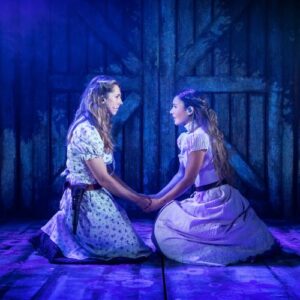
Lauren Drew and Maiya Quansah-Breed in Lizzie: The Musical at Southwark Playhouse Elephant. Picture: Pamela Raith Photography
Lizzie: The Musical continues at the Southwark Playhouse Elephant, London until 2 December 2023.
Star rating: three stars ★ ★ ★ ✩ ✩
What happened in August 1892 in the small town of Fall River, Massachusetts may never be known for sure. What is known is this: property developer Andrew Jackson Borden and his wife Abby were murdered, struck many times with an axe. Prime suspect was Borden’s daughter Lizzie, who was tried for the murders but acquitted.
Since then, the name of Lizzie Borden has been synonymous with sensationalist true crime murder stories, although the facts of the case have largely been forgotten. A composing team of Steven Cheslik-deMeyer, Tim Maner and Alan Stevens Hewitt first created Lizzie in 1990 as a four-song experimental rock show, but it has since expanded into a full-length musical, first performed in 2009.
With a cast of just four, Lizzie focuses on Lizzie (Lauren Drew) and the women around her who may, or may not, have been complicit: her sister Emma (Shekinah McFarlane); their friend Alice (Maiya Quansah-Breed), here repositioned as a potential love interest for Lizzie; and the Bordens’ maid Bridget (Mairi Barclay), who the family often called Maggie because that’s what their previous maid had been called.
By focusing on four women of similar age, the musical allows for a rock band aesthetic, which these days one cannot help but compare to that for Six (especially since three of the four cast members are alumnae of that show). That sort of vibe works well in a musical where all the co-leads are on stage throughout; it is marginally less effective here, with a much more conventional scene structure.
Visually, the hard guitar-led edge from the musical’s four-piece band (led by musical director Honor Halford-MacLeod) is complemented by some striking animated visuals, projected onto designer Andrew Exeter’s wooden-slatted set. It could perhaps extend more into the performers’ costumes than it does – beyond some striking footwear, the attire is rather more of the period than either music or other design elements.
The rockiness of the score is infused with nods to other genres, and there is a heavy Irish folk influence in evidence. This is due in no small part to the character of Bridget, the Irish maid, whose presence in any song inspires the composers to ramp up the folk element. That is mirrored by an ever-larger performance by Barclay, who at times comes across as playing almost at panto dame levels of comedic largesse.
At best that sometimes threatens to disrupt the work, and at times actively works against the emotions being felt elsewhere on stage. On the occasions where both director/choreographer William Whelton and performer allow for a more nuanced portrayal, the quartet becomes far more balanced.
Elsewhere, the relationships between characters are strong. Drew and Quansah-Breed, as neighbours whose affections go much further than just friends, have a sweet sexiness to their interactions, while McFarlane as Lizzie’s older sister brings a no-nonsense attitude to proceedings. This does mean that Lizzie is at her most effective musically when duetting; while this musical is named after Lizzie Borden, the composers clearly envisage the crime as a joint enterprise.
Musically, that allows for some fine duets, especially between Drew and Quansah-Breed – although the best of the evening is Drew and McFarlane’s beautiful Act II hymn, ‘Watchmen for the Morning’.
But that tight grouping does come at a slight risk of the storytelling of the crime itself. One never really gets a sense of the victims at all, although an early solo by Drew suggests that Lizzie’s relationship with her father may have been an abusive one. That means that, even as the writing team give us a definitive view of whether or not Lizzie did set about her father and stepmother with an axe, we’re never quite clear about the intentions behind the murders.
One of the few known facts about Lizzie Borden’s case is that she was acquitted, and continued to live in Fall River until her death in 1927 at the age of 66. That intrinsically leads to a dramatic anti-climax which Lizzie cannot escape. Thank goodness for that modern musical tradition, then, the curtain call megamix – performed with gusto with the cast changed into fully modern outfits.
That final moment is a distillation of all the great things about Lizzie: The Musical. It has lots of musically and dramatically great moments, but it is the quartet of performers who really make the work sing.
Scott Matthewman
SHARE THIS POST:


Comments are closed.