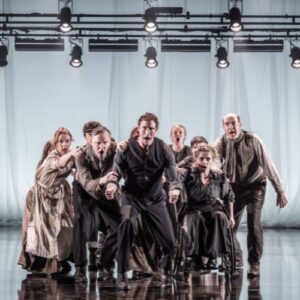
The cast of London Tide at the National Theatre, London. Pictures: Marc Brenner
London Tide continues at the Lyttelton at the National Theatre, London until 22 June 2024.
Star rating: three stars ★ ★ ★ ✩ ✩
London Tide delivers a typically compelling Dickensian story, yet the music feels ineffective. Ben Power’s adaptation of Charles Dickens’ last completed novel Our Mutual Friend is brought to the stage by director Ian Rickson with original songs by PJ Harvey (lyrics also by Power). The eponymous London setting, and particularly the Thames – upon the banks of which the National Theatre sits – is placed centre stage.
The quaint village of Barnes, the professional offices of Holborn and the rugged landscape of Limehouse are all connected by the lifeblood of the river, tying the narrative together. Even in the brief moments when we leave London, the river remains an anchoring presence. Particularly in the knowledge that this very river is flowing just behind the audience, it is a deeply satisfying creative choice.
The river’s presence is imbued into each scene with impressive set design and lighting. The former is left bare and open by Bunny Christie, framed by a grey and plastic canvas which lines the edges of the stage in creases and ripples.
Jack Knowles’ lighting is immediately striking, with an exposed rig hovering almost at ground level before the play begins. It rises in place of a curtain to open the play, and then beautifully undulates with the ensuing music and drama. This, along with murky colours of green, blue and grey, gives the impression of being submerged.
Movement director Anna Morrissey reinforces the feeling of being plunged underwater, with the characters that meet their fate in the dark waters floating eerily on stage after their deaths.
The cast is comprised of an intricate chorus of Dickensian characters. Bella Maclean and Brandon Grace are both strong protagonists as Bella Wilfer and Charley Hexam, with particularly powerful vocals from Maclean (she was previously part of the Almeida Theatre’s 2021 revival of Spring Awakening).
Ami Tredrea provides haunting vocals and a caring, protective sibling in Lizzie Hexam, and Tom Mothersdale brings a ghoulish quality to the mysterious John Harmon. Jamael Westman is a convincingly lovestruck Eugene Wrayburn, while Scott Karim veers a little too much into the comical in his villainous depiction of the gaunt Bradley Headstone.

Brandon Grace, Jake Wood and Ami Tredrea (above) and Bella Maclean
It’s the smaller roles that stand out though. Jenny Wren is confidently played by Ellie-May Sheridan – she claims many of the play’s comedic lines but also offers poignant moments, reminding us still to consider the suffering of those more easily overlooked. Bella Wilfer’s family too are a touching unit of loyalty and love, with her father Reg (Stephen Kennedy) remaining unconditionally kind and faithful to his daughter’s happiness.
The use of music in the play stands out, although not quite for its intended reasons. Harvey’s original songs are bare and often dissonant, sung ruggedly without vibrato by the cast. They predominantly take the form of character soliloquies, although some chorus moments, both overlaid and independent, provide powerful portrayals of London’s overriding, almost sentient setting.
Music has of course played a major role in plays seen at the National Theatre before, notably in the melodies that flowed through the heath in Emma Rice’s Wuthering Heights (2022) and the Welsh choir of miners in The Corn is Green (2022), both of which were also performed at the Lyttelton Theatre. London Tide’s songs too are not quite enough to justify calling the play a ‘musical’ (at least in the conventional sense), though they are still integral to the overall production.
Yet here the purpose is less clear – the songs lack individuality and often feel one-dimensional, almost repetitive. Whether it is simply Harvey’s composition, or the more structural choice to sit between the genres of play and musical, the music feels constrained, disallowing the full potential of its emotional depth to be received.
The centrality of music to the play, and its ineffectiveness compared to an otherwise strong set of creative decisions, seems restrictive and occasionally distracting. Nevertheless, this classic Dickensian tale of poverty, pain and mobility is still powerfully told.
Billy Nicholles
SHARE THIS POST:


Comments are closed.