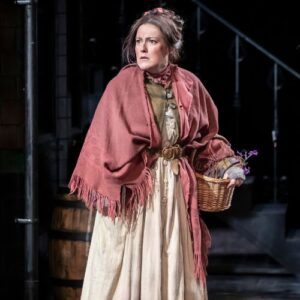
Katie Bird in My Fair Lady at Leeds Playhouse. Picture: Pamela Raith
My Fair Lady continues at Leeds Playhouse until 29 June 2024.
Star rating: five stars ★ ★ ★ ★ ★
Devotees of the 1964 Warner Brothers movie adaptation of My Fair Lady must have been a little bemused as Opera North’s version unfolded. Where were the big hats? What about the swirling frocks? Above all – where was the colour?
Director James Brining has obviously opted for a more monochrome set and costuming (Madeleine Boyd) that brings out Eliza’s side of the story. As the action unfolds, she finds herself between two worlds and not at home in either. Her old friends in Covent Garden are cold at best, while she has no real place in the world for which Henry Higgins has educated her. Other versions have presented a balanced view of the Higgins/Doolittle relationship, this one comes down decisively on Eliza’s side.
The songs have not been altered. They prove to be the anchor for those in the audience who expected to see Eliza’s rise as a rags to riches story, given some concessions. From the opening number ‘Why Can’t the English?’ and introduction in to Eliza (‘Wouldn’t It Be Loverly?’), we meet characters and judge the tone of the show.
Rex Harrison’s interpretation of Henry Higgins is definitive. He it was who turned most of his songs into a kind of talking blues which allowed for a more effective tirade.
It is when John Hopkins’ Higgins and Colonel Pickering (Dean Robinson) return from the Queen of Transylvania’s Embassy Ball, delighted at Liza’s success, that we see Higgins’ selfishness and thoughtlessness: Eliza sits alone while even the servants are offered celebratory champagne.
Eliza herself (Katie Bird) has one of those thrilling soprano voices that sets the spine tingling. At the same time, she can bring out the pathos in ‘Wouldn’t It Be Loverly?’. I never saw Julie Andrews perform the role on stage, but from what I have seen of archive footage, Bird manages to convey the same whimsical longing.
In between the main action, Eliza’s father Alfred Doolittle (Richard Mosley-Evans) offers some comic relief, notably ‘Get Me to the Church On Time’. He is a reluctant bridegroom, but apparently making the best of it. The choreography around him (Lucy Hind) makes use of all the familiar tropes of cockneyism: thumbs in braces, bent leg low-kicks, arms akimbo.
At the same time, the rather pathetic Freddy is singing the very special ‘On the Street Where You Live’. He has encountered Eliza at Ascot and fallen hopelessly in love. He gets a great song but little else.
The famous Ascot scene is the only example of blazing colour in the whole of the evening. The emphasis is, of course, on social differences. The Chorus assumes positions behind a screen that has holes for their heads to peer through. On the screen, there are vestigial sketches of what their costumes might have looked like, but the theme of class distinction continues to be apparent.
Despite Higgins’ final lament, ‘I’ve Grown Accustomed to Her Face’, he and Eliza remain at opposite ends of the stage – as distant as ever. When he demands: “Where the devil are my slippers?”, she does not move.
Conductor and musical director Oliver Rundell unleashes the power of the Opera North Orchestra when needed, and there is plenty in the tank, but is quite capable of subtlety when required.
Mike Tilling
SHARE THIS POST:



Comments are closed.