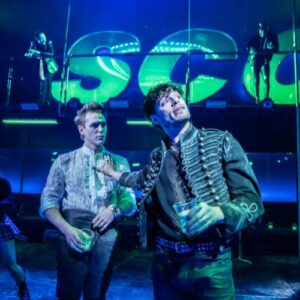
Jamie Muscato and Daniel Krikler in Natasha, Pierre & The Great Comet of 1812 at the Donmar Warehouse, London. Pictures: Johan Persson
Natasha, Pierre & The Great Comet of 1812 continues at the Donmar Warehouse, London until 8 February 2025.
Star rating: five stars ★ ★ ★ ★ ★
Finally. It feels like we’ve been waiting since the early 19th century for Dave Malloy’s Natasha, Pierre & The Great Comet of 1812 to arrive in the UK. After its critically acclaimed and award-winning runs off and on-Broadway (directed by Hadestown’s Rachel Chavkin between 2012-2017), it felt inevitable that this gorgeous reimagining of Leo Tolstoy’s War and Peace (or 70 of more than a thousand pages) would find its way to London.
But despite successful London runs of other Malloy works such as Preludes, Ghost Quartet, and most recently The Witches – all of which were brilliant, by the way – we have been denied Great Comet. Online snippets teased us with unfathomable beauty and opulence. Broadway’s Imperial Theatre was transformed with velvet and gold into an immersive Russian supper club where glamorous cast members performed to, around, and within the audience. Meanwhile, British theatre fans sat at home and wept.
Now we finally have Great Comet at Donmar Warehouse and the first thing to report is that this is a new production, with that much-ballyhooed opulence markably dialled back. The stage is relatively bare – even for a venue that regularly features minimalist sets – and though there are a handful of floofy dresses amidst Evie Gurney’s striking costumes, these are intermingled with Dr Martens, leather jackets and other anachronisms.
For those familiar with the show and story, this paring down of the lavishness may raise eyebrows: surely luxurious décor is demanded by the plot? Great Comet – and War and Peace itself – concerns itself largely with a Russian elite obsessing over life’s minutiae and domestic dramas while a massively consequential war rages outside. The countess Natasha misses the soldier Andrey to whom she is betrothed and finds herself caught up in a whirlwind affair with a handsome aristocrat. Wealthy but ill-suited to nobility, Pierre feels lost: his privileged life lacking meaning and purpose. As we all experience: it doesn’t matter how beautiful our cocoon and how iridescent the light, at some point, justified or not by the greater context of the world, we feel the darkness.
So, without the opulence of the Broadway production (and even the Off-Broadway Ars Nova run) to hammer home that point, what are we left with? Well, a truly dazzling achievement of contemporary musical theatre performed by a superb cast.
Disappointing as it may be to some to not get the fully immersive experience that won so many fans on Broadway, there is solid logic behind Tim Sheader’s decision to take a comparatively minimal approach. Talk of the original production sometimes focused so much on the wallpaper that its groundbreaking music and storytelling sounded like they were of secondary importance. In fact, these have always been Great Comet’s most thrilling elements.
In his first directorial undertaking as the Donmar’s artistic director, Sheader uses this beloved venue’s intimacy to focus attention on the plot. Though the stage is sometimes quite empty, Leslie Travers’ set is never uninteresting. Giant letters spell out our setting: Moscow, with the first ‘o’ collapsed to the ground. This large circle is hoisted up and down throughout, becoming everything from an opera box to the vast firmament in which the titular comet appears. Howard Hudson’s tasteful lighting design brings life and beauty to every scene while never drawing focus away from the story and the cast.
When the entire ensemble – all excellent and fulfilling multiple roles – bring the party, they do not hold back. Ellen Kane’s choreography is breathtaking, particularly in ‘The Duel’ and ‘Balaga’ (with the latter character played by a deliciously kinky Cedric Neal, positively commanding the room as he always does). Drinks and poi shimmer with green and alcohol is flung about the stage. Though there is less audience interaction than in New York, those on the front row may still find themselves getting to know the performers more intimately than they may have anticipated.
In an evening of impeccable performances, Chumisa Dornford-May as Natasha distinguishes herself as an absurdly talented presence. Not only is her singing voice powerful and her diction crystal clear, but she is a master of acting through song. In every moment, the decidedly unmodern language of Tolstoy (via Malloy) seems to be coming to her for the first time. Despite this being a sung-through show necessitating some suspension of disbelief, Dornford-May makes Natasha and her tumultuous inner life real throughout. We share in that universal tragedy of aging into an unjust world, where the mere act of trusting and acting upon your unfiltered emotions is no longer a virtue but the path to ruin.
On a parallel path, as Moscow high society rips Natasha from her childish innocence into existential angst, Pierre is drawn out from his depression thanks to his obvious, fundamental virtuous nature. Declan Bennett is a more awkward and quieter Pierre than powerhouses like Josh Groban have portrayed in the past, but in an intimate space that invites the audience to lean in, this choice is effective. Here is a man lost, asleep to the wonder that is true, selfless love, yet the only man whom Natasha trusts in her darkest moment. In Natasha, in this condemned soul’s instinctive faith, Pierre recognises the good in himself, and in all of humanity. The last five minutes of the show depicting Pierre’s spiritual reawakening are powerful beyond words and a moment of theatre you will remember forever.
As vocally stunning now as she was in the 2019 Boulevard Theatre production of Malloy’s Ghost Quartet, Maimuna Memon crafts a layered Sonya, cousin and best friend of Natasha. ‘Sonya is good’, the introductory, ‘Twelve Days of Christmas’-style ‘Prologue’ number informs us, but Memon deftly sprinkles in a little cheeky playfulness that makes her relationship with her (adopted, technically) cousin instantly recognisable and familiar. By the point in ‘Sonya Alone’ where she sings of her dedication to protecting the companion who has been selfish, foolish and negligent the whole play, our hearts break.
Elsewhere, Annette McLaughlin’s Marya Dmitrievna is perfectly imposing and impressive in her ‘old school’ sternness, whereas the coldness of Cat Simmons’ Hélène is decadently sinister. Daniel Krikler brings a winning physical unpredictability and menace to the revered assassin Dolokhov, while Eugene McCoy revels in the chance to play both old (Prince Bolkonsky) and young (his son and Natasha’s betrothed, Andrey) with comedy and tragedy in equal measure.
Also proving impressively adaptable, Chloe Saracco perfectly portrays ‘plain’ in Princess Mary – the devoutly religious sister of Andrey who takes a dislike to the fashionable and frivolous Natasha – yet parties hard with the best of them in several ensemble roles throughout the show.
But the king of the party is without a doubt Jamie Muscato, impossibly brilliant playing the dangerous scoundrel Anatole with a coked-up confidence that is somehow justified by his undeniable charisma. He has tangible sexual chemistry with every single human being onstage – including his sister, true to the source material – and a falsetto that can and does seduce everybody in that auditorium. Magic.
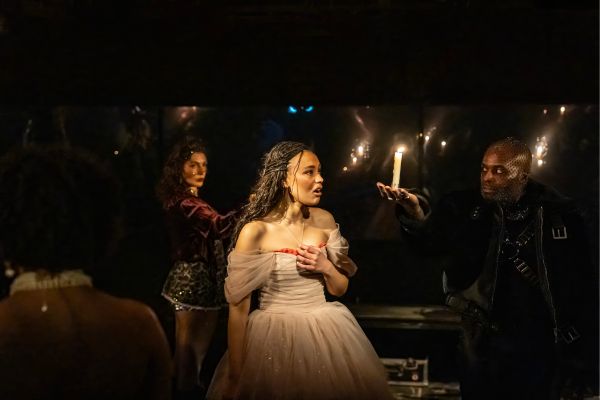
Kimberly Blake, Chumisa Dornford-May and Cedric Neal in Natasha, Pierre & The Great Comet of 1812
For those who love Tolstoy’s novel (i.e., anybody who has read it – such is the Stockholm syndrome effect of making it through those 1,440 pages), it is impossible not to be impressed by the economy with which Malloy is able to tell this story (a mere 70-page sliver of the original text). He takes some shortcuts in characterisation, but with a libretto consisting mostly of direct quotes, this show does not feel at all like a cheapened version of the original. We are not being shortchanged here, and if anything, the emotional impact of the music helps us better appreciate the story.
And it is the music that might be the best element of all. A refreshing divergence from the creeping homogeny in new musical theatre writing: Malloy pulls in influences from far and wide but melts them into an entirely cohesive and consistent whole. Klezmer meets indie rock meets electronica meets showtunes, and it all makes perfect sense. Natasha’s early aria ‘No One Else’ is as perfect a yearning musical theatre ballad as you are ever likely to hear, and it feels right at home in the same show as the unhinged drum and bass insanity of ‘The Duel’.
Musical director Sam Young has done a superb job in bringing Malloy’s original orchestrations to life in this new space. The 11-strong band is mostly visible, with some members on balconies, some onstage, and some even getting involved in the action directly. We don’t have any actor-musicians playing the leads as per Broadway, but with a band this good, that element is not missed. Special shout-out to James Mainwaring who provides some virtuosic woodwind solos. More shows should learn that nothing gets the party started like a rockin’ clarinet.
Late in the play, Krikler’s Dolokhov makes a passing reference to the stubborn attachment small-minded people have for conclusions they have worked out for themselves (like the bulk of Malloy’s libretto, a direct quote from War and Peace). There is a difficulty in reviewing a piece of art to which one has a pre-existing attachment: maybe impartiality is impossible? However, with the usual allowances for some theatregoers simply having fundamentally different tastes to me, I have never been more confident recommending a show.
My first experience with Natasha, Pierre & The Great Comet of 1812 was hearing that 2013 Off-Broadway cast recording. Despite being shorn of Broadway’s opulence, shorn of the Donmar’s powerful intimacy, shorn even of ‘Dust and Ashes’ – a remarkable song added for Broadway that is now a beloved highlight – I was enraptured by the music and the storytelling. Malloy has crafted a beautiful play, and Sheader’s bold directorial take only makes this gorgeous comet shine more brightly.
A plea to those mysterious forces with power in the West End (despite hosting a podcast arrogantly titled ‘The Mayor of Musical Theatre’, that’s very much not me): please can we have the rest of Malloy’s musicals now? An a cappella musical about internet addiction (Octet)? Yes, please! A three and a half hour adaptation of Moby Dick that includes a meal? We simply cannot survive without it! Whatever his most recent Three Houses is about? We’ll take it on trust! And bring back Ghost Quartet while you’re at it too. Please.
Until then, Natasha, Pierre & The Great Comet of 1812 is my favourite musical in London, and it may become yours too. The wait has been long, but oh so worth it. The Donmar Warehouse is a small venue and tickets are scarce, so the only ethical recommendation I can make is that you break any laws necessary to get into that theatre and see this show. There is a magic about it – shared with the book, shared even with the BBC TV adaptation – that changes outlooks, changes lives. Bangin’ tunes too.
Ian Bowkett
SHARE THIS POST:


Comments are closed.