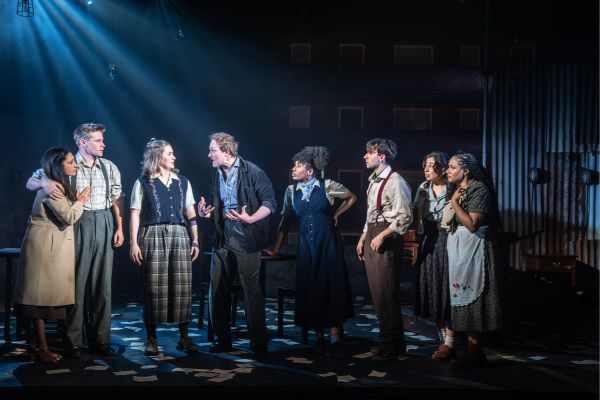
Picture: Johan Persson
Cable Street continues at Marylebone Theatre, London until 28 February 2026.
Star rating: three stars ★ ★ ★ ✩ ✩
It’s been exciting to observe the success of the new British musical Cable Street in recent years. Composer Tim Gilvin and librettist Alex Kanefsky’s powerful reflection on the rise of fascism in London’s East End during the 1930s was so successful in 2024 that it enjoyed two sell-out runs at Southwark Playhouse (Borough and Elephant). Now it’s back, this time at the Marylebone Theatre, with an Off-Broadway run on the horizon in April.
According to the programme, the writers and creative team have worked to “strengthen and refine” the piece. I must confess, however, that this was my first time seeing the show, so I cannot compare it to the Southwark production or comment on any changes.
When my colleague Ian Bowkett originally reviewed the musical, he wrote: “It will surely go on to secure an important place in the British musical theatre canon,” a statement I fully agree with. That said, there still appear to be areas that could benefit from further development.
There’s no doubting the quality of the individual elements, though they don’t always flow together as seamlessly as they might. Kanefsky handles the complex book well, weaving together multiple scenarios that begin in the present with East End tour guide Yitzhak Schienberg (Jez Unwin) recounting the life of his great uncle Sammy to American tourist Kathleen Kenny (Debbie Chazen).
When the narrative flashes back to 1936, the audience is drawn into a world of disparate communities wary of each other, a tension intensified by Oswald Mosley’s British Union of Fascists (BUF). With so many narrative strands, it can be difficult to form strong emotional connections with every character or invest fully in their relationships – but the three main protagonists stand out.
Ex-boxer Sammy (Isaac Gryn), living in the East End as part of an extended Jewish family, faces prejudice at every turn as he looks for work. Mairead (Lizzy-Rose Esin-Kelly) contributes significantly to her Irish family while aspiring to be a writer. Ron (Barney Wilkinson), desperate for employment, has moved from “up North” with his struggling mother. Sammy and Mairead find common ground in the anti-fascist movement, partly represented by the local Communist Party, while Ron is persuaded that the BUF has his best interests at heart.
Within a hardworking cast, Gryn, Esin-Kelly and particularly Wilkinson shine in their portrayals of Sammy, Mairead and Ron, navigating an eclectic range of musical numbers including ‘Angel on My Shoulder’, ‘Bread and Roses’ and ‘Shut Me Out’. The use of distinct musical styles for each character adds depth and individuality.
Among other performers taking on multiple roles, Unwin deserves special mention for his portrayal of Sammy’s father and his beautiful rendition of ‘Only Words’. Romana Lewis-Malley also impresses as Rachel Scheinberg, reflecting on the hate aimed at her community in a memorable performance of ‘Stranger/Sister’. These are two songs I will definitely revisit.
Gilvin’s score is distinctive for its incorporation of diverse musical styles, not only reflecting Jewish and Irish traditions but also drawing on rap, folk, pop-rock and contemporary musical theatre. Anthemic numbers like ‘¡No pasarán!’, which bring the ensemble together, provide some of the evening’s highlights.
However, the score’s eclectic nature sometimes conveys the sense that the musical is still searching for a cohesive identity. The ‘Read All About It’ sequences, which present news from different publications at each end of the political spectrum, are conceptually strong but fall flat on this occasion.
Clarity in staging would also be welcome. Director Adam Lenson, who has been with the project from the start, knows the material well, but some scenes feel exposed on the Marylebone stage. While there are memorable set-pieces – particularly the battle of Cable Street, which evokes Les Misérables vibes (lighting design by Sam Waddington and Ben Jacobs) – other scenes can feel cluttered and disjointed, with performers and musicians at times unsure how to inhabit the space.
Some rough edges remain, especially if Cable Street is to play in a larger venue, but there is much to celebrate in this significant new work. It is significant not only for the talent involved but also for its message of bravery, love and solidarity, and for the importance of remembering history at a time when antisemitism and far-right propaganda persist.
Towards the very end of the musical, we return to the present, when the Jewish tour guide and the Irish-American tourist realise their close connection. It is an incredibly moving moment.
After the Marylebone run, Cable Street will make its international debut Off-Broadway, where I expect a New York audience will be equally moved.
Lisa Martland
SHARE THIS POST:


Comments are closed.