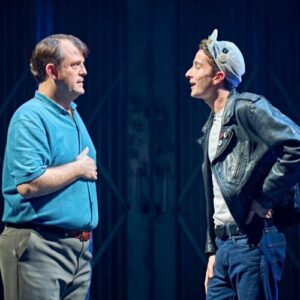
Matthew Woodyatt and Ryan Kopel in Pride The Musical at the Bridge Theatre, London. Picture: Manuel Harlan
Pride The Musical continues at the Bridge Theatre, London until 8 May 2027.
Star rating: five stars ★ ★ ★ ★ ★
There is something almost inevitable about Pride The Musical becoming a musical. The extraordinary true story of Lesbians and Gays Support the Miners (LGSM), the group of gay and lesbian activists who rallied to support striking miners in South Wales during the 1984-85 miners’ strike, already has all the ingredients of great musical theatre: unlikely alliances, larger-than-life personalities, political confrontation, romance, humour, tragedy and, ultimately, the triumph of solidarity.
Yet Stephen Beresford’s stage adaptation of his own 2014 film – transferred to the Bridge from the National Theatre – turns out to be considerably more than a successful transfer from screen to stage. In fact, I found it even more satisfying than the film, not least because it allows the characters to step outside the immediate events and tell us what became of them. That knowledge of the future gives the story an additional emotional dimension, particularly when the subject turns to the AIDS epidemic and the devastating losses that followed.
It is difficult not to think of Billy Elliot when watching Pride. Both are rooted in the industrial and political upheavals of 1980s Britain, both draw much of their emotional power from Britain’s mining communities, and both explore the tension between individual freedom and the expectations imposed by family, society and political authority.
But where Billy Elliot uses the miners’ strike as the backdrop to a personal coming-of-age story, Pride puts collective action at its heart. Its protagonists discover that their struggles are not so different after all, and that solidarity can emerge from the most unlikely encounters. What makes the musical particularly compelling is its refusal to turn that solidarity into an easy, uncomplicated feel-good message. The story is about resistance and protest, certainly, but also about hope in the face of despair.
The stage version is also considerably more forthright about the politics of Mark Ashton, the young activist who co-founded LGSM. The film, perhaps wary of alienating a mainstream or American audience, largely played down his Communist Party of Great Britain membership and his position as general secretary of the Young Communist League.
The musical restores this essential part of his identity. Ashton is not simply a charismatic young gay man who happens to become involved in a miners’ dispute: his Marxist convictions are central to his understanding of social injustice and the need for organised resistance. It makes the story more historically grounded and gives the alliance between the two communities a stronger ideological foundation. It is a welcome reminder that the movement was not simply about tolerance and acceptance, but also about challenging the economic and political structures that perpetuated inequality.
Developed and directed by Matthew Warchus, who also directed the original film, the production has a strong sense of theatrical identity. Beresford, meanwhile, demonstrates that he understands these characters well enough to let them grow beyond their cinematic origins.
The original score, by Christopher Nightingale, Josh Cohen and DJ Walde, draws on pop, rock and disco while making particularly effective use of Welsh choral traditions. Rather than merely re-creating the sounds of the period, the composers give the music a broader emotional vocabulary. Among the highlights is ‘Light Perpetual’, its hymn-like resonance, inspired by the Christian requiem phrase lux perpetua, blending beautifully with the Welsh choral character of the score. It is a particularly affecting piece, combining a sense of communal remembrance with something approaching spiritual consolation.
Act I has its pleasures, not least the infectious ‘I Miss Disco’, but the musical really hits its stride in the Act II opener ‘You Might as Well Live’, an absolute showstopper and a pure showbiz number, kickline and all, while ‘Make It Pink’ provides another welcome burst of theatrical exuberance.
‘Face It, Mum’, meanwhile, is an exceptionally effective 11 o’clock number, bringing considerable emotional force to the personal conflicts that run alongside the wider political narrative. Act II is the stronger of the two, partly because it allows the characters’ individual stories to come to the fore without losing sight of the larger struggle. The balance between entertainment and seriousness is particularly well judged: the show can be exuberant, funny and gloriously theatrical, but it never uses those qualities to evade the darker realities of its subject.
And it is here that Pride deserves particular credit. The AIDS crisis and the despair it brought to an already vulnerable community are not treated as incidental background or hurriedly acknowledged before the show returns to happier territory. The musical confronts the illness, the losses and the uncertainty directly. It is painful but necessary.
There is something especially moving about seeing these characters not simply as the young activists of 1984, but as people whose lives continued long after the events that brought them together. The pleasure of being told what happened to them is inseparable from the sadness of knowing what so many of them endured.
Ryan Kopel gives Mark Ashton the political conviction and youthful determination that the film only hinted at. His portrayal brings the activist’s idealism and impatience into focus, making clear that the campaign is driven by deeply held political beliefs as much as personal solidarity.
Michael Larcombe, as Jonathan Blake, provides a compelling counterpoint. His performance brings warmth, humour and vulnerability to a character whose experience makes the AIDS crisis particularly tangible. There is something especially poignant about Jonathan’s journey when we remember that the real-life Blake, one of the first people in Britain to be diagnosed with AIDS, is still alive today, although at the time his days seemed numbered.
Kirsty Malpass is particularly engaging as Hefina, the formidable Welsh activist whose initial suspicion gradually gives way to friendship and solidarity, while Gillian Elisa brings considerable personality to Gwen. Matthew Durkan’s Mike Jackson and Chris Jenkins’ Gethin also contribute to the ensemble’s sense of camaraderie, helping to make the relationship between the London activists and the Welsh community feel genuinely lived-in.
The choreography from Lizzi Gee brings welcome energy to the musical numbers, while Bunny Christie’s set and costume designs provide an adaptable theatrical environment in which the political meetings, social gatherings and more intimate moments can unfold without losing their connection to the larger story. Warchus keeps the action moving, allowing the ensemble to become an integral part of the storytelling rather than simply providing a succession of musical interludes.
There is a particular pleasure in seeing a story that could so easily have been softened into a conventional celebration of tolerance retain its political edge. Pride understands that solidarity is not a sentimental abstraction: it requires people to overcome prejudice, make uncomfortable alliances and stand up for others, even when doing so carries a personal cost. It also understands that political victories do not erase suffering, and that remembering those who did not survive is part of celebrating those who did.
More than a decade after the film first brought this remarkable story to a wider audience, the musical gives it a new and, in many ways, more powerful life. Its combination of political conviction, emotional honesty, infectious theatricality and sheer human warmth makes it a deeply satisfying evening. Above all, it leaves us with a message that feels as urgent now as it did in 1984: solidarity matters, resistance matters, and, whatever happens, we must just keep living, singing and dancing.
Patrick Honoré
SHARE THIS POST:




Comments are closed.