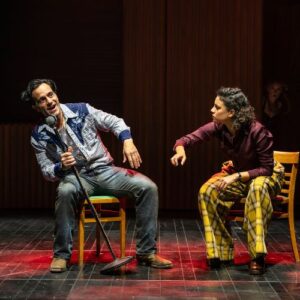
Ramin Karimloo and Anoushka Lucas in A Face in the Crowd at the Young Vic Theatre, London. Picture: Ellie Kurttz
A Face in the Crowd continues at the Young Vic Theatre, London until 9 November 2024.
Star rating: four stars ★ ★ ★ ★ ✩
Politics as entertainment. Celebrity trumping competence and decency. The fine line between American patriotism and bigotry. It’s not hard to see why playwright Sarah Ruhl, songwriter Elvis Costello, and the Young Vic have chosen this moment to stage-musicalise the classic 1957 Budd Schulberg satirical film, A Face in the Crowd.
Small town radio producer Marcia Jeffries (Anoushka Lucas) is determined to put the stories of real people on the airwaves, and by luck stumbles upon a stunningly charismatic drifter who calls himself “Lonesome Rhodes” (Ramin Karimloo). This man’s undeniable charm seduces the entire community, and eventually the country as he is given his own national television show.
As Lonesome’s fame grows, his message shifts from an amiable understanding of humankind to cynical commercialism, questionable political endorsements, and eventually outright fascist sentiment. As Marcia sees the public being swayed by this monster she helped create, she wrestles with her success, her guilt, and her unshakeable romantic longing for Lonesome.
At two hours, 35 minutes (including interval), this show is on the longer end of new musicals, but it perhaps could have been longer. Marcia disappears from much of the plot in Act II, though she is well fleshed-out compared to the movie and is given some touching ballads expounding her mental turmoil. In comparison, Lonesome himself is massively under-explored. Sure, he is onstage for the majority of the piece, but we are given little insight into his motivations or his thought process.
He is set up with an alcohol and pill addiction that doesn’t really have any consequence to the story. There are hints that his reactionary politics may have a basis in cynicism and opportunism rather than heartfelt belief, but without a glimpse into this character’s psyche, the audience is kept at a distance, unable to build empathy with a man otherwise so fascinating. As a result, Lonesome’s story sometimes feels more like a series of things that happen, rather than a sequence of mutually consequential events.
As a fan of Elvis Costello, I was excited for the score, with a side of the trepidation one feels when a new production employs a pop star rather than a musical theatre composer. There are a few aspects that might betray the songs’ non-theatrical origins – some questionable rhymes, some repetitious endings, and some endings that come long before the song has had a chance to develop – but for the most part, I greatly enjoyed this score. Musical director Phil Bateman’s band – which sometimes appears onstage, and arguably should stay there – is fantastic throughout, and the arrangements are distinctive and frequently moving.
Harmonically and melodically distinct from a lot of new musical theatre writing, Costello’s songs ably pastiche a wide tranche of classic Americana, from gospel, to rock ‘n’ roll, to surf. He even supplements the dawn-of-TV vibe with countless catchy advertising jingles for everything from toothpaste to mattresses. Even if you have no great fondness for Costello and are sceptical of him writing for musical theatre, I think you will find plenty to like here.
This embrace of Americana is where the piece shines. Though it could be argued that the story and pacing have room for improvement, I don’t think I would change a single thing about the rest for fear of spoiling the fantastic atmosphere of it all.
Director Kwame Kwei-Armah – in his final production as artistic director of the Young Vic – has absolutely nailed the feeling of a small southern American town: the friendly wholesomeness that grows more sinister the longer you stare at it. By the time Lonesome is leading the cast in a song extolling the importance of good ol’ American ‘Blood and Hot Sauce’ over anything foreign, the piece is virtually Cabaret with BBQ. Jackie Shemesh’s lighting and Anna Fleischle’s set are sophisticated and lush, taking us and Lonesome himself from a small-town jail to a big city penthouse seamlessly.
The performances are universally outstanding. Karimloo is given the impossible task of being simultaneously a shifty drifter, a borderline fascist, and the most charming man you have ever seen. Somehow, with his West End megastar slickness and exceptional voice, he excels. After the play concludes with its message of being wary of charismatic cult leaders, this entire audience would have followed him out onto the street and done whatever he said. This man is too powerful. Something must be done.
Maybe that something is the stabilising force of Lucas. Where many other actors would seem diminished in comparison with Karimloo’s performance, Lucas shines in a different but just as impressive way. She adds layers of nuance to a character that could easily be pure good, or pure bad, or a stereotypical 1950s film trope of a silly woman in love with a questionable man. Instead, through her stunning vocal stylings, and even more so through her acting, we see her struggle between her good intentions, her understandable feelings of affection for Lonesome, and the compromises she makes while seduced by fame and fortune.
Elsewhere, Lucas’ Oklahoma! co-star Stavros Demetraki brings perfect comedy and seediness to big-time TV agent Joey DePalma, Olly Dobson adds far more interest to ‘nice guy’ writer Mel Miller than may be there on the page, and newcomer Emily Florence exhibits remarkable talent in her delightful portrayal of baton-twirler turned TV wife Betty Lou. A real treat among the ensemble is the trio of Sadie-Jean Shirley, Vicki Lee Taylor and Annie Wensak, who appear throughout to sing advertisement jingles and generally add joy to any scene which they grace.
There are creases to be ironed for sure, but A Face in the Crowd is still one to see. Intellectually, there might be more obvious issues than average here, but there is a great deal more good too. I had such a wonderful time with its charming Americana and knockout performances that I can’t imagine how superb this piece will eventually become. It may not be quite there as a great satire or a great drama, but nonetheless it is still a great show and well worth the trip south of the river.
Ian Bowkett
SHARE THIS POST:


Comments are closed.