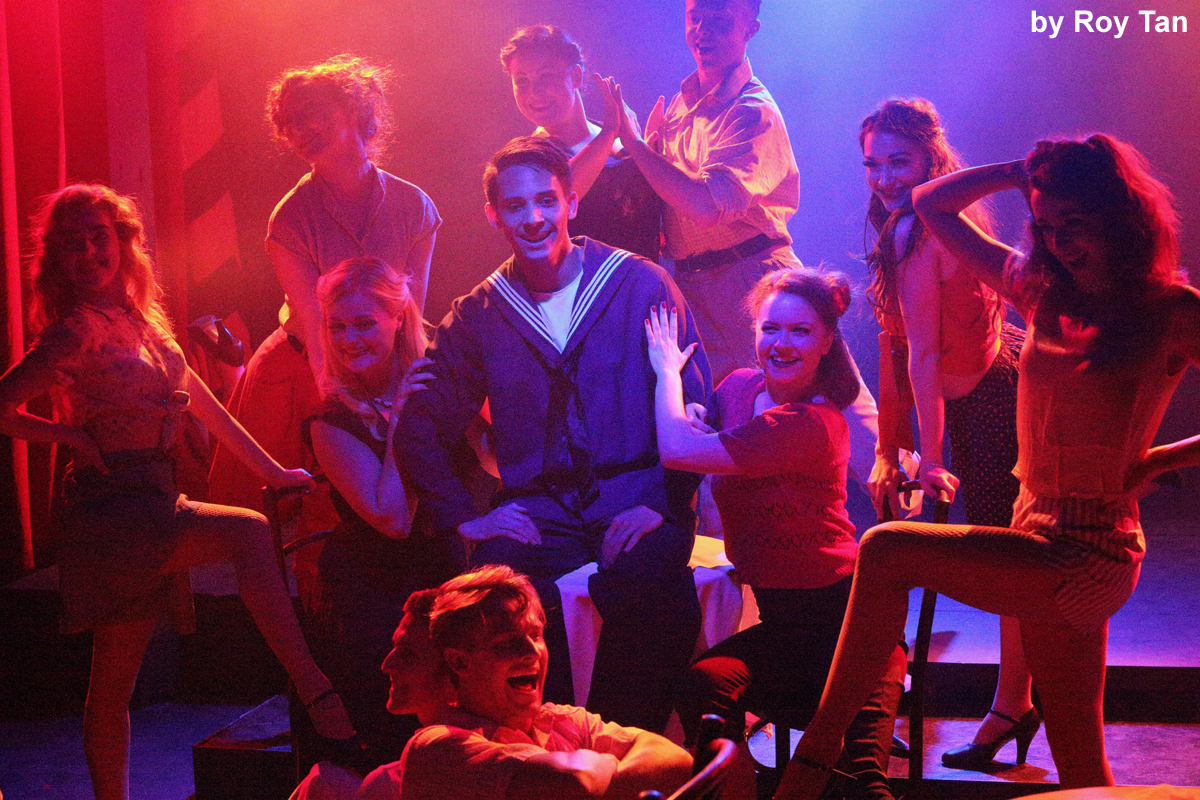
Ace of Clubs at the Union Theatre, London. Picture: Roy Tan
Ace of Clubs continues at the Union Theatre, London until 31 May.
The titular Ace of Clubs in Noel Coward’s 1950 musical is a gritty Soho dive ripe with busty showgirls and patronised by gangsters and sailors – a long way from the genteel country house settings of Coward’s more popular pre-war shows. Could this have contributed to the musical’s tepid reaction when it was first staged (with a cast that included June Whitfield and saw Coward booed at the curtain)? Perhaps. But whatever the reason, the show has gone largely unproduced since its debut, and is only now enjoying a revival at the Union Theatre, directed by Jack Thorpe-Baker.
Like many of the recent ‘forgotten musicals’ keeping London’s fringe theatre busy – such as Novello’s Valley of Song (Finborough) and Lane and Harburg’s Finian’s Rainbow (Union and Charing Cross) – Ace of Clubs is a dated period piece. Even at the show’s premiere, changing post-war palates, adapting to more sophisticated tastes such as Oklahoma! and Guys and Dolls, found Coward’s work unfashionable, and as much as it mirrored the likes of Guys and Dolls in terms of setting and sass, Ace of Clubs fell short of the mark.
But don’t let this put you off. Thorpe-Baker’s revival is a charming experience, and a rare chance to see Coward staged in an immersive and totally apt cabaret setting. With the help of a few dozen tables and chairs, the Union is transformed into the Ace of Clubs, and the action takes place in and around the punters. Enjoy, as I did, a bottle of wine during the show, and it feels like you’re part of the action, sitting cheek by jowl with hoodlums and tarts.
It comes as no surprise to read in the programme notes that Thorpe-Baker – who makes his directorial debut at the Union with the show – comes from a dance background, being an alumnus of the English National Ballet School. The show’s wonderful choreography, however, is credited to Mark Smith (of Deaf Men Dancing fame, and the opening ceremony of the London Paralympic Games). From the outset, the dancing plays a major role in the production, and is probably the most noteworthy element of the evening.
The cast is largely populated with dancers who can act and actors who can sing, meaning that the vocals take second or third billing. It doesn’t help that no one’s mic’d up, and on the whole the cast struggle to project their voices. There’s no real power in any of the leads – perhaps other than Lucy May Barker as the busty Baby Belgrave, who delivers the saucy ‘Would You Like to Stick a Pin in My Balloon?’, and Kate Milner Evans, excellent as the fag-ash club owner Rita.
Principals Emma Harris (the club’s star turn, Pinkie Leroy) and Gary Wood (sailor-boy love interest Harry Hornby) give likeable performances – Harris’ plummy RP and 1950s look, reminiscent of Celia Johnson, is perfect for the role, and Wood gets the chance to demonstrate his impressive dance skills, particularly in a sparkling tap routine in Act II. Hats off, too, to John Game’s (non-singing) gangster ‘Smiling’ Joe Snyder – the best actor of the night – and the surely Coward-inspired Michael Hobbs as Ace of Clubs MC Felix Felton, whose comical improvisations add sophistication and personality.
Wedged in stage left is Gemma Hawkins’ four-piece band of piano, accordion, violin and percussion – featuring a stellar performance from the vibraphone player in a couple of numbers. Because the show takes place in a club, the musicians are the house band. This, indeed, is the joy of the show: its nightclub setting, combined with designer William Fricker’s cabaret seating, is a wonderful conceit, with the action often taking part in the midst of the audience as the ‘show’ carries on silently on the stage area.
Ace of Clubs is a good-natured, frothy romp that’s augmented immeasurably by its cabaret setting. These aren’t the best of Coward’s songs – perhaps only ‘Sail Away’ is instantly recognisable, and his ‘London Pride’ song of 1941 is tacked on at the end as something of an encore – and I would have preferred some kind of amplification to give the singers more power and presence. But I really enjoyed settling down to a non-taxing evening of frivolity and fun. Like Finian’s Rainbow and Valley of Song, there’s a good chance you won’t be seeing this show for many a year to come, so don’t miss the opportunity to indulge while you can.
Craig Glenday
SHARE THIS POST:





Comments are closed.