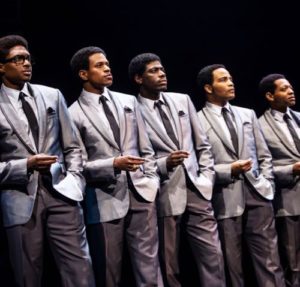
Ephraim Sykes, Jeremy Pope, Jawan M. Jackson, James-Harkness and Derrick Baskin in Ain’t Too Proud – The Life and Times of The Temptations at the Imperial Theatre, New York. Picture: Matthew Murphy
Ain’t Too Proud – The Life and Times of The Temptations continues at the Imperial Theatre, New York.
Star rating: five stars ★ ★ ★ ★ ★
Director Des McAnuff and choreographer Sergio Trujillo know how to put together a biographical jukebox musical: the smash Jersey Boys, the not-as-smashing but still entertaining Summer: The Donna Summer Musical.
And now they’re back in top form with Ain’t Too Proud – The Life and Times of The Temptations. This recounting of the quintet’s climb to the top of the pop music world and the backstage drama that accompanied it is not just well-tooled entertainment, it’s a brilliantly-tooled entertainment, bursting with explosive onstage talent, fortified with Olympian stamina.
Much of The Temptations’ catalogue, plus a few songs from other groups of the time, are crammed craftily into the show’s approximate two and a half hours (plus intermission). The programme lists 31 song titles. Sometimes they are woven into the narrative, sometimes they stand alone in full performance presentation. They range from the bright ‘My Girl’, their first big hit, to the sombre and complex ‘Papa Was a Rollin’ Stone’, their last chart-topping number.
You don’t have to be a dyed-in-the-wool Temptations fan to want to start gyrating in your seat when such songs as ‘Ain’t Too Proud to Beg’, ‘The Way You Do the Things You Do’, ‘Cloud Nine’ and ‘I Can’t Get Next to You’ come scintillating from the stage with Harold Wheeler’s pulsating orchestrations and music director Kenny Seymour’s arrangements.
The script by noted playwright Dominique Morisseau unspools in familiar style, with Otis Williams, the group’s founder and top man, serving as narrator. It’s based on the book entitled The Temptations by Otis Williams, and while it never quite escapes the feeling that we’re being conscientiously and chronologically fed a checklist of narrative points, it’s a fairly compelling story that goes deeper and darker than Jersey Boys.
Members of the group come and go, stresses build on the “brotherhood” that the music and the performing together form, as clashes of ego, personal demons and health issues take their toll. They have to overcome racism, most particularly as they travel though the Southern United States in their attempt to build crossover status for their music, while the anti-Vietnam War movement adds even more fervour to the times.
“Between 1963 and today, there have been 24 Temptations”, Williams tells us as his tale nears its end. The show, of course, doesn’t cover all of them. The show’s most central personalities are those five that were Temptations pretty much at the beginning, when Williams, a young transplant from the South, put together the group in Detroit.
Williams holds the stage continuously and easily, as a sensitive, smart and totally engaging persona in the performance of Derrick Baskin. He does an epic job, moving without strain from direct address to the audience into scene work and propulsive musical numbers. The other four include Melvin Franklin (Jawan M. Jackson), the group’s easy-going bass; Eddie Kendricks (Jeremy Pope), the sometimes contrary falsetto; David Ruffin (Ephraim Sykes), the dynamic but unpredictable personality that early in the game replaced the group’s lead singer; and Paul Williams (James Harkness), not related to Otis, a steadfast guy who we see developing the group’s moves. The performers are all terrific, whether working in sync or taking a solo or lead spotlight.
There are also outstanding turns throughout the ensemble. Among them, Jahi Kearse exudes unyielding authority as Berry Gordy, the Motown head, while Rashidra Scott piques our sympathy as Otis Williams’ neglected wife.
Melding impressively into the proceedings are Jarvis B. Manning Jr., as the original lead singer, and Saint Aubyn, E. Clayton Cornelious and Christian Thompson as various Temptation replacements.
Candice Marie Woods as Diana Ross, along with Nasia Thomas and Taylor Symone Jackson, make some razzle-dazzle appearances as The Supremes, who are The Temptations’ chief competitors for fame at Motown Records. Their sparkly gowns, by the way, are the high-points of Paul Tazewell’s costumes, dominated by the sleek tailored clothes for the performing Temptations.
McAnuff’s staging is masterful in setting intimate scenes in the wide-open look of Robert Brill’s handsome set, constantly intimating a sense of forward movement, and in seamlessly interpolating the plentitude of musical numbers. And the numbers exponentially heighten the excitement with great singing and Trujillo’s choreography, which finds endless variations in the synchronised movement that was almost as much a reason for The Temptations’ success as the vocals.
As Otis Williams tell us, right before the rousing finale, enumerating the reasons for The Temptations’ success: “A little bit of funk. A lotta love. A well of soul. And some of the smoothest moves ever known to five men and a mic.”
Ron Cohen
SHARE THIS POST:


Comments are closed.