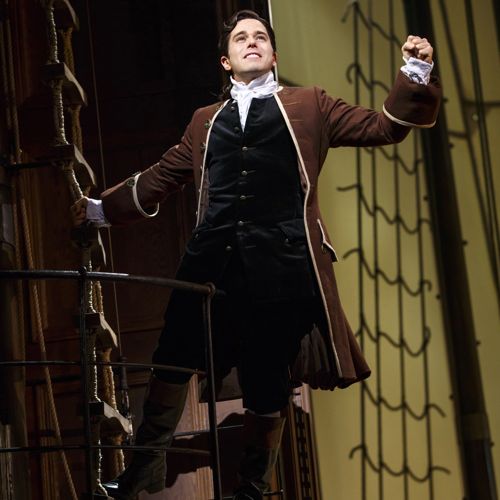
Josh Young in Amazing Grace at the Nederlander Theatre, New York. Picture: Joan Marcus
Amazing Grace continues at the Nederlander Theatre, New York.
Star rating: three stars ★ ★ ★
The first musical of the new Broadway season has come to the Great White Way in an improbable state of grace. The show, appropriately entitled Amazing Grace, centres on the early adult years of John Newton, a reformed English slave trader who became a force for the abolition of slavery in Great Britain in the 1700s. He also became an Anglican clergyman and a prolific hymn writer; his works include, as I’m sure you know or have already guessed, the enduring ‘Amazing Grace’.
The show, which played in Chicago last year, represents the first professional writing of a fellow named Christopher Smith. As his programme bio tells us, Smith is: “the concept creator, composer, lyricist and co-author [with playwright Arthur Giron] of the book. Chris has been composing music since his teens and is entirely self-taught. The show was born while he was working as a police officer and youth outreach and education director in Montgomery County, Pennsylvania,” a suburban area near Philadelphia. A page in the programme is devoted to thanking a list of some 55 people who “were moved and inspired by this story” and made “early investments”.
The piece that they have invested in is an elaborate but not always enthralling production that packs a lot of plot and quasi-operatic music into its two and a half hours. But most of all, it is a show that fairly throbs with good intentions, as it graphically depicts the horrors of slave-trading. With some vivid staging from director Gabriel Barre and dedicated ensemble work from the cast, we see the captured Africans deprived of their humanity, transported in cages, sold on auction blocks and mercilessly branded by their owners.
All this is woven into the story of Newton, who enters manhood as a loose cannon, drinking and embittered by the early death of his mother and chafing under the yoke of his domineering father, the owner of a slave-trading empire. When we first see him he is returning to his hometown of Chatham from a stint at sea as a crewman, having left school to sign on. He is greeted on the dock by his long-time girlfriend Mary and his angry father. And as things quickly develop, his father is abruptly called away and young Newton takes over a scheduled slave auction, determined to show he can make more money at it than his father. The auction is stopped, however, by an attack from underground abolitionists, who inspire Mary to join their ranks.
Events continue to move at a heady pace, as Newton is impressed into Royal Navy service, his ship is sunk by the French, he is captured in Africa by slave traders and manages to join them in their work. But not for long. He’s rescued by his father and then survives a hurricane on the ship taking him home, and it’s that event that finally leads him to see the error of his ways. As Newton sings: “And the man that I was/I cast upon the fury of the seas/Let the wind and the waves/Wash away the fool I used to be…”
And as if all this weren’t enough story, the book keeps shifting back to Chatham, where Mary, while secretly working with abolitionists, keeps trying to fend off the attentions of the chronically obnoxious Major Gray, who oversees things at Chatham. The bouncing back and forth between Newton’s Ben Hur-like adventures (everything but a chariot race) and the Sigmund Romberg-operetta like-travails of Mary tend to dissipate the storytelling.
On top of this, the score often seems to stop things dead in their tracks, as characters agonise in song over their emotions. The music displays Andrew Lloyd Webber-type ambitions, but with few of the inspired snatches of melody that can keep a Lloyd Webber song etched in your brain. On occasion, Joseph Church’s throbbing orchestrations lend the score an action movie urgency. However, the show’s most engrossing moments tend to come when the music stops, as in Newton’s climactic confrontation with the slave who has acted as his serving man since childhood. Musically, the most elevating moment comes in the rich rendition of the title hymn sung by the entire company as the finale and then repeated after the curtain call.
In the demanding role of John Newton, Josh Young gives an absolutely heroic performance, brawling, bruising, whipping and being whipped, and nimbly climbing every now and then the ship riggings that inhabit the scenic design by Eugene Lee and Edward Pierce. Young does this all this frequently accompanied by a hefty amount of singing in a strong and vibrant tenor. Erin Mackey’s Mary is imbued with an impressively fluid soprano along with a sturdy determination to do good, and Tom Hewitt is gruff but paternally concerned as John‘s father.
Chuck Cooper delivers a powerful turn as John’s devoted serving man, and Laiona Michelle, as Mary’s protective house slave, has an impressive moment in which she urges Mary to continue her abolition work, with an African-inflected song of courage. Harriett D. Foy is ferociously haughty as an African princes in cahoots with the slave traders, and Chris Hoch is smugly repellant as Major Gray.
In a programme note from the show’s authors and creators, they tell us that: “with this work, we hope to recognise and honour all of the victims of slavery, both through the ages and alive today, as well as the new generation of abolitionists that has arisen to join their forefathers in standing up for the life, freedom and dignity of all people.” Perhaps, it was simply too tall an order for its novice creator to accomplish with complete grace.
Ron Cohen
SHARE THIS POST:



Comments are closed.