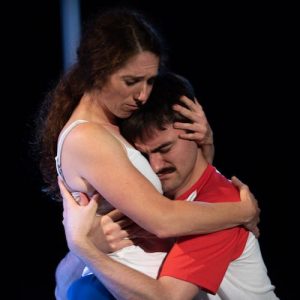
Picture: Thomas Scurr
Baby continues at the Drayton Arms Theatre, London until 9 November 2018.
Star rating: two stars ★ ★ ✩ ✩ ✩
The musical theatre composing duo Maltby and Shire are best known for the 1989 revue Closer Than Ever, a song cycle with looks at all stages of love and romance. The composers described that show as a “bookless book musical”, which may prompt to wonder why they chose to abandon a book. One look at their earlier Broadway musical, Baby, may provide an explanation.
Sybille Pearson’s book introduces us to the stories of three couples who have very different pregnancy-related experiences. Danny and Lizzie are students who were taking precautions; Alan and Arlene are an older couple facing unexpected parenthood again after their three daughters have grown up and left the family home; and Pam and Nick are desperately trying to conceive.
The concept of multiple families crossing paths due to a shared experience is not without its merits. The TV writer Kay Mellor, among others, makes a virtue of such a setup (although her Fat Friends worked rather better on screen than it did on stage). But a successful ensemble drama, be it on television or in theatre, needs to have more than one character trait per couple, and this is where Pearson fails.
Potentially the most interesting of the three stories is that of Laurel Dougall’s Pam, whose desire to become a mother is being thwarted by biology. This is the storyline with the most potential for wide-ranging emotion, and both Dougall and Stuart Scott, as her husband, do their best to accentuate the script’s highs and lows.
The principal problem is that there seems little in the way of original thought in their story. The touchpoint in Pearson’s script must have seemed rote in 1983; 35 years later, there is nothing that hasn’t been done better in the intervening years. Even Ben Elton’s awful 2000 film Maybe Baby managed to find more humour in the reduction of sex to a series of mechanical experiments designed to wring out the greatest possible chance of conception.
That said, here and elsewhere, David Shire’s music and Richard Maltby, Jr’s lyrics do rise above the script that surrounds them. Those same rules about how to conceive are deftly satirised in the ironic ‘Romance’, for example. But that cannot escape some of the sexist clichés around Pam and Nick’s woes: a woman who cannot conceive is a shame, it suggests, but a man’s infertility is nothing short of an existential crisis.
Similarly, the story of Barbara Jaeson and Christopher Lyne’s older couple, Arlene and Alan, faced with the prospect of their empty nest being refilled, has dramatic potential. And initially, the discussions about whether they are willing to abandon their plans of growing old disgracefully and once again become parents hints at a story that could be mined for some interesting inner conflicts.
Again, though, there is little in the book to sustain interest in their story. And as an Act II climax to Arlene’s troubled pregnancy forces the couple to appreciate that their children may have been the only thing keeping them together, so too the audience realises that there is little in the way of interest to them besides being plot devices.
It is perhaps ironic that the least interesting couple, Danny Whelan’s Danny and Holli Paige Farr’s Lizzie, get the best songs (it may not be unrelated that Danny is an aspiring musician, always a sign that composers like characters more). Their Act I duet ‘I Chose Right’ is the romantic highlight of the whole show.
And opening Act II, Farr and the female members of the show’s ensemble perform a sweetly comic number, ‘The Ladies Singing Their Song’, about all the unwanted advice and attention mum-to-be Lizzie receives from other women.
Generally, though, it is hard to comprehend how this show ever reached Broadway, let alone got nominated for seven Tony Awards. The scale of this Fringe theatre production is definitely more fitting to the show’s intimate intent: but perhaps this cast and production team could have found better source material towards which to devote their time.
Scott Matthewman
SHARE THIS POST:


Comments are closed.