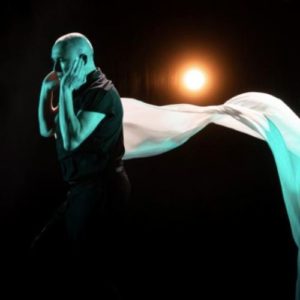
 Before continues at Dance Base, Edinburgh until 25 August 2019.
Star rating: four stars ★ ★ ★ ★ ✩
Once in a while, a performance blows you away so heavily that you’re almost tempted to overlook the flaws in the production. Alas, we must remove our tinted glasses and properly examine this strange and beguiling show.
We’re about to spend the afternoon with Pontius (Pat Kinevane). He’s wandering round Cleary’s department store on the day he is to meet his estranged daughter. After nearly 20 years apart, he’s not sure what gift to buy her and his mind turns to reminiscence of other formative moments in his life.
Of course, nothing is ever as it seems. Pontius hates musicals, for example, but he can’t stop himself bursting into a song and dance routine (any musical theatre afficionado can’t help but leave smugger than before, picking up on the barrage of sly references). The store tannoy sings of offers, but soon begins to go off-script.
This is the tale of a man trying desperately to hang on to his humanity through unimaginable ordeal – and where Kinevane really shines is in his connection to both the pain and the humanity, and his willingness to transmit that vulnerability within him. And there is no doubt that he plays it masterfully. From light quip to throaty roar of agony, it’s a rare privilege to watch.
Neither to be underestimated, is Jim Culleton’s silky direction – an understated hand which keeps us guessing – and sanctions a playful space for Pontius to exist within.
Emma O Kane, too, presents visceral, angular choreography, referencing Fosse, Kelly, Robbins, to name a few, though the musical numbers don’t quite feel settled into the greater narrative. They make sense but they don’t move the show forward, remaining an easy-listen, and as such, O’Kane hasn’t much to truly get her teeth into.
Denis Clohessy does an admirable job with the music, but again, without much to connect the music back to Pontius’ journey, he remains in limbo – beautifully mimicing the Golden Age Hollywood genre, but not evolving it. Our climactic duet, therefore, is doomed to be disappointing.
Ultimately, the greatest flaw lies in the book. It feels like the clarity of vision has been lost somewhere along the way. Adversaries remain suspiciously one-dimensional; biblical references which feel critical, remain under-developed, and the core conflict feels like more of an afterthought than it should.
Nevertheless there’s an agonising and important story being told. It’s a beautiful vehicle for Kinevane – and benefits from all the good things about writing your own dialogue. It feels organic and full of that disarming wit you can only really expect from an authentic voice. Well worth seeing.
Aura Simon
SHARE THIS POST:


Comments are closed.