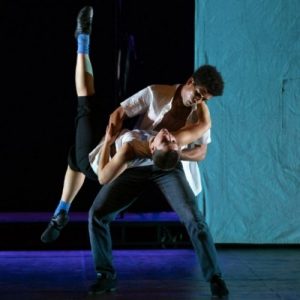
Melina Sofocleous and Stephen Quildan in West Side Story Symphonic Dances at the Grand Theatre, Leeds and Touring. Picture: Richard H Smith
Bernstein Double Bill (Trouble in Tahiti/West Side Story Symphonic Dances), presented by Opera North, continues at the Grand Theatre, Leeds until 30 October 2021, before touring until 20 November.
Star rating: five stars ★ ★ ★ ★ ★
How nice of Mr Bernstein to have provided us with two such complementary pieces. Trouble in Tahiti portrays a frustrated couple fading into middle age; West Side Story depicts one of the first of many post-war tales of teen violence and angst. Both illustrate what used to be called ‘the human condition’.
In a particularly fecund period, Bernstein became the first American to conduct an opera at La Scala; wrote the music for the Marlon Brando vehicle On the Waterfront; the scores for On the Town and, of course, the incomparable West Side Story. At the same time, he was the only rival to Herbert von Karajan as the number one conductor in the world.
Trouble in Tahiti falls within this period (1952), but in many ways has been swamped by the magnitude of all those other achievements.
Covering the events of a single day, Trouble in Tahiti observes the classical unities of time, place and manner, and riffs on the same themes as Thornton Wilder’s Our Town (1938): love and companionship, failures of communication and complacency that lead to the under-valuing of what we have until it is too late.
The couple, Sam and Dinah, awake to their loveless marriage. The piece is usually played with minimal sets but Opera North goes for credible plastic fittings for the kitchen (designer Charles Edwards) and Opera North favourite, Quirijn de Lang as Sam, appears to have taken time off from the set of Mad Men.
Sandra Piques Eddy as his wife, Dinah, is also well served by the costume department (designer Hannah Clark) but, good as she looks, it is the range, clarity and subtlety of her mezzo-soprano voice that does justice to Bernstein’s music and lyrics. Her singing of the aria ‘There is a Garden’ evokes that quality of silence in the audience that happens only when they know they are in the presence of something very special.
The whole piece is a mere 40 minutes long and Bernstein displays that talent for melody that served him so well in West Side Story.
The Symphonic Dances use most of the best tunes from the stage and film musical, but rearrange them to open up different narratives.
The original choreography for the Symphonic Dances of 1961 was prepared by Sid Ramin and Irwin Kostal, but here Phoenix’s own Dane Hurst is in charge of the ensemble. He has much to contend with, given the iconic stature of the Jerome Robbins choreography for the film: moves that are surely etched into the memories of most in the audience.
In the event, he does a wonderful job demanding subtlety, athleticism and power from his dancers. At dizzying speed they change partners and exploite the minimal set (Edwards and Hyro) with a smooth efficiency.
The two halves are bonded by a ten-minute short from Phoenix Dance reflecting the words of poet Khadijah Ibrahim.
The Orchestra of Opera North plays splendidly through all three pieces and seems to relish the complex, jazzy demands of Bernstein’s music in the Symphonic Dances. The brass section, in particular, gives an excellent account of themselves. At the curtain, conductor Antony Hermus bows to the enthusiastic audience, cheers ringing in his ears.
After the equivocal reception to the recent Carmen, it is good to see Opera North back at the top of its game.
Mike Tilling
SHARE THIS POST:


Comments are closed.