Picture: Leanne Dixon
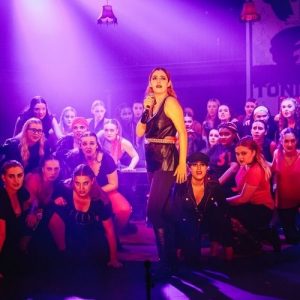
Cabaret Macabre at the Bridewell Theatre, London.
Anybody who has seen the musical Six, in which the wives of Henry VIII sing about the hands they were dealt and attempt to reclaim their own narrative, will recognise its genes in British Youth Music Theatre’s Cabaret Macabre.
Director and book writer Jessica Walker and composer Joe Atkins set their revue in Joan’s Place, a Weimar era-style cabaret club run by Joan of Arc in which many female and non-binary characters from history can sing about their lives.
Quite why the Maid of Orleans might have made such a post-death career change is something of a mystery, and one which British Youth Music Theatre’s cabaret evening never quite solves. As Joan, Olivia Spillane makes for a beguiling Emcee, although whatever plans the character may have for the evening seem often to be derailed by her guests, several of whom seem to want to tell their story on their own terms rather than Joan’s.
With 30 characters to deal with in the same time that Toby Marlow and Lucy Moss’ West End antecedent has to concentrate on one-fifth their number, several group numbers are required. One, centred around Abbey Jobson’s Alice Nutter and other women from history accused of being witches, hints at their deaths being the fault of a fear-driven patriarchy, and indeed the unjustness of many characters’ life, and death, does seem to be a common thread.
One area where it can be judged a complete success is in showcasing thirty young performers, and in terms of BYMT’s goals that is the one that matters
Sometimes, this thread pulls together a series of seemingly disparate women from history. One would not normally think of grouping naturalist Dian Fossey (Betsabe Valez) with Goth teenager Sophie Lancaster (Isabelle Tarran), for example, much less give the group they’re in a foot-stomping, uptempo blues number, even if it does end up being one of the best songs in Atkins’ catalogue and meriting a worthy reprise at the end.
Lest one think an evening of stories about women and how they died as being too depressing, a sequence revolving around the life (and, yes, premature death) of dancer Isadora Duncan (Eleanor Meredith) provides the opportunity for a group Charleston number, appropriate to the era if not the dance style of the piece’s protagonist. Meredith emerges as one of the evening’s breakout performers, her Isadora performing impromptu dance breaks throughout – though quite why she should be, in death, a tap-dancing child with all the precociousness of a pre-teen Bonnie Langford character is quite anyone’s guess.
Elsewhere, other characters from history pop up, with First World War spy Mata Hari (Eleanor Grainger) meeting Isabella Endacott’s Noor Inayat Khan, and Philippa Bateman and Naomi Park providing contrasting visions of oppressive attention as Marilyn Monroe and Princess Diana.
Perhaps the most moving segment, though, is a sequence that memorialises a sequence of women murdered by men, brought up to date by the inclusion of Sarah Everard and Blessing Olusegun. Using names of women so recently murdered is uncomfortable, but deliberately so: one feels that we should perhaps retain that level of discomfort for some of the other victims of crime featured here, where instead the passage of time numbs us to their pain.
The disappointing thing is that the power of such a sentiment is undercut by Walker’s book trying to do too much, and as a result failing to hit home on any of the levels it aims for. One area where it can be judged a complete success is in showcasing thirty young performers, and in terms of BYMT’s goals that is the one that matters.
Scott Matthewman
SHARE THIS POST:


Comments are closed.