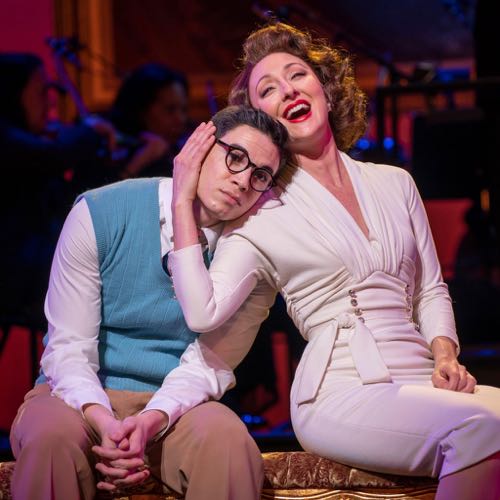
Call Me Madam played New York City Center’s Encores!
Star rating: four stars ★ ★ ★ ★ ✩
It’s hard to imagine New York City Center’s Encores! series lavishing more polish and affection on any show than it did on Call Me Madam, whose seven-performance run marked the start of the series’ 2019 season.
The production also carried a sense of occasion. The musical is only the second title in the history of the series to get a second mounting. Encores first staged the show in its second season back in 1995, and this new repeat was presented, as the Playbill told us, “in honour of New York City Center’s 75th Anniversary Season.”
Call Me Madam, which originally opened on Broadway in 1950, is certainly worthy of such a ceremonial spot. It has a wonderfully tune-laden score by Irving Berlin, with his genius for smart lyrics at its peak, stuffed into a brightly politically knowing satirical book by celebrated playwrights Howard Lindsay and Russell Crouse.
While still mounted under the rubric of a concert adaptation, the Encores offering – as has been its growing wont in recent years — was marked by high-stepping production numbers, trunkloads of costumes, attractive scenery ideas, 11 principals and 20 ensemble members, and not a script binder anywhere to be seen.
And then, of course, there was the 29-piece orchestra, conducted by Encores music director Rob Berman, lending a surprising richness to both Berlin’s silken romantic melodies and his infectious up-tempos.
Yet, despite all this, the show seemed a bit betrayed by time. It was like being served a gorgeous Jeroboam of champagne, resting in a gleaming silver ice bucket, and finding that it had been uncorked too long; the wine tastes a bit flat.
The script is a take-off on the 1950s political scene, namely the appointment of Washington society gal and party-giver extraordinaire Perle Mesta (called Sally Adams in the show) as ambassador to Luxembourg (renamed Lichtenburg).
There’s a lot of mittel-European chicanery and joking about America’s sudden global dominance after the Second World War and its cash-machine foreign policy at the time. And of course, both Sally Adams and her young press attaché, Kenneth, find romantic partners among the Lichtenburgers, Sally with the noble statesman Cosmo Constantine and Kenneth with the Princess Maria.
Back in 1950 all this was pulled together to provide a vehicle for Broadway powerhouse Ethel Merman, giving the lady a follow-up success to her blazing triumph in Berlin’s Annie Get Your Gun.
In this new Encores staging, Sally was played by Carmen Cusack, a formidable talent who garnered a Tony nomination for her 2016 Broadway debut in the short-lived Bright Star. Cusack’s vocal talents were her main strength here, sometimes veering away from the Merman register to give a shimmering head voice to the ballads ‘Marrying for Love’ and ‘The Best Thing for You’.
She also gave Sally a non-Merman country-western twang and down-home personality. The inflections are certainly consistent with Sally’s background. As she tells us in her great introductory song, ‘The Hostess with the Mostes’ on the Ball’, she was born “on a thousand acres of Oklahoma soil”. But the twang and good-ole-gal style softened the character and tended to blunt the jokes.
She was not the force of nature needed to blow away the dust from the script’s 1950s topicality, dutifully maintained in the “concert adaptation” credited to Bill Russell and Charles Repole. Similarly, director Casey Hushion’s staging of the book scenes found little to rev up the action beyond workmanlike. Even nostalgia can use some real tension and urgency.
Sally’s repeated phone conversations with President Harry Truman – with its buoyant “Hello, Harry” and her commiseration over the bad notices given his Margaret in her attempts to be a concert singer – did not gain in humour through repetitions. They just became repetitious. A couple of oblique references to the current state of US politics seemed more like obligatory catnip for the presumably liberal leanings of a New York theatre audience rather than an integral part of the dialogue.
Among others in the cast, Ben Davis, singing the show’s love song duets with Cusack in an impressively fluid baritone, gave us a taste of the gravitas but couldn’t quite unearth the admittedly hard-to-find charisma in the character of Cosmo.
Jason Gotay as Kenneth, however, did exude a likeable sincerity and held his own nicely in the show’s signature contrapuntal duet with Sally, ‘You’re Just in Love‘. He also made a credible romantic pairing with the overly kittenish Princess Maria of Lauren Worsham; their cavorting through ‘It’s a Lovely Day Today’ had an easy charm.
The casting also had a certain frisson in the cameo appearances of two well-appreciated television, performers, Carol Kane, long remembered for her work on the sitcom Taxi (which ended in 1983) and a host of later series as well, and Darrell Hammond, a former regular on the Saturday Night Live sketch comedy show. They came on late in the game as the comically accented Grand Duchess Sophie and the somewhat doddering Grand Duke Otto.
A sensation on the internet with his viral comic videos, Randy Rainbow seemed fairly innocuous as Cosmo’s political opponent. As a trio of US Senators, Adam Heller, Stanley Wayne Mathis and Brad Oscar tried hard with their outdated or familiar political jokes but fared better with a welcome sampling of old-time vaudeville shtick with their rendering of ‘They Like Ike,’ Berlin’s prescient homage to Dwight D. Eisenhower, who succeeded Truman as US President.
Many of the show’s livelier moments came with Denis Jones’ choreography in such well-danced production numbers as the ‘Washington Square Dance’ and ‘Something to Dance About’.
Time-tested combinations were freshened up with some jazzy interpolations, and it was fun to see the frolicking peasants at Lichtenburg’s annual festival lock arms in ‘The Ocarina’ number to form what looked like it was going to be a kick line and then watch them do lots of other idiosyncratic steps but hardly any kicking.
Since there wasn’t an Ethel Merman around, this was the kind of successful defiance of expectations this Call Me Madam could have used in greater supply.
Ron Cohen
SHARE THIS POST:


Comments are closed.