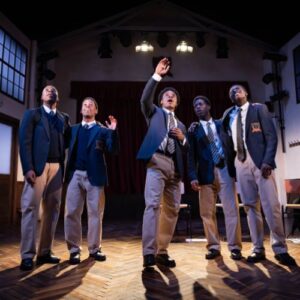
Rabi Kondé, Khalid Daley, Michael Ahomka-Lindsay, Freddie MacBruce and Terique Jarrett in Choir Boy at Stratford East, London. Picture: Mark Senior
Choir Boy continues at Stratford East, London until 25 April 2026.
Star rating: four stars ★ ★ ★ ★ ✩
We all carry with us a secret history, moments that can seem inconsequential for others but are monumental in our own mind. Nowhere is this more apparent than in the schoolboys of the Charles R Drew preparatory school, a historically Black boarding school at the heart of Tarell Alvin McCraney’s Choir Boy.
The play revolves around the school’s illustrious five-person choir, an important part of the school due to its performances being central to the school’s fundraising efforts. We first meet them in performance mode as the choir, led by Terique Jarrett’s charismatic Pharus, is performing the school song. When Pharus is distracted by a fellow choir member whispering homophobic slurs at him, he attracts the ire of the headmaster (Daon Broni) – but, being a “True Drew”, refuses to snitch on his classmates.
As the play progresses, we learn more of the boys both through dialogue and their performance styles. The play is never far away from breaking into a cappella harmonies, all ably and beautifully arranged by musical director Femi Temowo. Jarrett’s Pharus is unapologetically himself, swishy and camp, while deflecting any discussion of his sexuality. His tormentor is revealed to be Rabi Kondé’s Bobby, a legacy student who is also the headmaster’s nephew, and who is struggling to come to terms with his mother’s death.
Much of the play’s Act I sees each of the boys’ personalities set out, from Khalid Daley’s dim sidekick Junior and Freddie MacBruce as Pharus’ sporty, kind roommate AJ. Most complex of all is Michael Ahomka-Lindsay’s David, a young man being groomed for life as a pastor, but who has his own secrets.
In such a masculine, overtly heterosexual environment, Pharus’ refusal to tone down his mannerisms and disguise his ambition is as refreshing as it is defiant. It’s not immediately clear, though, where McCraney is headed. The introduction of a new unorthodox teacher (Martin Turner’s Mr Pendleton) feels like we may be headed down Dead Poets Society territory.
That feeling progresses into Act II. As Mr P encourages the boys to find a popular, accepted theory on which to present a counterargument, Pharus once again puts other boys’ backs up by choosing the origin of spirituals. Many such songs are said to have included coded messages, shared between slaves as descriptions of how to escape and avoid capture. ‘Wade in the Water’, for example, is said to have instructed escaping enslaved people to use rivers to hide, and to conceal their scent from bloodhounds.
Pharus rejects this narrative. If messages are coded so obliquely that they have to be accompanied by an explanation, he avers, then perhaps they’re not present at all. But this dissent triggers further violently disruptive arguments, with Bobby in particular using racist and homophobic language towards Pharus. Notably, Mr P, a white man who was active in the civil rights movement, explodes about Bobby’s use of the n-word, but says nothing about the f-word homophobic slur that the boy frequently lobs towards Pharus.
As Act II progresses, it feels as if the rate of plotting increases, but some strands dissipate unsatisfactorily, with a few characters all but disappearing for stretches. We do get to find out more about Pharus’ school life in the years before the play, with MacBruce really getting a chance to show AJ as one of the more compassionate voices in the piece. An offstage act of brutality triggers an explanation from Jarrett that, while devastating in its own way, might have been better explored through character interaction than through monologue.
Despite those small faults, though, Nancy Medina’s production of Choir Boy remains a powerful exploration of how young men are encouraged to exert themselves in society, as long as they conform to a restrictive view of what constitutes masculinity. A recurrent theme is that Pharus is expected to look down, to bow his head in shame while in the company of others. But when he lifts his head, when he takes pride in himself and his difference, both he and Choir Boy soar.
Scott Matthewman
SHARE THIS POST:


Comments are closed.