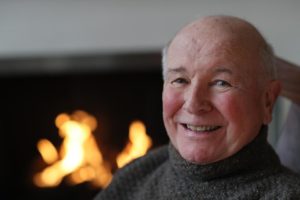
 Terrence McNally, one of America’s greatest writers for the theatre died aged 81 on 24 March 2020 from complications arising from the COVID-19 Coronavirus. He had an extraordinary career in the theatre as both a writer of original plays and as a contributor of lyrics to some of the most original stage musicals to come out of the US. Michael Darvell pays tribute to a great man of the theatre…
I met Terrence McNally when he was in London in 1996 for the staging of his play Master Class about the celebrated diva Maria Callas. He was a very pleasant man to interview, soft-spoken, unassuming and perhaps unaware of his considerable abilities as a skilled writer of dialogue and song lyrics. He was the author of over 40 plays and some ten musical books and lyrics plus four operas and eight works for film and television.
He was essentially a man of the theatre and was showered with awards for his considerable pains. Taken to musical shows by his parents from an early age, he was seduced into theatre by seeing Ethel Merman in Irving Berlin’s Annie Get Your Gun and Gertrude Lawrence in Rodgers and Hammerstein’s The King and I and the effect on him was then compounded by his viewing of the film of Leonard Bernstein’s On the Town. He then decided: “That’s where I want to live,” that is, on stage and, as he said: “I’ve never regretted it.”
Nor should we, his audiences, regret his choice of career, having enjoyed his particular talents as a writer. For some 60 years he took the temperature of the American way of life and presented his findings as cogently and impressively in his many works for the theatre. He has been likened to Shakespeare in his output of excellence, and The New York Times went so far as to call him “the bard of American theatre”. The only other possible contenders in the list of the ‘Greatest American Men of 20th-century Theatre’ might be Stephen Sondheim or Arthur Miller. That idea aside, Terrence McNally stands alone as a total original when it comes to his choice and the range of themes he covered in his six-decade career as a purveyor of theatrical subjects.
He was born Michael Terrence McNally in Florida on 3 November 1938 to Hubert and Dorothy McNally who ran a beach bar and grill in the US seaside resort. Originally from New York, his parents were forced to leave Florida when their bar was destroyed by a hurricane. They headed back to New York and then they relocated to Texas. Even at that distance the family was still able to enjoy the delights of New York’s Great White Way and its musical shows, where young Terrence received his early stage education.

Terrence McNally, Lynn Ahrens and Stephen Flaherty. Picture: Jeremy Daniel
His official formal education was gained at the W. B. Ray High School in Corpus Christi, Texas where he was encouraged to write by his English teacher Maurine McElroy. Later he enrolled at Columbia College in Manhattan where he studied Shakespeare and wrote the annual college revue. After graduating in 1960 with a B.A. in English he was employed by novelist John Steinbeck to tutor his two sons while the family were on a world cruise. Whilst on board McNally wrote a draft of And Things That Go Bump in the Night and at Steinbeck’s behest a libretto for a musical version of his novel East of Eden, which became Here’s Where I Belong in 1968, although it ran for only 21 performances.
McNally then wrote a one-act play for the Actors’ Studio in New York but it was turned down. However, he was offered a post as stage manager at The Studio. In 1962 they staged his first full-length play, This Side of the Door, about a boy and his bully of a father, which was the first in a line of plays in which McNally wrote about issues of the time such as family problems, changing sexual attitudes, the Vietnam War and social protest. Sadly, the play he wrote earlier, And Things That Go Bump in the Night was finally staged in 1964 but was not a success. Dealing with homosexuality before its time and before it became an acceptable theme, it seemed to appeal to none of the critics. However, after the theatre producer discounted the tickets to one dollar apiece, it ran for three weeks to full houses.
McNally’s next plays began to establish him as a writer with his own satirical voice. They included Next in 1968, about a middle-aged businessman sent to join the army by mistake. Elaine May directed James Coco in the role. Botticelli in 1968 featured US soldiers on guard in the jungle and in the same year Melina Mercouri starred in Cuba Si!, about the US idea of revolution. In Sweet Eros a young man offers love to a bound and gagged naked woman. It was performed with Witness, about a man deciding to kill the American President.
Where Has Tommy Flowers Gone? covered the American youth movement, and in Let It Bleed a young couple think they have an intruder while they are showering. Bringing It All Back Home concerned a family’s loss of a son in Vietnam, while Whiskey, set in Texas, featured a drunken cowboy troupe and their horse, the eponymous Whiskey. These and other plays were building McNally’s reputation as a writer to watch, albeit in Off-Broadway fringe productions.
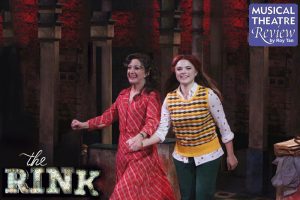
Caroline O’Connor and Gemma Sutton in The Rink at Southwark Playhouse, London. Picture: Roy Tan
The origins of The Ritz lay in a play McNally wrote for the Yale Repertory Theatre in 1974. Bold for its day, The Tubs (its original title) was set in a gay bathhouse and covered all the antics the customers got up (or down) to. It opened on Broadway the following year with a starry cast including Jack Weston, Jerry Stiller, F. Murray Abraham and Rita Moreno who won a Tony Award for her performance as the sauna singer Googie Gomez. The four actors listed repeated their roles in the 1976 film version directed by Richard Lester.
Frankie and Johnny in the Clair de Lune was a study of loneliness in a two-hander in which two solitary people meet and end up in bed together. The Off-Broadway production starred Kathy Bates and F. Murray Abraham at the Manhattan Theatre Club and then transferred to the WestsideTheatre with Kenneth Welsh replacing Abraham. Edie Falco and Joe Pantoliano then took over the roles. It was filmed in 1991 with Michelle Pfeiffer and Al Pacino.
McNally’s first moderately successful musical was Kander and Ebb’s The Rink in 1984. At first it was doing badly, so McNally was brought in to re-write the book. With stars Chita Rivera and Liza Minnelli as a mother and daughter trying to make a success of their roller skating rink, it eventually played over 200 performances. Four years later it came to London with Josephine Blake and Diane Langton but clocked up less than 40 performances. I went on the last day when the Cambridge Theatre was packed to the gills.
The Lisbon Traviata, about opera fans and Maria Callas, had a short run in New York in 1989 and reached London in 2003 at the King’s Head Theatre in Islington. Lips Together, Teeth Apart (1991) was about two straight couples on a weekend at a gay community. A Perfect Ganesh, about two female friends travelling to India, starred Frances Sternhagen and Zoe Caldwell briefly in 1993, although it was nominated for a Pulitzer Prize.
More successful was Love! Valour! Compassion! which found eight gay friends on summer weekends at a lakeside vacation house interacting with each other. With good reviews and a cast including Nathan Lane, John Glover, Stephen Bogardus and Randy Becker, it ran for over 350 performances and won two Tony Awards including Best Play. It went to the Edinburgh Fringe and the Tristan Bates Theatre in London.
Kiss of the Spider Woman won six Tonys including Best Musical, Best Book, Best Score and Best Performances by Chita Rivera, Brent Carver and Anthony Crivello. This reunited Kander and Ebb, McNally and Rivera in an adaptation of the book by Manuel Puig that detailed the relationship between a gay window dresser and his prison companion. It was initially workshopped at the Performing Arts Center in New York in 1990, then had a production in Toronto before finally premiering at London’s Shaftesbury Theatre, running for nearly 400 performances. The subsequent Broadway production ran for over 900 performances from 1993.

Ragtime at the Charing Cross Theatre, London. Picture: Roy Tan
McNally drew on his own experiences for his plays. Being gay himself, he often depicted the homosexual way of life in his work. Corpus Christi is his passion play about the life of Jesus Christ as depicted by a group of gay actors living in Texas. McNally was once a resident of the Texas town of Corpus Christi where he had lived with his parents. Calling the piece and setting it in Texas provided a personal involvement for the writer. In its questioning of Christ’s and his Apostles’ sexuality the play was controversial wherever it was staged. The first New York production was banned first but staged later on. Subsequent productions were vilified by the Catholic Church, including its British production in 2000, but it has since been successfully revived in London and elsewhere.
If McNally’s plays after that were rarely staged overseas, he did contribute some fine work to a number of musicals. In 1996 he wrote the book for Ragtime, Stephen Flaherty and Lynn Ahrens’ adaptation of the novel by E. L. Doctorow. It was a study of three groups of the indigenous US population, African-Americans, upper-class Suburbanites and Eastern European immigrants. It was a huge success, had many other US productions, came to London and was also staged in Norway and Australia.
The Full Monty in 2000 was an even greater success worldwide. With music and lyrics by David Yazbeck, it took Simon Beaufoy’s screenplay about unemployed men in Sheffield who, to make money, become male strippers. The musical was relocated to Buffalo, New York, although it followed the film’s plot fairly faithfully.
McNally returned to working with Kander and Ebb for his book of The Visit, based on Friedrich Dṻrrenmatt’s play. Chita Rivera replaced the original choice of Angela Lansbury who withdrew because her husband was ill. The show initially played Chicago in 2001, had a staging in Arlington, Virginia in 2008 and was revived for a short run on Broadway in 2015.
A Man of No Importance with music and lyrics by the Flaherty and Ahrens Ragtime team, had a book by McNally based on the 1994 film with Albert Finney as a Dublin bus conductor and amateur actor in a company trying to stage Salome. It had a four-month run in 2002 at the Lincoln Center in New York, played Toronto in 2008 and had a month’s run at the Union Theatre in south London in 2013, an engaging production of a delightfully charming show.
Catch Me If You Can (New York, 2011) was a musical comedy based on a book and a Tom Hanks film about a con-artist called Frank Abagnale with music and lyrics by Marc Shaiman and Scott Wittman, famous for the musical of Hairspray. Even with a book by McNally the show never took off in a big way. Following its premiere in Seattle it moved to Broadway but only played just over 200 performances. A better proposition was Anastasia, about the disappearance of the Russian Grand Duchess Anastasia. Working with Flaherty and Ahrens again, McNally’s book contributed to a successful run of two years on Broadway and the show had further stagings overseas.
In between writing the books for musicals, McNally also wrote opera libretti for Robert Beaser’s The Food of Love, and works by Jake Heggie, namely Dead Man Walking for San Francisco Opera in 2000, and Great Scott for Dallas Opera in 2015. Heggie also adapted McNally’s unpublished play Some Christmas Letters for his chamber opera Three Decembers for Houston Grand Opera in 2008.
Although basically a man of the theatre McNally has had some of his plays committed to film (The Ritz, Frankie and Johnny and Love! Valour! Compassion!) and for television he wrote the sit-com Mama Malone for Lila Kaye, adapted his play Andrḗ’s Mother with Sada Thompson, Richard Thomas and Sylvia Sidney, made The Last Mile, a short film about an opera singer played by Bernadette Peters, and contributed Mr Roberts, one of three segments in Common Ground, a trio of stories on gay themes, by McNally, Paula Vogel and Harvey Fierstein
Apart from his Tony Awards, including a Lifetime Achievement Tony, McNally also won multiple other awards for his plays. He also secured an honorary degree from the Juilliard School, the Dramatists Guild Lifetime Achievement Award, an honorary doctorate from New York University, and in 2018 was inducted into the American Academy of Arts and Letters, the highest recognition of artistic merit in the USA.
On a personal note, early on in his career he was the partner of fellow playwright Edward Albee for four years while Albee was still in the closet. Then he had a relationship with the late actor-director Robert Drivas. In 2003 McNally had a civil union ceremony with Tom Kirdahy, a theatre producer and former civil rights attorney for AIDS organisations. In 2010 they married and in 2015, when the US Supreme Court legalised same-sex marriage throughout the States, they celebrated by renewing their marriage vows at New York City Hall.
Terrence McNally had a long career in the theatre, perhaps not always a successfully commercial one, and he often invited controversy with his work, particularly with his early writing on gay themes. But then he still became one of the most honoured and respected playwrights of his generation. Is there anyone to replace him? Probably not, but he must have inspired many writers to carry on expressing their personal feelings without fear, prejudice or compromise.
Michael Terrence McNally: 3 November 1938 to 24 March 2020. R.I.P.
SHARE THIS POST:


Comments are closed.