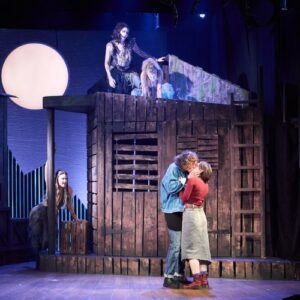
Picture: Tom Bowles
Dark of the Moon continues at the Charing Cross Theatre, London until 8 August 2026.
Star rating: two stars ★ ★ ✩ ✩ ✩
Howard Richardson and William Berney’s 1945 stage play Dark of the Moon had its origins stretching even further back. It was itself adapting and expanding the folk song ‘Barbara Allen’, usually about a woman who denies a dying man her love only to fall sick with grief when he dies.
Richardson and Berney twisted the ballad into a supernatural tale, where a ‘witch boy’ from a mountain community of immortal beings falls in love with a mortal human, the Barbara Allen of the song. The witch coven’s matriarch, the Conjur Woman, grants the boy’s wish to become human, for a year. If he and Barbara Allen stay committed all that time, he will become fully human; if either is unfaithful, he will return to the coven and his beloved will die.
The play already has a presence, however tenuous, in the West End, as the production that Hawkins High School is producing in Stranger Things: The First Shadow. Charing Cross Theatre’s production is a new take, with the play’s material adapted into a book by Jonathan Prince and music and lyrics by Lindy Robbins, Dave Bassett and Steve Robson.
Set in the Appalachian Smoky Mountains, it’s not immediately apparent in which period this iteration of the work is set. The residents of Buck Creek seem to dress slightly more modern than the wooden set designs and stilted dialogue would suggest. The community’s songs are performed in a timeless, banjo-and-fiddle bluegrass style.
That is in sharp contrast to the ‘witches’ – a term used very differently here to most modern usages of the term. Josie Benson and Gary Turner are the matriarch and patriarch of a clan of supernatural beings, largely invisible to the human eye. The audience is not quite so lucky, so we can see that they resemble 1980s disco fairies, as if Arlene Phillips’ Hot Gossip had staged A Midsummer Night’s Dream on a budget. Their musical style is a complete contrast to the townsfolk’s, all hard rock electric guitars and screeching vocals.
While that contrast is a clear intent to delineate between the two communities, the actual impact is at times so intensely jarring as to be verging on painful. It also reduces Benson’s Act I contributions to just shouting, making poor use of her tremendous rock belt. The presentation of the witches is further reduced through three figures (Al Knott, Appolilly Szwarc and Jordan Broatch) who act as antagonising sprites throughout, reducing the supernatural presence to a level of annoying bitchiness rather than mystery.
More successful are the portrayals of townsfolk. True, each character is an archetype we’ve seen a thousand times before on stage and on screen – the bumbling cleric, the overly censorious old maid, and so on. Among them is Lauren Jones’ Barbara Allen, a strong-headed and forward-thinking young woman. It’s never apparent if the reputation Barbara has acquired is because she’s sexually adventurous, or just modern in other ways. Whatever, the tensions between her character’s pull towards Glenn Adamson’s John the Witch Boy, and her family’s previously agreed choice of partner for her, Marvin (Samuel Murray) feel as genuine as this fantasy-based story can manage.
Libby Todd’s set, comprising two large buildings atop which the witches sit on a level that both implies them watching the action from rooftops and portrays their mountaintop home, feels overbearing on the stage. It reduces the space available for those occasions where the whole village comes together, limiting the ability for choreographer Jane McMurtrie to do much effectively when it comes to town celebrations. Even when the onstage performers thin out, though, this never feels like a musical that’s much inclined to dance.
What generally works much better is Jonathan Chan’s lighting design. Frequent flashes in and out of blackout are used to make the witches feel as if they can move at super-high speeds – far more effective than the occasional flash-bangs used to suggest magic. There are occasions where the town’s warm colour palette is invaded by the cooler, ivy blues of the witches’ to great effect.
Musically, the imbalance between the town bluegrass and the witches’ rock is set aside when Jones and Adamson come together. The musical style they share feels much more contemporary musical theatre, all romantic piano and guitar ballads. Thematically, one feels a combination of the two worlds’ differing styles might work a little better, but any relief from the overly amplified electric guitar from the witches’ songs is welcome.
The songs themselves feel pretty good throughout, particularly Jones and Adamson’s duets, ‘Wildflower’ and ‘Maybe’. But there is also a sense that the writers go back to the same well over and over. Act II reprises are nothing new, but with several of the numbers feeling stylistically similar to one another, there is a greater sense of repetition than looking at song titles alone would suggest.
That sense of repetition is fuelled by the book, which is never content to let a single plot point go by without it being rammed home time and time again. The same can be said of the show’s weak attempts at humour, most of which are carried by Wills Mercado as Barbara’s brother Floyd and, more effectively, Martin Callaghan’s Preacher.
All told, Dark of the Moon feels like it is missing that spark that can turn a good idea into a great musical. The original play introduced themes of societies rejecting others from different backgrounds, and of the enforced removal of mixed-race babies from their mothers. It was written and performed in a time when Jim Crow segregation laws would have been in full effect across much of America, particularly the areas depicted in the play.
The scope for fantasy to be an allegory with which to engage the issues of the day is entirely removed here. Instead, we’re left with a story of love across the divide that feels decidedly more generic than its cast deserves it to be.
Scott Matthewman
- Search for tickets for Dark of the Moon at the top of this page!




Comments are closed.