 Dorian Gray continues at the King’s Head Theatre, London until 12 April.
Star rating: 3 stars ★ ★ ★
“I have the simplest tastes,” said Oscar Wilde famously. “I am always satisfied with the best.” If this was the case, then Mr Wilde would perhaps be left wanting after experiencing Another Soup’s musical exploration of his only novel.
As ambitious and as creative as it is, Dorian Gray sadly doesn’t go far enough theatrically, or musically, to satisfying the fully immersive experience promised. And the promise was certainly tantalising: a ‘poignant, Brechtian immersion’ into Oscar Wilde, warnings of ‘partial nudity, mature themes and strong language’, and glowing Edinburgh Fringe reviews invoking the name of Tim Burton.
Another Soup – founded in Durham in 2010 by a creative collective led by artistic director Dave Spencer – strives to ‘takes audiences somewhere they would not usually go’ and ‘[entice] audiences to forget that they are watching a show, thereby increasing the effect of the respective performance’. I’m not doubting the passion and commitment the group has to this form of theatrical presentation, but their Dorian Gray left me at best nonplussed.
The show marks the 125th anniversary of the novel’s first publication, and this musical interpretation attempts to get to the core of the book in its short 80-minute single act. From a book point of view, this it does admirably, condensing the (admitted already meagre) story to its essence and drawing out of it the themes of aestheticism and hedonism… and the thrill and dangers of both. Musically, it is less successful.
Bringing buoyancy to the production – and giving credibility to the whole venture – is its cast, all of whom are very much up to snuff. Thomas Judd’s Henry exemplifies all the overbearance and imperiousness you’d expect from a Wildean flinger of bon mots, with his height and sheer force of personality making him a dominant force in the show.
Blair Robertson, who takes on the role of the artist Basil as well as James, the aggrieved brother of one of Gray’s victims, also gives an impressive performance, and has a great voice to match. The highlight of the piece – much-needed comic relief in the shape of a music hall song by two sapphic chanteuses – is brilliantly delivered by Judd and Robertson in drag.
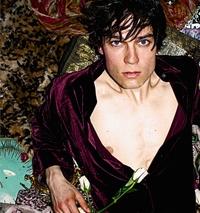
Dorian Gray is, according to the opening monologue (in modern vernacular) from Thomas Judd (or is it Lord Henry?), the original Mr Gray of ‘50 Shades’ infamy. He’s given life by Samuel Woodhams, who has the model looks and razor-sharp cheekbones you’d expect of the vampiric fop.
Woodhams is the perfect Gray, and the character’s louch, apathetic coolness comes disarmingly naturally to the actor. Vocally, he’s less impressive, and with none of the voices amplified, I lost too many of his lyrics for my liking. But overall he gives a mesmeric performance that holds the audience’s attention throughout.
Felicity Kirwin provides the love interest in the shape of the pathetic Sibyl, and does a good job with a difficult role that’s not quite fleshed out enough to give her much to do get her teeth into. Last and certainly not least, Felicity Sparks bustles around the space as housekeeper Mrs Leaf, while also doubling at the piano.
As thin as the plot is, especially in this distilled version, it’s still engaging enough to keep the interest levels up (although if you didn’t already know about the painting ageing away in the attic, it certainly isn’t clear here).
There’s a bit of ‘immersion’ in that the cast mill around the pub and interact with the queuing audience, and once inside, the audience is jostled and unseated a couple of times (at one point to dance at a ball). One unlucky punter is even roped in to help with a scene.
Interestingly, the performance space is actually Mother Superior’s heroin den from the set of Trainspotting, which plays at the pub in the slot before Gray. This bedsit set, weird as it is with its expletive graffiti and ill-sprung sofas, is somehow fitting, even though you’d expect to see Wilde performed in an oak-panelled drawing room. Perhaps it’s the inside of Gray’s mind? Perhaps heroin, like Gray’s take on aestheticism, also represents hedonism unchecked by morality? I couldn’t say, I’m sure…
So the ‘immersion’ isn’t particularly fully realised, but ultimately it’s the music that I feel lets this piece down. In the creative team are Jo Turner (named as composer, although there is no biography in the programme), director/writer (and co-founding member) Dave Spencer, co-writer Steffi Walker and musical director Isaac Lusher, who provides the majority of the piano accompaniment and the occasional violin (and, weirdly, cajon).
Their songs are largely simplistic and instantly forgettable, and – other than the aforementioned comic relief – don’t engage the audience or advance the plot. On saying that, I suspect the show would work well as a straight play (pun intended) with some musical asides; if presented in a Victorian music hall style, they might have given the show the quirkiness that it needed.
Songs aside, Dorian Gray has an engaging (enough) script and strong, credible performances, and for £15 it earns that third star for offering good value. Their efforts in this production fall a little short of the hyperbole, and we’re left with a rather pedestrian presentation, but Another Soup can only be applauded for their attempts to explore the boundaries of the theatre experience. Next time, I just hope they go a bit further.
Craig Glenday
SHARE THIS POST:


Comments are closed.