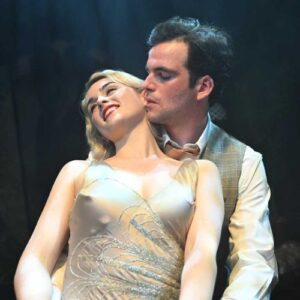
Daisy Snelson and Dominic Sullivan in Entertaining Murder at Upstairs at the Gatehouse, London. Picture: Peter Davies
Entertaining Murder continues at Upstairs at the Gatehouse, London until 10 May 2026.
Star rating: four stars ★ ★ ★ ★ ✩
In December of 1922, Frederick ‘Freddy’ Bywaters and Edith Thompson were found guilty of the murder of Percy Thompson, Edith’s husband. Both were sentenced to death and then hanged in January of 1923. Freddy had confessed to the crime, but both maintained Edith was innocent. Her life may have been saved were it not for a series of private letters Edith had written to Bywaters in the years prior.
British society in the 1920s found the very hint of adultery shocking, let alone the sexually-charged content of these private letters. Ever since the conviction, the elephant in the UK justice system has been: was Edith Thompson found guilty of murder purely on the strength of the evidence against her, or were the judge and jury influenced by the sensationalist public and press commotion surrounding her trial? Edith had wished her husband dead in the letters, but there was nothing to suggest she had any direct involvement in planning Freddy’s fatal attack.
Entertaining Murder lays out the case for the defence, and its compelling argument is much more likely to succeed with today’s public. Indeed, there have been numerous attempts to have Edith Thompson pardoned posthumously, though thus far they have been unsuccessful. Fascination with the case has grown and Chris Burgess’ excellent new piece of musical theatre writing is here to educate and entertain us.
Clearly a labour of love by writer/director Burgess, the first iteration of Entertaining Murder premiered back in 2024, presented then as a musical true crime podcast. A key theme of this piece is suggested by the dual meaning of the show’s title: real-life murder as popular entertainment. The true crime podcast framing device was a clever way to address this, but by freeing the narrative from this lens and presenting us with a true musical comedy on the subject, this new production arguably goes further in its exploration of our morbid fascination with crime.
Events are narrated by the wonderful Sue Kelvin, playing Edith’s sister Avis Graydon. It was Avis who brought Freddy into their family’s life, initially as a potential suitor for herself. Dora Gee pitch-perfectly portrays the young Avis with a mix of uptight innocence and genuine familial warmth. Her perspective is an ideal window into this play: though her family ties and closeness with her sister mean she never fully believes her sister could be a murderer, there is enough bitterness and shock at her adulterous behaviour to sustain some uncertainty.
Gee also portrays a variety of incidental characters and exhibits impressive range while doing so. Likewise, Alex Cosgriff delivers a masterful transformation from gruff, abusive husband Percy Thompson when required for other roles. Dominic Sullivan as Freddy is almost underused in comparison, but his formidable stage presence ensures the spectre of this destabilising figure is felt even in scenes where he has no lines. He shows off his charming side in the early song ‘Why Not?’, but it is his emotional Act II breakdown ‘Enough’ that gives Sullivan his vocal ne plus ultra.
At the centre of the action, of course, is Edith Thompson, played by Daisy Snelson. Snelson has been involved with the development of this show for some years now and the work she has put into this character is evident. At the outset, she embodies the scandalous femme fatale of public imagination with a telling glint of vulnerability in her eye. Over the course of the evening, we see her experience rapturous pleasure, unimaginable pain, and everything between. If you need just one reason to make that uphill trek to the Gatehouse, Snelson’s stellar performance is it.
Edith is swept away with love for her young paramour, at times confusing her affair with the fantastical drama of her beloved romance novels. By grounding the show in a plausible love story, the audience is invited to imagine how close any one of us may be to these horrifying events.
Burgess’ score is wide-ranging, with plentiful nods to the sound and styles of the era. Between Steven Edis’ arrangements and MD Aaron Clingham’s orchestrations, the music has heft: flirting with busy though rarely breaching that line. Clingham acts as an impressive one-man band, augmenting live keys with pre-recorded samples.
The two-hour running time allows Burgess’ book to dwell in moral grey areas through which other shows might rush. As we approach the story’s climactic executions, we descend into a jarringly jaunty music hall number: ‘See Edith Thompson Swing’. The contrast of the plot’s horrors and the medium’s frivolity leads us to question ourselves as a public finding entertainment in murder. Like Kander and Ebb’s Chicago, Burgess uses musical theatre to reveal our ills as a society.
As populism’s jackboots march ever closer to Westminster, Entertaining Murder is a timely production. The court of public opinion, the death penalty, our disconnect from our fellow human beings when presented with their stories as entertainment: these are all pertinent issues with which we wrestle. Burgess could afford to go deeper on these themes but is wise to trust audiences to infer his meaning rather than moralising.
Though billed as a ‘Murder Mystery Musical’, the show isn’t overflowing with mystery. The show’s position on the events of that fateful night is made clear early and our entertainment comes from learning fascinating details of the case and the questions they pose – not the traditional tension of a whodunnit. Still, the score is superb, the cast is wickedly talented, and Upstairs at the Gatehouse remains the best pub theatre in London. Do anything (not that) for a ticket.
Ian Bowkett
SHARE THIS POST:


Comments are closed.