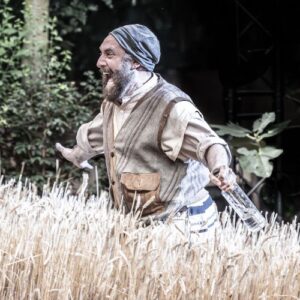
Adam Dannheisser in Fiddler on the Roof at Regent’s Park Open Air, London. Picture: Marc Brenner
Fiddler on the Roof continues at Regent’s Park Open Air Theatre, London until 21 September 2024.
Star rating: five stars ★ ★ ★ ★ ★
This vital new Regent’s Park Open Air Theatre production speaks to both faces of Fiddler on the Roof. On the one hand, this has always been a very Jewish story about the specific hardship faced by Eastern European Shtetl communities that no longer exist after the horrors of the early 20th century. However, under the stewardship of musical theatre legends Hal Prince and Jerome Robbins, the original 1964 production spoke so universally about community, family, political precariousness and – of course – tradition, that it found a universal appeal and at the time became the longest-running show in Broadway history.
Worryingly, on the evening before press night, this theatre’s lobby was sieged by protestors apparently blaming the very existence of Jewish people for the daily tragedies still unfolding in Gaza. The production also plays against the backdrop of this week’s modern-day pogroms intimidating minority communities across the UK. Televised scenes of vandalism, violence and arson are fresh in our minds when Anatevka is attacked and burned. That this violence is also committed by Russian loyalists on Ukrainian land is another layer of contemporary relevance that does not go unnoticed.
So, audiences have a lot on their minds. Not only does this Fiddler tell a Jewish story and deal with the very specific insidiousness of antisemitism, but it also taps into a universal relevance that has resonated with broad audiences for decades. Crucially, besides the politics, it remains a smashingly well-executed piece of Broadway musical theatre writing.
Firstly, Jerry Bock and Sheldon Harnick’s score remains extraordinary. Virtually every song is a classic and musical director Dan Turek’s 11-piece band plays them all beautifully. The timbre is a little more raw than previous productions, and all the better for it. With musicians onstage, it feels like the cast is better able to relax into the songs and the sense of play is wonderful.
Director Jordan Fein does not downplay the show’s comedy one bit. Beverley Klein’s matchmaker Yente is hilarious throughout, and even more minor characters like David Freedman’s Rabbi and Michael S Siegel’s Lazar Wolf have their moments to shine. Of course, many of the funniest lines go to Adam Dannheisser’s Tevye, and he is a pure delight. He imbues the role with a winning goofiness that softens the period-correct but uncomfortable misogyny – aided by a formidable and thoroughly likeable Golde played by Lara Pulver – but still elicits plenty of tears when tragedy comes.
The accents of Anatevka vary, but what is lost in strict authenticity is more than made up for by the humour found in modern cadences. Casting decisions appear to have favoured “actors who can sing” rather than “singers who can act” and that is absolutely the right choice when the intention is to create a relatable and human community. That’s not to say there is a lack of astounding vocals on stage. Case in point: Liv Andrusier’s Tzeitel is an energetic powerhouse who lights up the stage with many a stunning vocal performance in the show’s Act I.
Elsewhere, Georgia Bruce’s charming Hodel and Daniel Krikler’s firebrand Perchik share a fantastic romantic chemistry, and Hannah Bristow is a joyously spirited Chava whose journey is truly compelling. Her relationship with Gregor Milne’s Fyedka is believable and suitably tinged with tragedy given the break with her culture and people that it represents. By the time she is playing a mournful clarinet atop the village as her family and friends march off to an uncertain future, our hearts break.
She also duets with Raphael Papo as The Fiddler, who in this production haunts the set, and Tevye specifically, reminding him and the audience of the show’s key themes: tradition and precariousness. His ‘roof’ is an elevated field of wheat, being peeled back from the stage – forcefully ripped from its soil with literal roots visibly dangling below. Tom Scutt’s set design is as transportive as it is metaphorically fitting, and his collaboration with lighting designer Aideen Malone produces many a stunning moment as the sun sets (during ‘Sunrise, Sunset’, no less).
As the tragedy of this story unfolds, the whole company bears witness. Characters not in the scene stand on the outskirts, watching on. Sometimes, they line up in intrusive rows to stare. It feels like there has never been a more important time to heed the lessons of this tale, but that isn’t strictly true: antisemitism and bigotry are beasts that may never be slain, but the joy and humanity on display here inspire hope. Regent’s Park reliably produces some of the best communal theatre experiences in London, and rarely has this atmosphere been put to such good use as here. Do not miss it.
Ian Bowkett
SHARE THIS POST:


Comments are closed.