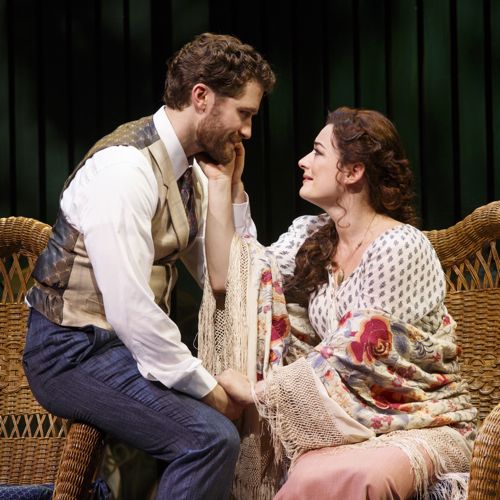
Matthew Morrison and Laura Michelle Kelly in Finding Neverland at the Lunt-Fontanne Theatre, New York. Picture: Carol Rosegg
Finding Neverland continues at the Lunt-Fontanne Theatre, New York.
Star rating: 4 stars ★ ★★ ★
“Second star to the right and straight on ’til morning” is Peter Pan‘s direction for getting to Neverland. But Finding Neverland, the musical telling how playwright JM Barrie came to create Peter Pan, aims straight for the tear ducts. And it hits a bull’s-eye.
Now, tear-jerker may sometimes be a derogatory term. But let me say it’s quite pleasurable these days to have a Broadway musical gently cause your eyes to moisten when so many shows seem designed simply to bombard you into submission.
Finding Neverland is also a pleasing conclusion to a harried gestation. It’s based on the 2004 movie of the same name, a prestigious if not overwhelming affair stuffed with such names as Johnny Depp, Kate Winslet and Dustin Hoffman. The movie in turn was taken from the play The Man Who Was Peter Pan by Allan Knee, which played Off-Broadway in 1998.
An initial attempt to turn the flick into a stage musical in Leicester in 2012 failed to fly. Its producer, movie mogul Harvey Weinstein, whose former company Miramax produced the movie and who now was making his first stab at the stage, got rid of the creative team and cast in one fell swoop, just as movie moguls are prone to do. He turned the project over to director Diane Paulus, a current wonder-lady of the Broadway musical, whose resume includes the latest revivals of Pippin, The Gershwins’ Porgy and Bess and Hair.
Paulus’ reworked version played last summer at American Repertory Theatre, Cambridge, Massachusetts, where she’s artistic director. It was renewed with a book by English playwright James Graham and music and lyrics by popular UK singer/songwriters Gary Barlow and Eliot Kennedy.
But the work was not finished. As the production chugged onto Broadway, two of the leads were replaced. Matthew Morrison, who won heartthrob credentials from his work on television’s Glee, took over the role of JM Barrie, and Kelsey Grammer, whose long-time portrayal of the psychiatrist Frasier on the series of the same name made him a tube favorite, signed on as Barrie’s American producer Charles Frohman. (Morrison had played Barrie in an early reading of the script.)
All the trial and error has paid off in an involving family-friendly entertainment, with lots of the requisite magical touches. The creative credits include such items as ‘illusions’ by Paul Kieve, ‘air sculptor’ Daniel Wurtzel, and ‘flying effects’ by ZFX, Inc. and Production Resource Group. They get equal billing along with the more conventional elements such as Scott Pask’s scenic design, Suttirat Anne Larlarb’s costumes, Kenneth Posner’s lighting and Jon Driscoll’s projection design.
As the show begins, a travelling dot of light travels through the theatre. Who else could it be but Tinker Bell? It flits through the curtain, and as it opens on a London park circa 1900 we see Barrie and Peter Pan, the latter cavorting with Tinker Bell.
“This is the story of a story that one year ago was still waiting to be written… which means you shouldn’t even be here yet,” Barrie tells Peter, who indignantly blows Tinker Bell into a lamppost light and leaves the stage. After Barrie sings the introductory anthem about the moment his “world turned upside down”, the scene shifts back a year to the opening night of Barrie’s latest play in the West End, greeted with all the usual perfunctory huzzahs and glitter. Mia Michaels’ striking choreography animates the dubiously congratulatory crowd nicely. Barrie, however, knows his latest work isn’t very good, and he feels he has lost his knack.
Inspiration is rekindled, however, when during a stroll in Kensington Gardens he comes across the Davies family: the recently widowed and comely Sylvia and her four boys, three boisterous tykes and one fellow – who happens to be named Peter – still somewhat traumatised by the death of his father. Barrie finds an immediate connection, their games and high spirits awakening his own youthful imagination. Conversely, Barrie’s efforts eventually pull the young Peter out of his shell. (Cue up a start on the tears.) At the same time, the bravely cheerful Sylvia ignites a romantic connection.
As things progress, the married Barrie’s relations with the Davies family ignite troublesome rumours and the upset of his marriage. That’s all brushed aside, though, as the games and frivolities lead to Barrie’s writing of Peter Pan, and despite the early doubts of Frohman and his actors, the play is an immediate triumph.
But there is a bleak note. The endearing Sylvia is not well. Barrie has discovered blood on her handkerchief, and she is unable to attend the opening night of Peter Pan. After the performance Barrie brings the entire cast back to the Davies home for a private showing. It’s a jolly good night, even as Sylvia’s imminent demise will again set those incipient tears flowing. Her departure to ‘Neverland’ is a dazzlingly beautiful and moving coup de theatre.
There are times that Graham’s script lays on the importance of child-like imagination and play a bit too thickly. There are also a few misplaced attempts at humour. A nod to Cheers – the television sitcom that gave Grammer his break-through role – seemed liked an unnecessary jab in the ribs of the knowing adults in the audience. “Do they say ‘cheers’ where you’re from Charles?” one of the actors pointedly asks Grammer’s Frohman as they are about to down a beer during an after-rehearsal gathering in a pub.
There is also a jarring somewhat tired double-entendre joke about “fairies” in the theatre. But these are small quibbles to a generally well-crafted script, easily leading into the fairly mellow songs. The Barlow-Kennedy score pleasantly overlays pop notations with a vintage patina, only occasionally giving into those overwrought extended notes marking much of current Broadway.
The fine cast avoids the overly-sentimental traps that such a story might foster. Morrison mixes Barrie’s newly regained sense of play with a touch of gravitas that imbues the character with a compelling importance. He also sings strongly, making emotional sense out of the frequently oblique lyrics, and to top it off, he does it all with a consistent Scottish brogue.
Grammer brings comic heft to the sometimes grumpy and child-adverse Charles Frohman, making his bountiful epigrams sound as if they had just popped into his mind. His sense of fun further elevates when in Barrie’s imagination he transforms into Captain Hook.
As Sylvia, Laura Michelle Kelly is an appealing presence, evincing a genuine warmth brightened with an inherent gaiety. Sylvia’s four boys are each portrayed by a trio of alternating youngsters. At the performance reviewed, they were Aidan Gemme, Christopher Paul Richards, Sawyer Nunes and Alex Dreier. They all were no less than terrific, especially Gemmes who plays the pivotal Peter and handles the character’s emotional breakdown and big duet with Barrie with astounding confidence.
Adding to the strength of the company is Broadway stalwart Carolee Carmello as Sylvia’s uppity mother. When in her big number late in the show she comes to fully realise and accept the importance of Barrie to her grandchildren and her daughter, it’s the impetus for yet another gush of those well-deserved tears.
Ron Cohen
SHARE THIS POST:


Comments are closed.