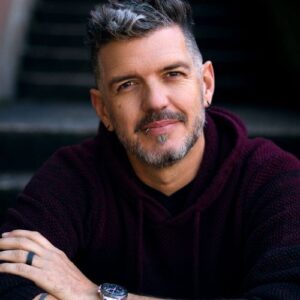
 As music supervisor, arranger and orchestrator, ETHAN POPP has taken an all-encompassing role on the Broadway production of The Lost Boys, overseeing every aspect of the show’s sonic identity. His role has landed him a Tony Award nomination for Best Orchestrations alongside Kyler England, Adrianne “AG” Gonzalez and Gabriel Mann.
Based on the classic Warner Bros film, the 12-time Tony nominated musical The Lost Boys is directed by Michael Arden (Maybe Happy Ending, Parade) and features music and lyrics by The Rescues and a book by David Hornsby and Chris Hoch.
The bold, hybrid score blending rock, orchestral writing and digital production features 28 original songs which draw heavily from film scoring techniques rather than traditional Broadway structure.
Ethan is a Grammy Award nominated music producer as well as an Olivier Award and Tony Award nominated orchestrator. With a career spanning over the last 25 years, his work as a music producer, music supervisor, arranger, orchestrator has been seen and heard worldwide.
Theatre credits include: The Lost Boys (Broadway world premiere), Back to the Future, Mrs Doubtfire, Tina: The Tina Turner Musical, School of Rock, Hedwig and the Angry Inch, Motown The Musical, Rock of Ages, Disney’s Tarzan, We Will Rock You, Disney’s Aida, Disney’s The Lion King, Mamma Mia! and many more.
For television Ethan has served as a composer, music producer, arranger and orchestrator on works ranging from NBC/Universal’s Smash to HBO’s Last Week Tonight with John Oliver. His work on the big screen can be heard most notably as music director and music production supervisor for 20th Century Fox’s The Greatest Showman and as vocal and piano coach to Academy Award winner Rami Malek in his starring role in Bohemian Rhapsody.
Here Ethan Popp continues Musical Theatre Review’s interview series: Five Questions With…
The Lost Boys has been described as a ‘blockbuster event’ with a highly cinematic quality. How did you approach translating the energy and atmosphere of such an iconic film into a live musical experience through sound?
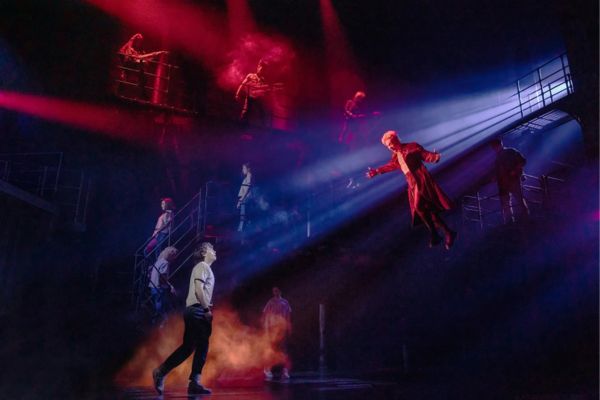
My job was not to re-create the film’s sound, but to build the theatrical language through which its emotional world could live onstage. From the beginning, I was focused on how to translate the danger, sensuality, humour and propulsion of the film into something that could feel immediate and alive in a theatre. The Rescues’ music already carried so much of that emotional and sonic DNA, and Michael Arden’s staging has such sweep and imagination that my work became about shaping how that world actually lands with an audience through sound.
That meant thinking of the score not simply as accompaniment, but as a critical part of the architecture of the storytelling itself. I drew on orchestral writing, rock energy, electronic production and spatial design to create a sound world that could feel cinematic in scale while still remaining deeply theatrical in its immediacy.
Pictures: Matthew Murphy
The production’s 7.1 surround sound design is unusual for Broadway. What opportunities did immersive audio open up creatively, and how do you think it changes the audience’s emotional relationship to the story?
Immersive sound allowed us to treat the score not just as music, but as an environment. For me, that was never about technology as spectacle. It was about asking how sound could circle, close in, seduce, destabilise, or haunt. In a story like The Lost Boys, where danger and desire are constantly intertwined, that becomes a very powerful storytelling tool.
It also changed the way I thought about orchestration itself. I wasn’t only thinking about what the audience hears, but how they experience the score physically and emotionally in space. At its best, immersive sound makes you feel inside the story rather than simply in front of it.
The score blends orchestral writing, rock influences, and vintage synth textures in a way that feels both nostalgic and contemporary. What guided the sonic identity of the show from the beginning?
I wanted the show to feel as though it had inherited the 1980s in its bloodstream, not as though it was dressing up as the 1980s. The Rescues’ music already carried so much of that emotional and sonic DNA, and my work was about shaping a theatrical language around it that could honour the atmosphere of the era without turning it into a museum piece.
So the guiding principle was balance: analog warmth against digital edge, orchestral depth against contemporary production, and paying homage to the sonic language of the 1980s while meeting the necessities of live theatrical storytelling. I wanted us to honour not just the synth sounds of that era, but the full production language – the drums, guitars, textures and atmosphere — while creating a sound that could transcend eras and feel equally at home in 1987 or 2026.
This musical seems to push beyond traditional Broadway structures and lean more into film-style storytelling. Do you think audiences are increasingly looking for musicals that feel more cinematic?
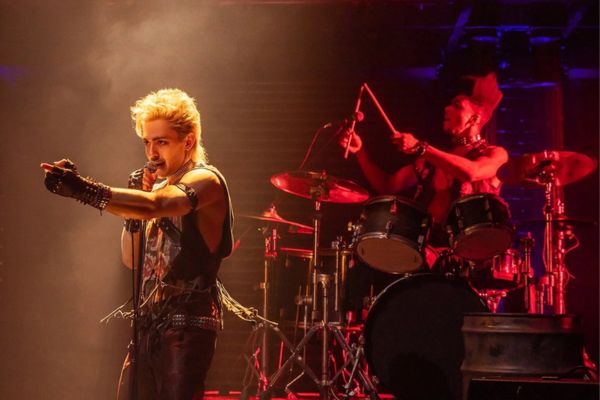
The question, to me, is not whether theatre should become film, but how theatre can borrow some of film’s emotional tools while remaining unmistakably live. I do think audiences are increasingly open to musicals that use atmosphere, momentum and a more immersive emotional language, especially when it deepens the storytelling rather than just making something feel bigger.
What interests me most is expansion, not imitation. Broadway still depends on the electricity of live voices, live bodies, and shared space, and I never want to lose that. But I do think audiences are excited by work that stretches the form a little and lets music behave in a more atmospheric, dimensional and immediate way.
With the cast album now recording and the show receiving major awards attention, how are you thinking about preserving and expanding the life of The Lost Boys beyond the theatre itself?
The cast album is, in some sense, a re-orchestration of the experience rather than a simple preservation of it. What happens live in the theatre is spatial, physical and communal in a way that can never be replicated exactly on a recording, so the challenge becomes: how do you preserve the emotional weather of the show in a different medium? How do you let a listener still feel the danger, sensuality, rebellion and scope of the piece at home?
More broadly, what excites me is the possibility that The Lost Boys can continue to live not just as a production, but as a musical world people want to revisit. My hope is that the show continues to resonate because of the specificity of its sound – the way live orchestration, electronic textures, contemporary production and immersive storytelling all work together to create something theatrical, but also very much of this moment.
- The Lost Plays continues at the Palace Theatre, New York
- Search for tickets for The Lost Boys at the top of this page!




Comments are closed.