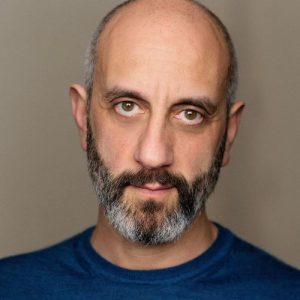
 RICHARD KATZ has joined the multi-award-winning and critically acclaimed production of Cabaret at the Kit Kat Club in London’s West End, playing the role of Herr Schultz.
Richard is an associate artist with Shakespeare’s Globe Ensemble and an associate at Complicitè. His many theatre credits include Love and Other Acts of Violence at the Donmar Warehouse, The Fir Tree, The Merry Wives of Windsor, Bartholomew Fair, As You Like It, Hamlet and Nell Gwynn, all at Shakespeare’s Globe, The Encounter, The Master and Margarita, Measure for Measure, Mnemonic, The Noise of Time and Strange Poetry, all for Complicité and Blindness and Seeing, Peer Gynt, As You Like It, The Comedy of Errors, Romeo and Juliet, The Drunks, Silence, The Winter’s Tale and Pericles, all for the Royal Shakespeare Company. He has appeared in The Lorax and The Divide at the Old Vic, A Soldier’s Tale with the Hallé Orchestra, 1984 for Headlong Theatre and Way To Heaven at the Royal Court.
Here Richard continues Musical Theatre Review’s interview series: Five Questions With…
Your theatre credits are extremely impressive but I don’t spy oodles of musical theatre there, what has particularly attracted you to being part of the award-winning West End production of Cabaret?
Well, it’s the kind of thing that is normally so off my radar. I was asked if I fancied meeting the creative team and was so excited by the prospect. Do you want to come and be part of a hit show, that’s won a bunch of awards and seems to have landed just at the right place and time?? It was a total no-brainer. I wanted to be in it so badly. To be part of a company, with these people, these artists who made this wonderful piece of work, people at the very top of their game – both on and offstage – how wonderful to be part of it.

Richard Katz as Herr Schultz in Cabaret at the Kit Kat Club, London. Picture: Marc Brenner
What appeals to you about playing Herr Schultz and how are you approaching the character? It is such an important role but one that obviously doesn’t feature in the much-loved feature film.
It’s funny, because of course a lot of people’s relationship with this show is the film. So when I explain what I’m doing it’s quite often met with a look that says ‘are you sure that’s what you’re doing??’ In terms of playing it and approaching it, the writing is so, so perfect. So simple, elegant. In a funny way, you have to get out of the way of it. Don’t try and be too clever, play as clean and simple as you can. What comedy that there might be, what sadness, what romance… that’s for the audience and their imagination. I try and be as honest to the relationship and situation as I can be. I know that should be the case with whatever one plays, but I reckon it’s particularly important in this show.
Is it daunting joining an existing production in which another actor has created the role, or do you find it easy to separate that from the way you are interpreting the part?
It was so daunting! I think I said yes to doing it only days after Elliot [Levey] had won the Olivier award too. The good news was that at no time was I encouraged to be like Elliot, or how he had done it. And, by the time I actually saw the show, I was so deep into rehearsals that I felt pretty confident in our differences, interpretation-wise. And I honestly think it works best when I treat it like Schultz is (in his own head anyway) enjoying his Romeo moment. It’s a love story. The fact that there are other, much bigger forces at play as he’s trying to forge this romance… well, that turbulence is pretty juicy to play, to be swept away by.
You have performed many highly acclaimed productions/revivals of classic drama and obviously have a particular allegiance with Shakespeare. Do you think there is a snobbery surrounding revivals of classic musicals?
Honestly, I don’t get that impression. But I guess that any revival – whatever it is – needs to speak to us, now, here. I’m sure that plenty of things right the way across theatre which might be programmed because they’re simply ‘box office’, and who can blame a theatre from trying to pull audiences in. But, if you can find a way of making any revival relevant, give it something new, something different, something of the now, then surely that’s going to pull audiences in, regardless of which genre people perceive it to be a part of.
Impossible question, but can you pick out a special highlight from your career so far?
If I had to pick one, it would probably be The Encounter for Complicité. The piece was created as a one-man show for Simon McBurney. I was part of the team that helped him develop the piece. When he had the opportunity to take the show to Broadway, he asked if I would be interested in being his alternate. It essentially meant I got to do a one-man show… on Broadway! It was absolutely wild. I think I did about 30 in New York and then took it out to do the international festival circuit. It’s such an incredible piece, one of a kind really, and to get to be at its centre was the most wonderful experience.
SHARE THIS POST:


Comments are closed.