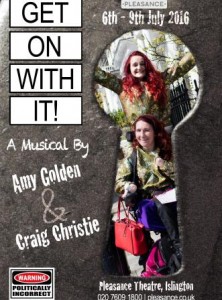
 Get On With It was performed at the Pleasance Theatre, London.
A truly important piece of theatre hit the Pleasance in Islington in the form of this unique new musical, Get On With It. Based on an autobiographical essay written by Amy Golden, it tells the tale of a young woman growing up with Cerebral Palsy. The show is brazen and full of heart, although it is also in need of some more sophisticated development to reach the heights it deserves.
When we look at what’s on offer, at what we rally behind in terms of new musical theatre writing, we should look to the themes that bridge our understanding of the issues we find uncomfortable. One thing this show does brilliantly is to tackle those musings head on. We have no sooner begun to wonder about the mechanics of life for a woman who possesses high mental and emotional complexity but little physical command of her body, than our questions are answered, even the delicate ones, with much wit and warmth.
In this production, Golden played herself, shadowed by her onstage counterpart (Suzanna Kempner), who delivered her inner thoughts to the audience. Kempner gave us a feisty, down-to-earth and endearing performance as Golden’s inner woman, and her vocals were fantastic.
Amy navigates a joyfully mischevious childhood with her two brothers (‘When Amy Comes Out to Play’), and her first encounter with depression, as her close-knit group of friends and family begin to pair off and form their own units.
She takes us through her everyday encounters with the world at large, and indeed its reaction to her. Taking everything with a pinch of salt, she lampoons those too uncomfortable or ignorant to treat her decently, and welcomes those who take the time to focus on her for long enough to communicate properly.
She lusts after sexy men, and pines for the intimacy that comes so inevitably to others. Despite the candid nature of her musings, it still feels as though she’s holding back, and we miss the extra dimensions of the individual inhabitants of Amy’s inner world.
Golden is a very capable author, and her original essay demonstrated great promise in its construction. It feels as though there is a lot less of her authentic voice in this show. Many of the nuances and turns of phrase have been over-encumbered, and Craig Christie’s libretto feels heavy-handed, and at times, condescending.
The opening number, for example, is so derivative and twee it feels like it’s regressing back into music hall territory, and not in an ironic way. Thankfully, the rest of Christie’s music is much more bearable. The mother’s ballad, ‘Amy’s Eyes’, is a lovely combatant (sung with great warmth by Emma Odell), and the wild, liberating ‘Howl’ has a great urgency to it.
I would have liked to have seen more of the dangerous humour employed in the opening scene (Amy appears through a golden door centrestage, but the actors struggle to get her chair through it smoothly).
That feeling of ‘Should we be laughing at this?’ is clearly where they want us, but often that is lost, either because the actors seem uncomfortable with the gags or because it isn’t fully committed to in the writing.
It is the penultimate number, ‘So Close Yet So Far’ which really excels. One of the only numbers penned (in lyric, that is) by Golden herself, with more than a hint of Kate Bush’s ‘Mrs Bartolozzi about it’, it feels head and shoulders above the rest of the music.
The raw vulnerability in the lyric is both enigmatic and utterly heartbreaking. It’s clear that in the next turn of the creative screw, this is the kind of material that needs pulling forward and developing further.
The show seems undecided as to its target audience. The performers at some points appear to be aiming the drama at children, but the themes of the show are far too adult at times for it to be considered a family piece. On the whole the performances aren’t delivering the subtlety and gradation that the subject matter deserves, which is a shame.
This is a brave show with a huge amount of potential. Golden is blessed with a great amount of love and support from her family and friends – but now it feels as though it’s her time to take ownership of her story and move it forward. We need to see more theatre like this being taken on and developed in partnership with independent and experienced creative teams. I wish this production, and Amy, the very best.
Aura Simon
* I highly recommend having a listen to Amy Golden’s original essay which was performed for BBC Radio 4 by Rhiannon Neads: bit.ly/29IFS4r
SHARE THIS POST:


Comments are closed.