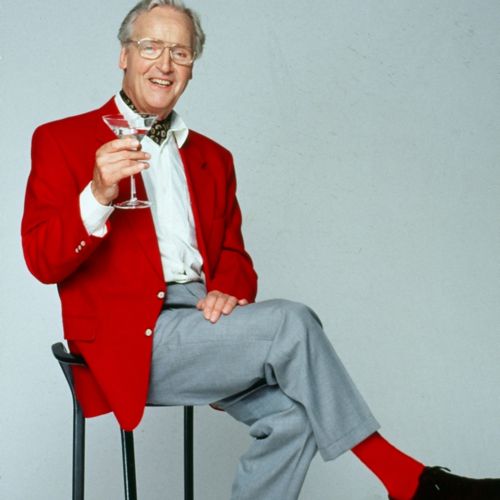
Nicholas Parsons hosted The Great British Musicals in Concert at the Matcham Room, at the London Hippodrome
The Great British Musicals in Concert was performed at the Matcham Room at the London Hippodrome.
Who better to host an evening dedicated to the best of British musical theatre than Nicholas Parsons, himself a performer in some of the featured shows more than 50 years ago? “Do I know these shows?” he asked. “I was in them! It doesn’t half make you feel old!” And where better to stage such a show than the Hippodrome in Leicester Square, where a number of the songs received their debuts all those years ago?
Parsons – looking fantastic in his 90th year, kitted out in a blue crushed-velvet jacket (acquired from his time as the Narrator in that Great British Musical The Rocky Horror Show) and sporting a silver-headed cane – was referring to shows “from a time when light music was taken seriously…”, shows written by the likes of Gilbert and Sullivan, Lionel Monckton, Ivor Novello, Noel Coward and Noel Gay. But this cabaret concert of highlights from the history of the British musical also included later gems from the talents of Sandy Wilson, Leslie Bricusse and Anthony Newley, and, of course, Andrew Lloyd Webber.
The one-off evening was the brainchild of creative and musical director Ross Leadbeater who, in 2013, had conceived and staged Ivor Novello – The Great British Musical at the St James Theatre and Hippodrome. Leadbeater, who provided the delightful piano accompaniment on the night, was also responsible for establishing The Novello Singers – the West End’s Katy Treharne (Phantom), Rhidian Marc (Les Miserables), Richard Kent (Wicked) and Annatt Bass (Phantom) – supported by an eight-voice choir consisting of Leigh Rhianon Coggins, Victoria Humphreys, Mira Ormala, Lydia Jenkins, Jonathan Bourne, Matthew Crowe, Charlie Vose and Lee van Geleen.
The format was a fairly straightforward cabaret, presented chronologically from G&S to Lloyd Webber and punctuated with amusing anecdotes and off-the-cuff observations from a very chipper Parsons (including one about his mother’s dog humping a bishop’s gaiters at Noel Coward’s home!). It was something of a game of two halves, with the first 16 songs taking us up to the end of the Second World War – covering the period from G&S’s HMS Pinafore (1878) to Novello’s Perchance to Dream (1945) – and the remaining 17 from Sandy Wilson’s The Boy Friend (1953) to Lloyd Webber’s The Woman in White (2004).
A classy and sophisticated affair, the youthful performers brought vim and vigour to what could have been a bit of a dusty evening, and movement director Philip Joel ensured that the performances were a notch above a static stand-and-deliver. Leadbeater, a champion of early 20th century British musical theatre, did a good job – in what I suspect was a short time – to communicate his enthusiasm to the singers, who took great delight in performing the earlier songs in an appropriately old-fashioned way. None of that over-the-top West End emoting here: just simple, effective songs delivered in a simple, effective manner. I suspect this was as close as one could come to hearing these older songs as they would have been sung the first time around… perhaps something that only Parsons would have appreciated!
Performances of note included a tender and poignant rendition of Novello’s most beautiful song ‘We’ll Gather Lilacs’ (Perchance to Dream) from Treharne and Bass; Kent’s comic turn in ‘And Her Mother Came Too’ (A to Z), also by Novello; and a powerful song entitled ‘Soliloquy’ from Ron Grainer and Ronald Millar’s 1964 musical Robert and Elizabeth by Treharne.
So, a refined evening of lighthearted, pleasant show tunes in a classy venue, and one that has surely introduced a new audience to some forgotten gems. I wasn’t convinced that the British connection was enough to gel the songs together – there was no inherent ‘Britishness’ in the material and no other obvious grand unifying theme – and the Lloyd Webber element at the end felt a little tacked on and obligatory. A fan of G&S is not necessarily a fan of ALW, for example. But I’m not sure it really mattered. The audience certainly didn’t care. Parsons’ suggestion that the event should become a regular occurrence was followed by a rousing “hear, hear”.
Craig Glenday
Readers may also be interested in:
Ivor Novello – The Great British Musical – Review
SHARE THIS POST:



Comments are closed.