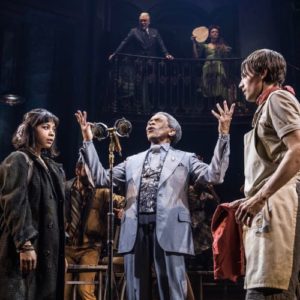
Eva Noblezada, André De Shields and Reeve Carney in Hadestown, London. Picture: Matthew Murphy
Hadestown continues at the Walter Kerr Theatre, New York.
Star rating: five stars ★ ★ ★ ★ ★
With a decade-long peripatetic journey of development and furbishing, Hadestown has finally ignited on Broadway. The wait was worth every minute. With book, lyrics and music by singer-songwriter Anaïs Mitchell, this deep dive into Greek mythology works like an hallucination you may never want to end.
The stops along the way to the Main Stem included early versions presented in Mitchell’s home state of Vermont in advance of the release of a concept album. Then, ground-breaking director Rachel Chavkin climbed on board, joining Mitchell to further develop the piece as fully-fledged musical theatre. Their work was revealed in 2016 in an Off-Broadway production at the adventurous New York Theatre Workshop and then in a follow-up mounting in Edmonton, Canada in 2017.
With Broadway already in the cards, Hadestown, as I’m sure you recall, came to London last fall in an acclaimed mounting at the National Theatre, then bounding over the Atlantic to dig in for what should be a notable New York stay. The fandom already built for the show was evident at the performance attended. As each of the major characters was introduced, their names were greeted with frenzied bursts of applause and cheers. It’s a little surprising (at least to Hadestown novices) to hear rock-concert style greetings given such names as Persephone and Orpheus.
Playing Mitchell’s five principal characters are the five performers from the London production. Reeve Carney is the earnest and golden-voiced balladeer Orpheus; Eva Noblezada is his beloved Eurydice lured into the underworld by its king, Hades, embodied by Patrick Page. Persephone, goddess of the seasons and Hades’ wife in a marriage turned sour, is portrayed by Amber Gray, while André De Shields narrates the whole shebang as the messenger god Hermes.
Under Chavkin’s non-stop inspirational direction, the five are giving spectacular performances that fairly seethe with magic, combining contemporary vibrancy and attitude with the power of legend.
The close-harmonising trio of Fates, continuously reminding us how they control our destinies, now are Jewelle Blackman, Yvette Gonzalez-Nacer and Kay Trinidad, mixing more than a hint of threat with infinite vivacity.
Finally, there’s the chorus, as in both the Broadway and the Greek sense, commenting on the action as citizens of the earth and then assaying the enslaved workers of Hades’ domain. They add intensity to just about every turn in the storytelling. They are Afra Hines, Timothy Hughes, John Krause, KimberIy Marable and Ahmad Simmons.
Or maybe not so finally. There is also the seven-member orchestra, nestled on stage in three different areas of Rachel Hauck’s majestically foreboding set. It’s conducted by Liam Robinson, who also plays piano and accordion. The musicians, like just about everything else on stage in Chavkin’s grand panorama, including the revolves and treadmill, and, of course, the costumes by Michael Krass and Bradley King’s lighting, become an integral part of the storytelling and the dynamic choreography of David Neumann.
That story tells how Orpheus does not quite succeed in rescuing Eurydice from Hadestown, while almost – but not quite again – fomenting a revolt among Hades’ oppressed workers. “It’s a sad tale,” as Hermes tells us toward the end, but one that will be sung again in hope that things might turn out better.
Into that tale, Mitchell has woven so ingeniously a panoply of up-to-the-minute concerns that you might feel you’re getting breaking news along with your supreme entertainment.
These concerns include climate change, economic inequality, the double-speak of politics, and when Hades unleashes his anthem in even-tempered tones of fake rationality ‘Why We Build the Wall,’ you may be dazzled by the sheer perspicacity and prescience of it.
Hard to believe this particular song was included in the concept album, recorded long before the United States had its own top guy with a penchant for building walls.
Almost overriding these themes, what Mitchell tells us about is the power of love and the power of music. And it’s in the music – wonderfully orchestrated and arranged by Michael Chorney and Todd Sickafoose and gloriously performed throughout – that Hadestown reaches its most heavenly heights.
The score skips with constant surprise from the invigorating rhythms of Dixieland, Creole and Cajun (the set, too, has a New Orleans flavour), to ear-caressing ballads, contemporary folk and strains of soul-piercing, almost liturgical character.
It’s music that’s alternately seductive, mesmerising and exhilarating, adjectives that, of course, describe the entire Hadestown experience.
Ron Cohen
SHARE THIS POST:


Comments are closed.