 Hotel For Criminals continues at the New Wimbledon Studio, London until 29 October.
Star rating: three stars ★ ★ ★ ✩ ✩
If, this Halloween, you’re looking for an evening of spooky respite, guaranteed to make you laugh, cry, and sing along… this is not your show. Get back on the train, and catch The Rocky Horror Show.
If you hanker after something much more unsettling, surreal, and complex, get over to the New Wimbledon Studio and try this on for size. It may surprise you, as long as – and this is important – you don’t expect any kind of emotional release. As the show’s director Patrick Kennedy eloquently puts it: “Don’t trouble yourself with catharsis. It won’t happen. Just experience.”
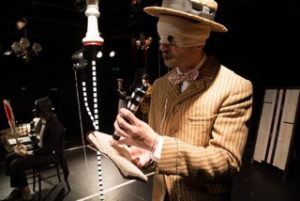
Inspired by the popular gothic 19th century villain of Parisian fiction, ‘Fantômas’, Richard Foreman has created a darkly disjointed underworld of characters, led by the felon himself, who hosts a remarkable assortment of reprehensible characters in his underground hotel. These include the seductress, Irma Vep; his Madonna of a virginal daughter, Helene; Max, a journalist who may or may not be imprisoned; and an omen of death, in the form of a great black raven – because no surrealist drama is complete without at least one!
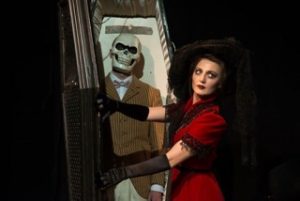 Narrated by an interminably slow devilish voice-from-above, the company slot, almost doll-like, into their tracks, flitting from scene to scene with the feel of a puppet or clockwork-box show, heightened by the oversized chess pieces and brilliantly re-purposed/sourced set pieces.
Each short scene is bookended with a violent buzzer. We learn only enough to make us question – Max loves Helene – or does he? The maid is a vampire – is she? Why is he looking at me? Will he stop soon? Reader, that’s about as close to a narrative as I can get.
Foreman’s ‘Ontological-Hysteric Theatre’ has gained a formiddable reputation and cult status in New York as a pillar of avant-garde practice, and it is a torturous beast to wrestle with.
The difficulty is that it doesn’t feel like generous theatre. It doesn’t afford you the privilege of comprehension, so it runs the risk of self-indulgence, and because it abstains from the standards of conventional theatre, it is difficult to hold to account.
If its aim is to suspend the audience in permanent uncertainty, deliver no feeling within the dialogue, and allow no musical relief, it must offer something more seductive to engage with, which this production doesn’t entirely manage.
There are sparks of genius here and there. The comic characters formed by the ensemble (Tom Whalley as Lacloche and Ben Rawlings as Julot are hysterical) turn out to be physically wonderful to watch, and it’s easy to get lost in watching them over the action.
Kate Baxter’s incredible soprano is worth going through a whole host of discomfort to listen to, as is Alistair Frederick’s stunning range and tone.
Niccolo Curradi as Fantômas feels a little self-aware for a part which requires such indifference to the audience, though he is authoritative and resonant, and his final ballad (‘Surprise’) is a highlight of the show.
The music is the best thing about the production: complex and clever, Stanley Silverman’s score leaves you continuously stretching for release, but never allows it. It acts as a character in itself, dancing through forms from underscore to full silent film romance, to Wagnerian fanfare and all the shades in between. The a cappella quintets need a little work in terms of blending and tuning to each other, but in general they work very well.
This is theatre for the curious, the absurd, those with a dark turn of mind. There’s no guarantee you’ll love it, but you’ll leave with no end of questions, and perhaps that’s part of the point.
Aura Simon
SHARE THIS POST:


Comments are closed.