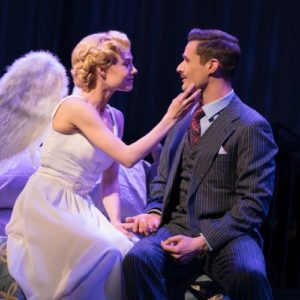
Sara Mearns and Mark Evans in I Married an Angel, an Encores! production, at New York City Center. Picture: Joan Marcus
I Married an Angel, an Encores! production, played New York City Center.
Star rating: four stars ★ ★ ★ ★ ✩
I Married an Angel was a Broadway hit in 1938, a classy and frothy entertainment filled with 1930s-type risqué tomfoolery, a cornucopia of Richard Rodgers melodies, both lush and jaunty, and Lorenz Hart’s wickedly genius lyrics.
The show merits important footnotes as well: the legendary choreographer George Balanchine, who collaborated with Rodgers and Hart on four shows, created the dances here for his wife-to-be, famed ballerina Vera Zorina. They married on the stage of a New Year’s Eve performance of the show, according to the Encores programme. (What the programme doesn’t tell us is that they divorced in 1946.)
In mounting the show as one of the three productions of its 25th season, New York City Center’s Encores! series obviously approached the title as a very classy project and gave it its own classy fillip in casting. Playing the titular seraph was New York City Ballet principal dancer Sara Mearns, and she’s married to Josh Bergasse, who directed and choreographed the show. The high-toned mode was further evident at the overture. Rob Fisher, founding music director of Encores, conducted the peerless on-stage 29-piece orchestra in white tie and tails.
The mood continued with six pairs of waltzing couples in elegant formal dress who opened the show, and carried through to inform at least the look of the production until the final bows, thanks to Alejo Vietti’s costumes, Allen Moyer’s set design and Jeff Croiter’s lighting.
What was in shorter supply was the froth. It seemed to come and go, as the story in Rodgers and Hart’s book, with “concert adaptation” by Sandy Rustin and Sarah Saltzberg, unwound.
Based on a play by Hungarian Janos Vaszary, it tells of a Budapest banker who, as the title says, married an angel, an actual angel. She obligingly comes down from heaven to wed him, after the banker, Count Willie Palaffi (Mark Evans), scornful of the loose morals and flippant ways of human womankind, has him declaring that if he were ever discovered married it would have to be with an angel.
However, the modus operandi of the new bride, simply known as “Angel”, is – despite that with marriage she has lost her wings and become human – to always tell the truth, and she winds up insulting the bank’s biggest depositors. This exacerbates further a run on the bank. The unworldly Angel has also slapped the face of the wealthy Harry Mischka Szigetti (Tom Robbins), who has promised Willie a loan, after he takes her on the dance floor and slips his arm around her waist, simply in preparation for a rhumba. Now Szigetti has reneged on the loan.
Finally, though, Willie’s very worldly sister, Peggy, takes Angel in hand, teaches her that a woman can get away with anything – any kind of dishonesty – if she does it with, as the song says, ‘A Twinkle in Her Eye’. And taking Peggy’s advice, Angel goes on to save the day both for her marriage and the bank.
It might well take a treasure trove of wit and inventiveness to make the nonsensical plot completely beguile today’s audiences, particularly in its view that the human female animal needs to be a little deceitful, perhaps falsely seductive, to get things done for her man. Not exactly a #MeToo era message, but it could be seen as just musical comedy frippery if the accoutrements were distractingly dazzling enough.
A lot of the problems came with the over-emphatic delivery of fairly stale comic lines, and Bergasse’s tendency to overload the comic songs with just too much awkward business. The melodic delight of ‘I’ll Tell the Man in the Street’ between Robbins’ Szigetti and James’ Peggy almost got lost, as they cavorted endlessly about the stage, although the talented performers still managed to deliver the lyrics with the utmost clarity.
Mearns brought to Angel, the character’s guilelessness notwithstanding, an impressive sense of native intelligence, and while Angel doesn’t sing, her low-octave speaking voice is a stagewise pleasure to hear.
The extended ballet numbers include the honeymoon sequence (which Angel seems to spend with the corps de ballet rather than her husband) and the parody of surrealist dance, which is part of a long fantasy in which the characters imagine what they would do if they were performing in New York ‘At the Roxy Music Hall’.
The ballets are always at least admirable, sometimes lovely, and danced by Mearns with all the expected eloquence and precision, but they rarely rise to exciting. It’s almost as if the short rehearsal time of the Encores’ playbook had limited Bergasse’s invention.
The show comes more alive with some hard-driving tap numbers. The main tappers are Hayley Podschun, playing Anna Murphy, Peggy’s American friend, and Phillip Attmore, as Peter Mueller, Willi’s bank manager. They lead the company in a spirited ‘How to Win Friends and Influence People’, and in the Roxy Hall fantasy Attmore shows off his not-so-inner Astaire with a terrific solo.
Podschun also shines in delivering the many lyrics of ‘Roxy Music Hall’, as she suggests to her Budapest pals that they visit the place should they ever be in New York. It may be the most strained introduction to a production number in the history of musical comedy, but the free-wheeling stuff that follows makes you forgive it.
Another Roxy Hall fantasy is Willie’s operetta parody, in which he leads a group of defiantly macho ‘Men from Milwaukee’, singing about the city’s signature beverage: beer. Evans performs the number with a blast of gusto that’s missing elsewhere in his rather flat interpretation of Willie. He does, however, deliver highly listenable versions in a vibrant tenor of the show’s two big ballads, the title song and the gorgeous ‘Spring Is Here’.
So, while this Angel may not have taken you completely to heaven, you would have gotten more than occasional glimpses of the Elysian Fields in the show’s seven performances, which concluded on 24 March.
Ron Cohen
SHARE THIS POST:


Comments are closed.