 As the run of Billy Bishop Goes to War at the Southwark Playhouse comes to the end this weekend (6 April 2019), we reflect on the time actor CHARLES AITKEN, playing the younger Billy, spoke to Musical Theatre Review’s Tal Fox.
After the First World War, Billy Bishop became a celebrated war hero credited with 72 victories, earning him the top spot in the Canadian and the British Empire army. He was awarded the Victoria Cross for his incredible success during the war.
If you haven’t heard of him, you’re probably not alone, but audiences have been learning more about the man in the musical Billy Bishop Goes to War.
This musical is a dark comedy where an older Billy looks back on his life and what it means to be a celebrity of his stature. The show also acknowledges the often neglected complexities of Britain’s colonial past.
Charles Aitken plays the younger Billy in the show alongside Oliver Beamish as older Billy.
Charles’ theatre credits include: Coriolanus (Royal Shakespeare Company, Barbican), Cat On a Hot Tin Roof (Manchester Royal Exchange), All My Sons (Regent’s Park Open Air Theatre), Sweet Bird of Youth (The Old Vic), Little Eagles (Royal Shakespeare Company, Hampstead Theatre) and King Lear, As You Like It, Antony and Cleopatra (Royal Shakespeare Company, Roundhouse NY).
How does it feel to be portraying a real person?
It’s wonderful but it comes with its challenges. You can draw on so much information to help build the character and a quick Wikipedia search will give you all the bare essentials. Billy Bishop wrote his book detailing his own exploits in 1919 so I got a hold of that and then I got a book by his granddaughter, she gives a different perspective on the man. Of course you’ve got historians who’ve got a more academic approach. So you have this 360° resource of information but the challenge of his story comes from what’s on the page.
John Gray and Eric Peterson devised a specific portrait of Billy Bishop. Having all that extra information is useful because it gives you more options and more in your arsenal of ideas to play with, but you’ve also got a responsibility toward the man who actually lived. You’ve got to make choices. Apparently Billy Bishop had quite a sibilant S so we asked ourselves whether we wanted to make a virtue of that or would that just be distracting? No one ever comments on it in the play, that’s just a bit of an interesting fact I found out during research.
Do you feel any pressure playing a real figure?
Yes, I met the head of the army museum from Canada because he was over here celebrating an exhibition in London about First World War painter Alfred Munnings. As the head of the Canadian army museum, he knew exactly who Billy Bishop was and said: “Oh wow, you’ve got some big shoes to fill there.”
I want to honour the creators who would have had a specific agenda that may not always be hagiographic, but that’s not the job of the artist. The job of the artist is to interrogate the psychology and the emotion of what it means to be someone who goes through this war experience and try to distill something universal from it. It’s not intended as a monument to the man but certainly not a takedown of the man. It’s the presentation of the human being in all his gorgeousness and all his failings as well.
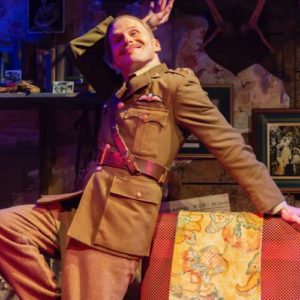
Picture: Nick Rutter
What attracted you to the show and the role?
Everything! I’m massively interested in the First World War fan. I did Journey’s End at drama school a number of years back. I have Canadian family and have spent time living in America, so Billy’s sort of optimistic, can-do, charming ‘let’s just take a chance and see what happens’ approach to life resonates with me very much.
There’s a lot of comedy in it and sometimes there are sections that feel like an Eddie Izzard stand-up because I’m playing multiple characters. But it’s just me so I thought that would be a great challenge.
There are some gorgeous songs which I get the pleasure to sing, all original. There are some very moving sections, it creeps up on you. This is totally out of the confines of the dugout, it’s up in the air, it’s in the skies, it’s open and free, so it has a lightness and an expansiveness to it.
The playwrights have done a brilliant job of threading in the poignancy and the cost that comes with success in war. They look into what it means to succeed when other people have failed and lost their lives. I cried when I read it, let’s put it that way. I laughed at the beginning and then thought there are bits in it that are almost like action set-pieces especially, stuff when he’s describing his dog fight in the air. Then there’s very moving sections. I thought, if it moved me to tears just from reading it, it’s probably worth a go.
What’s the most interesting or surprising thing you’ve learnt about Billy Bishop?
The most surprising thing I guess would be, and this is slightly controversial, is that immediately following the war and for a good 34 years after he was this huge celebrity, particularly in Canada. He had a Rolls-Royce and he was rolling around town with the high and mighty.
He went back to Canada and slowly he got forgotten about here, but in Canada he was still this celebrity. Hr was friends with Howard Hughes, appeared in a Warner Brothers movie, and possibly had an affair with Rita Hayworth. He died in West Palm Beach in the early 60s and he was this unimpeachable legendary hero.
But there’s always been these mutterings that maybe he didn’t have as many victories as he suggested. In the early 80s there was a documentary released which called into question large parts of his wartime success and in particular the Act of Valour for which he was awarded Britain’s highest distinction, the Victoria Cross.
It was for this solo raid on the German aerodrome and it’s the first and only time that the Victorian Cross had ever been awarded to someone without any corroborating testimony from another source. So it was literally just Billy’s account of what he did and the condition of his plane when he got back to base. There were no eyewitnesses, no evidence on the German or English side, all there was was Billy’s word. It happened at a time when the British really needed a good PR story.
One of the books I read was by a historian a Canadian military historian who has since said that Billy might have been the bravest man flying but he might have also been the biggest liar and I thought that’s fascinating. The idea of the unreliable narrator is a really attractive one for me and everything I’ve read says the guy was charming, the guy was lucky, he could charm the birds from the trees, and he just had that kind of twinkle in his eye – that Hans Solo maverick quality that made him very attractive and certain people got behind him.
Our play isn’t in any way suggesting that he made up his victories but it is offering up the possibility that a great storyteller never lets the truth get in the way of a good story. Here’s a man who may have become the most highly ranked, most famous wartime hero for his country and it could have been built on a series of extraordinary great fabrications.
What was it like to live with that level of celebrity?. He was a celebrity by 23. What do you do when you’ve got to live the rest of your life and you know you’ll never get back to those glory days and then that little extra thing: what if you knew it was all a lie?
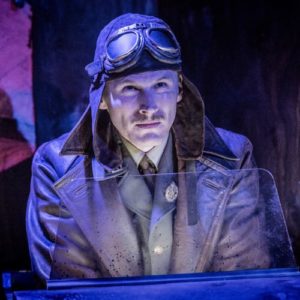
Does the show acknowledge that?
It acknowledges that he was a liar and a cheat at school and in the first few lines we have older Billy looking back on his younger self (my role) and he says: “Look at me, I was at Royal Military College, I was called a liar and a cheat.” Immediately we say that this guy wasn’t really that bothered about playing by the rules. Throughout the show people of high status are constantly saying: “You’re nothing,” “You’re rubbish,” “You’re just a Canadian,” “Look at you, get your act together,” “You’re a waste of space,” “You can’t fly” and they’re always running him down, so it’s almost like he decides: “I’m going to prove you all wrong, I’m going to become number one whatever it takes.”
The play itself doesn’t say that he lies his way to number one but we have staged his famed single-handed aerodrome attack in such a way that is quite theatrical and opens up the possibility that it’s possibly too good to be true. We abandon naturalism and make something a little more theatrical which I don’t think says he’s lying, but it does become a little bit far-fetched, just to plant that little seed.
Then it’s up to the audience to decide whether or not they feel the guy is being straight and deserves all the acclaim he has received. It’s ultimately about a man just trying to survive the war any way that he can and accidentally becoming a hero in the process.
What’s it like having the two perspectives intertwined throughout the show?
It’s amazing, for starters I haven’t shared the same role with another actor since drama school and it’s a brilliant process. Oliver Beamish is amazing on the piano, he’s an amazing actor, but he’s also amazingly generous and kind and open.
What we have is the example of Edmund Hillary and Sherpa Tenzing who reached the summit of Everest together, one is dependent on the other entirely and it is a mountain to climb to tell this big story. With only two people in an intimate space, it goes from being close-up camera shots of incredible intimacy to trying to sell the story of being in a soaring plane with barrel rolls and gun fire. It’s a big theatrical mountain to climb and without him I couldn’t do it.
The audience gets this gorgeous almost simultaneous perspective on the same thing, one from the position of a young man actually living these experiences, but then they can check in with older Billy and what it means to this old man in his twilight years. I think it creates a very poignant dual perspective and it also gives audiences different people to get behind.
Younger members of the audience will naturally gravitate towards me as young Billy and feel really involved in the action set-pieces and the older members will really relate I think to this older gentleman, trying to make sense of his life and especially this highpoint in his young life. How he has dealt with having survived something which so many people didn’t.
How does it feel to be playing multiple roles?
In the original incarnation, John Gray was just a piano player and Eric played Billy and 17 other characters. When I read the play I thought that was what I was going to be doing and I was both thrilled by that challenge and absolutely terrified. When Jimmy [Walters], our director, said: “Look, I’ve got this idea that actually the piano player is older Billy,” everything slotted into place.
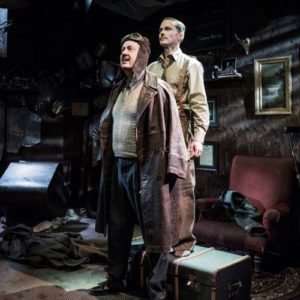
Picture: Robert Workman
There are some very high status characters who are natural people for Oliver to play and I don’t have to find 17 other characters and voices. It gives me someone to play with on stage so I’m not just purely doing Eddie Izzard talking to the audience and thin air, it gives me someone else to actually talk to and to play off.
Oliver gets up and plays other characters frequently enough that the audience get to hear a fresh voice. As much as I love the sound of my own voice, I think the audience would get a bit tired. So what’s lovely is every five or ten minutes they get a blast of this other voice. I get to play some fun characters, I get to play a sectgenarian, aristocratic lady who is a mixture of cheerleader and dominatrix and then I get to play a sexy French cabaret singer at one point. Making this play more of a two-man rather than one-man show just increases the drama and the variety for audiences enjoying the performance.
How does the music fit into the story?
Originally John Gray wrote songs and a score that provided a soundtrack to the whole thing. We’ve taken that score out so we have a play with songs as opposed to something that has music throughout. The songs are gorgeous and they’re all original and they move the story forward. The piece was written in the late 70s early 80s and you can hear certain flavours that range from pre Les Mis to a bit of Neil Young or Randy Newman.
So you’ve got this lovely mixture of styles that feels contemporary in terms of music and the songs exist to move the story forward. They’re shared between older Billy and younger Billy which is lovely and we’ve done a lot of tinkering with the show so that certain songs that were exclusively sung by me are now shared between the two of us for a dual perspective.
They’re funny and moving and there’s one in particular in the second half that’s very moving, it’s a contemplation on fallen comrades and I think it’s gorgeous. I’ve only done one musical in my professional career since leaving drama school which was Hair, so for me it’s super important that it’s a good tune that helps move the story forward lyrically and emotionally and I think that’s what we’ve managed to achieve with this.
Does moving to a bigger venue allow for any changes to the show?
Yeah, it’s a completely different layout from the Jermyn Street Theatre. The whole show is done as a direct address to the audience There are scenes where we play it like there’s a fourth wall, but then immediately the fourth wall gets broken and I go back to saying: “Alright guys let me continue with my story.” To push that further, I go into the audience.
There’s constant talk in the play of going behind enemy lines so I wanted to really get amongst the audience. At Southwark I very much enjoy crossing behind enemy lines into the audience.
What can you tell us about the show that we couldn’t find online?
I think what you can’t find online is the music. Some of it feels like quite classic musical theatre and some of it feels like it could be wartime songs from the First World War, but the music on the whole is gorgeous. It’s a story about a heavy subject matter that doesn’t make heavy of going of it at all.
It’s an art piece, it’s not in the trenches slogging through the mud. It’s a story about a charming guy who takes a punch, swings himself into the air and takes great joy in it. There’s great joy, humour and fun and the songs support that. I think that won’t necessarily come across from pictures or just reading about it.
It’s a really fun show, although we don’t shy away from being honest about the more poignant aspects of it. But by that point in the evening hopefully everyone has been laughing and really charmed by this guy and then they get a bit of a gut punch when they realise in the second half what it’s costing him to be this ever effervescent charming guy.
They can also check in with the older Billy and see the price of celebrity, you can never not be on, you always have to be ‘Billy Bishop’, you can’t just be Billy. It’s fun and it’s upbeat and it’s exciting until it becomes quieter and then very moving. To me it kind of has it all.
SHARE THIS POST:


Comments are closed.