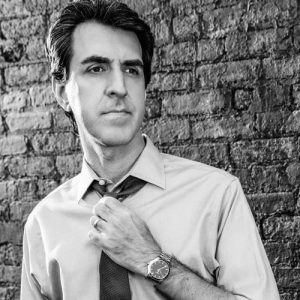
 Jason Robert Brown in Concert was at the London Palladium.
Star rating: four stars ★ ★ ★ ★ ✩
“I came to sing a song about hope,” Jason Robert Brown croons in his opening number for what will become a special edition of BBC Radio 2’s Friday Night is Music Night. It is a highly metatextual number, self-consciously describing the composer’s anguish as he struggles to construct the song he is actually singing now.
Brown is not the sort of composer with whom one would traditionally associate any form of self-doubt. The man whom comedy revue Forbidden Broadway once characterised as “President of the Jason Robert Brown Fan Club” has the kind of immodest swagger that is carried well by people who have the utmost belief in their own talents.
But with that also comes the self-deprecation of someone who has matured enough to know their own limitations. When describing how he was approached by a charity to write a song inspired by an 11-year-old girl needing long term medical care, he quips that he asked the organisers: “You do know what songs I write?” And they said: “Yeah – not one of those.”
And the resultant number of that collaboration, ‘Invisible’, is indeed unlike Brown’s theatrical scores. A relentlessly breezy disco number, his performance is greatly enhanced by being backed by the BBC Concert Orchestra.
Brown occasionally conducts the orchestra himself, first for a suite of orchestrations from his Tony-winning musical The Bridges of Madison County, and again with a suite from The Trumpet of the Swan, a symphony for orchestra and narrator based upon E.B. White’s novel. But he seems to feel more comfortable sitting at a downstage piano, engaging the audience rather than having his back to them.
At other times, conductor Larry Blank corrals not only the orchestra, but vocalists Capital Voices and Brown’s own rhythm section, joining him as a means of promoting his forthcoming album How We React and How We Recover.
But while there are several numbers from that album scattered throughout the evening, the emphasis is on Brown’s back catalogue. The Bridges of Madison County gets another airing in a selection of vocal performances from the show, with Betsy Wolfe and Norm Lewis taking the roles of Francesca and Robert.
Both performers have recurring spots throughout the evening, as does Brown’s third guest Rachel Tucker. But, while Tucker excels in her rendition of ‘Stars and the Moon’ from the composer’s Songs For a New World, she is eclipsed by Wolfe’s rendition of ‘The Flagmaker, 1775’, as a woman (possibly her near namesake, Betsy Ross) stitches together a flag as her loved ones go off to fight in the Revolutionary War.
That is not to say Tucker is secondary in any way; her stellar performance in a performance on ‘Flying Home’ is testament to that. Possibly the performance of the evening, the song combines everything that is so good about the evening’s entertainment: lyrics that are warm without being overwrought, good backing vocals work and an orchestra that is both occupying every inch of the Palladium stage and owning it.
Indeed, the raucously full sound of the BBC Concert Orchestra – playing songs by a composer who, while acquiring thousands of fans within the world of the musical theatre cognoscenti, usually has to put up with minimalist cabaret arrangements – often provides a 1970s lounge lizard vibe to Brown’s work.
It’s an unexpected feel to a composer whose back catalogue has become so well known, even though the West End has yet to experience either The Bridges of Madison County or the bonkers Honeymoon in Vegas (represented here by several songs, most notably Norm Lewis playing a parachuting Elvis impersonator in ‘Higher Love’, a fine pastiche of the King’s style).
And while Brown’s most well-known musical, The Last Five Years, is only represented musically by one number (Wolfe singing ‘I Can Do Better Than That’), the vicissitudes of being a show recorded for radio means that the show ends with a reprise and a retake of the barnstorming song ‘Melinda’.
The first version having been performed near the start of the show, there is a sense of circularity in it also being the final number that one feels fans of Brown’s oddly structured chamber musical would appreciate.
Scott Matthewman
SHARE THIS POST:


Comments are closed.