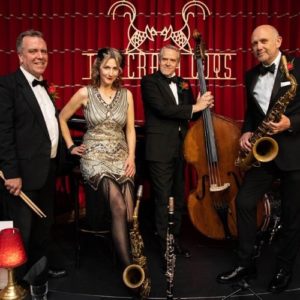
 Kate Garner: Songs From the Art Deco Decades at Live at Zédel, London.
Star rating: four stars ★ ★ ★ ★ ✩
Singer, pianist and songwriter Kate Garner presents a very eclectic programme of music in her programme of songs from an earlier age.
Her father was the late Chas Hodges, of Chas & Dave fame, while her mother is an actress and former Bunny Girl, so Kate Garner is following in the family tradition of music making and performance. Her grandmother played piano in a London pub and was often visited by the great Lionel Bart. So, in fact, music seems to have been in her blood since day one.
Apparently she spent the first week of her life in a cot on the stage of Gracie Fields’ ballroom. By the age of five she was writing her own songs. Later on she sold pianos at Harrods as well as playing them in over 50 pubs before making appearances at the London Palladium and the Royal Albert Hall.
Although obviously encouraged by her family’s musical history, Garner has, however, pursued her own career by taking a different path to that of, say, dad Chas and his musical partner Dave Peacock. Her admiration is reserved for the songs of the golden age of Art Deco, from the early part of the 20th century before the First World War up to the late 1930s. That era offered new ideas in art, design and fashion and the popular songwriters of the day responded in kind by producing material that has now become to be known as the Great American Songbook.
Garner plunders this productive era with great aplomb and delivers what this reviewer would call some of the greatest songs of the century. Songwriters of the day were writing not only for the popular singers of the day and their audiences but also nightlife cabarets, the Broadway theatre and the Hollywood movies of the time and, in the process, were making it the best of times for the popular song in the USA.
At the piano, Garner opens with a clutch of great numbers, namely ‘Please Don’t Talk About Me When I’m Gone’, ‘Happy Feet’, ‘Pretty Baby’, ‘Yes Sir, That’s My Baby’ and ‘Happy-Go-Lucky You’. It is amazing to think that all these numbers were written between 1916 and 1932 and yet they have all remained indelibly etched on our memories.
What’s more is that they still sound just as fresh now as they did when they were first written. Garner does all of them very proud indeed and her obvious joy of singing and playing them is very apparent. These are songs that have lasted and will still last for evermore. Are there many popular songs of today about which we could say the same?
Garner then moves on to demonstrate her own songwriting talents and indeed she appears to have been influenced by the Art Deco period. Writing both music and lyrics in her own songs, she captures all the spirit and the vitality of the 1930s after she had just played songs by the likes of Milton Ager, Gus Kahn and Walter Donaldson. Her songs might well have been written several decades ago as they evoke a similar joie de vivre and wry humour, qualities that she captures so well in her performances.
Her double set also includes some fine and classic stage and screen songs such as ‘The Way You Look Tonight’ by Jerome Kern and Dorothy Fields, from the film Swing Time; Noël Coward’s ‘Someday I’ll Find You’, from Private Lives; Cole Porter’s ‘What Is This Thing Called Love?’, from Wake Up and Dream; Sigmund Romberg’s ‘Lover Come Back to Me’, from The New Moon; and Jerome Kern’s ‘Can’t Help Lovin’ Dat Man’, from Show Boat.
And, talking of shows, Garner has written the book, the music and the lyrics for her own stage musical based on the Mapp and Lucia novels of E.F. Benson, written during the Art Deco decades. Both ITV and the BBC have over the years dramatised the books for television and they certainly retained their own charm in transferring from page to TV.
They tell of a community of society snobs, in particular Miss Elizabeth Mapp and her friend Lucia and their camp-following companion Georgie Pillson. They live in the fictitious English seaside town of Tilling, which is allegedly based on Rye in East Sussex. Garner’s songs fit this setting very snugly indeed and she has captured the essence of Benson’s satirical writing in songs such as ‘Let’s Make Mischief’, ‘I Don’t Want to Marry You’, ‘All at Sea’, ‘Diva’s Tea Shop’, ‘Novices in Maquillage’ and ‘Modern Odyssey’. The show is due to be produced later this year, so that is something to look forward to in transferring the books now from page to stage.
She is aided and abetted for the Mapp and Lucia songs by Lucy Thackeray and Julia Riley plus Paul Garner at the piano and as Georgie, with added support from Tom Carradine. Her resident musicians at Crazy Coqs (every one a virtuoso) are Robert Fowler on clarinet and saxophone, Dave Berry on double bass and Mike Osborn on drums and percussion, who all contribute to a very enjoyable evening of nostalgia.
Michael Darvell
SHARE THIS POST:


Comments are closed.