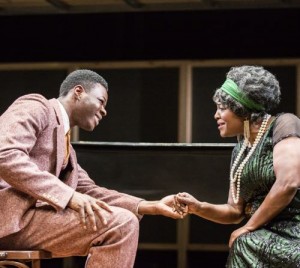
Tunji Lucas and Sharon D Clarke in Ma Rainey’s Black Bottom at the Lyttelton Theatre, London. Picture: Johan Persson
Ma Rainey’s Black Bottom continues at the Lyttelton Theatre, London until 18 May.
Star rating: four stars ★ ★ ★ ★ ✩
It’s hard to deny the influence that blues music has had on musical theatre, indeed a great deal of western popular music owes a debt in one way or another to blues, ragtime, and African-American roots music. Dominic Cooke’s revival of August Wilson’s 1984 classic Ma Rainey’s Black Bottom at the National, the first of Wilson’s ten-strong ‘Pittsburg Cycle’ of plays confronting the undercurrent of residual post-slavery anger, is faithful to that undertone of resentment, if occasionally playing up to it a little too much.
On the surface, this is a piece about the great diva Ma Rainey, self-styled ‘Mother of the Blues’, set during the course of one recording session, in 1927. It fidgets around while we watch the studio crew bending over backwards to try and pacify/motivate/placate her into a smooth session, but there will be none of that today. The real story lies with the musicians in the session band, who begin the day hopeful for a slick and easy experience, but ultimately unravel into tragedy, spurred on by the seething vein of distrust and resentment slavery has left in its wake.
Levee, the volatile and charismatic young cornet player, is at constant odds with the rest of the ‘tub jug washboard band’, as he refers to them. Yearning for his own band and songs (as the flippant Sturdyvant has no doubt promised him offhand), he inflates and sulks like a teenager longing for his moment of freedom. It would be easy to leave Levee as a sullen adolescent, but O-T Fagbenle is in his element here, lending a nuanced and harrowing hand to the performance.
A perfect counterpart, Lucian Msamati as band master Toledo, infuriates Levee with calm opposition at every turn. The two are well cast, and play off each other nicely. Clint Dyer, as Cutler the trombone player, is a highlight – there is a huge sense of a man torn between loyalties, to his race, his God and his desire for a quiet, peaceful life.
There is chemistry lacking between the manager Irvin and Sturdyvant, our music producer (namely, Finbar Lynch and Stuart Mcquarrie), and the dialogue which opens the show lags a little for it. The motivations seem to be well-rehearsed but lacking spontaneity, which of course ruins the comic timing. Fortunately, the arrival of the band revitalises the pace, and we begin to understand the real guts of the piece.
This is an actor-muso’s dream. A gritty, important drama rooted in the music of the time, and driven by the musical interludes. The beauty of Wilson’s script is that the music takes over where the words have done all they can. Whatever platitudes or self-denials are in the mix, the honesty of their sound cannot be escaped, and that tension is manipulated expertly by the cast of band-mates. The Act I finale in particular packs a punch with monologue and agonising blues ballad crying out to each other in a powerful duet between the volatile Levee and easy-going Giles Terera as Slow Drag, the bass player (with what turns out to be an incredible voice.)
There are, however, moments where the pace lags, and some of the dialogue and anecdotes are treated with a bit too much reverence. The sharp turns of mood and atmosphere are being signposted a little too much so the moments never quite reach the heart-dropping edge the text deserves.
Sharon D Clarke of course has enough stage presence to fill several stadiums, and her treatment of Ma Rainey is dignified and played with great pride. However, the performance lacks a little something extra, the idiosyncrasies aren’t quite there, so the portrayal comes across occasionally as just less than three-dimensional. But there is a great sense that the diva in front of the mask isn’t there for facade, in this white, male-dominated world. Even the smallest of her demands are a battle for control, and the stakes are too high to lose out to any of them.
Her nephew, Sylvester, is a delight to watch. Tunji Lucas’ performance as the henpecked relation stuttering his way through the recording’s introduction is a piece of comedy genius, and genuinely tense and heartwarming in equal measure to watch.
All in all, this is a moving and multi-faceted piece of work. Everything from the set design (functional but with a sparse elegance to it, by Ultz) to the musical numbers (Tim Sutton) is top-notch. However, I can’t help but feel that the cast have sat back just a touch on the material, not quite giving it the bite it needs, and I look forward to seeing it again later on in the run once it has percolated a little more.
Aura Simon
Tickets for Ma Rainey’s Black Bottom at the Lyttelton Theatre are available HERE.
SHARE THIS POST:


Comments are closed.