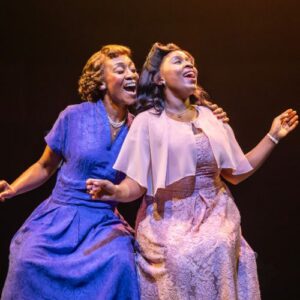
Beverley Knight and Ntombizodwa Ndlovu in Marie & Rosetta at @sohoplace, London. Picture: Johan Persson
Marie & Rosetta continues at @sohoplace, London until 11 April 2026.
Star rating: five stars ★ ★ ★ ★ ★
Inspired by the church, filtered through seedy nightclubs, and driven by a magnificent self-determination in the face of prejudice and injustice; rock ‘n’ roll music was invented by a queer black woman: Sister Rosetta Tharpe. This trailblazer was performing passionate gospel and R&B songs with swing and muscle in the 1930s and 40s, interspersing verses with lightning-fast guitar solos. Literally decades ahead of her time and wildly influential (Presley, Hendrix, Clapton and many more revered and imitated her style), her impact on the course of popular music is staggering.
Many consider the records Tharpe cut with Marie Knight – the vocalist/pianist she plucked from the backing band of rival gospel star Mahalia Jackson – to be her most stirring work. This new play at @sohoplace (written by George Brant and directed by Monique Touko) sets out to tell the story of this collaboration and bring this vital, century-defining music to a whole new generation.
An intimate two-hander, the show is an astonishing achievement on all fronts. Lily Arnold’s set is a triumph of shag carpeting, transforming the central stage of @sohoplace into a tasteful but attractive funeral home-cum-nightclub, aided and abetted by Matt Haskins’ lighting. Special shout-out though to casting director Jacob Sparrow for the headline acts: Beverley Knight and Ntombizodwa Ndlovu as Sister Rosetta Tharpe and Marie Knight, respectively.
It could go without saying that MOBO and Olivier Award winner Knight is superb, but even after the rapturous standing ovation at press night, I feel she deserve yet more adulation. She transforms herself for this role with stunning physicality and her vocals are perhaps even more breathtaking than her already stellar reputation might lead you to expect.
Just as excitingly, however, Marie & Rosetta is the West End debut of Manchester School of Theatre graduate Ndlovu. This pairing of a younger artist invited to perform alongside an established master of their craft mirrors the dynamic of their characters, resulting in truthful and very touching performances.
The pair’s chemistry is off the chart. Each actor is given ample opportunity to show off their incredible singing voice in solo numbers, but when they sing together their vocal blend is heavenly. Throughout, we feel they are performing for each other as much as us. They cry and they laugh and they share heartwarming looks of admiration.
Now, in an ideal world they would also play their instruments, but Marie & Rosetta makes the correct choice in leaving this to the offstage band. Tharpe’s revolutionary guitar playing was a once-in-a-millennia achievement of innovation and technique, which would only have been cheapened if represented on stage by a performer not quite up to those towering standards. Knight is supremely talented, I have no doubt she could do a good job playing guitar, but outsourcing the job to musical director Shirley Tetteh gives Tharpe’s thrilling guitar solos a special and deserved reverence.
I am the first person to cringe at any hint of the dreaded ‘air guitar’, but though Kloé Dean’s choreography sometimes skirts close, when Knight and Ndlovu play their instruments, there movements are always thoughtful and stylised. When the energy ramps up, as in the electrifying act one closer ‘Didn’t It Rain’, the energy generated by just two onstage performers is remarkable.
Of course, the performers offstage deserve just as much credit. Musical director Tetteh is not just note-perfect, but she imbues each song with incredible feeling when she plays her guitars: first an old archtop and then a reproduction of Tharpe’s iconic white and gold early 60s Gibson Les Paul Custom when the play anachronistically explores her transition into electric instrumentation. Her four-piece band – Ishara Andrews on drums, Mia Odeleye on piano and Genevieve Namazzi on double bass – alternately bring the house down with the rockers and bring us to tears in the slower numbers.
This play could be a straightforward gospel concert and not one attendee would leave feeling shortchanged, but Brant’s well-crafted dialogue sections give the music context and weight. Set on the night before the then relatively unknown Knight’s first show with the already legendary Tharpe, the pair work out how they are going to perform together. As they discuss the setlist, many differences in style and personality appear.
However, where many shows would turn these differences into fodder for the easy drama of argument, Marie & Rosetta instead sees the pair learn from one another, grow as people and develop the partnership that led to some of the most revered gospel recordings of the era.
The play’s loose relationship with time – the career-spanning tracklist, Knight playing Tharpe quite significantly aged up – pays off beautifully in a finale celebrating Tharpe’s legacy and its significance. Marie & Rosetta ultimately celebrates a courage of which all are capable, but which very few ever exhibit: the courage to forge your own path, to create that which only you could create. When history delivers us a person with such courage, they invariably change the world.
The press night audience departing the beautiful @sohoplace must have felt they could walk on water, air or fire. I am a non-religious white man who grew up in 90s and 00s Britain: I have no obvious connection to any of the big themes discussed in this play. Still, Marie & Rosetta is easily the best thing I have seen in the West End so far this year.
Rock ‘n’ roll became an international cultural juggernaut not because of the specifics of its origins, but because of the inspiring, emotional truth-telling artists who mined those origins and dared to share it with the world. With beauty and joy, this play connects us across time and spiritual planes to two such artists.
Ian Bowkett
SHARE THIS POST:



Comments are closed.